
General News
Stakeholders urge Bauchi govt to domesticate gender policy, youth manifesto on Agric


By Samuel Luka, Bauchi
Participants at a symposium on inclusive market systems in Bauchi State have called on the state government to domesticate and implement the Revised National Gender Policy on Agri-food System Transformation for Nigeria and its Strategic Plan of Action 2025-2030.
The stakeholders, in a communique issued at the end of the symposium, said the policy should be implemented with emphasis on inclusive markets, equitable access to resources and technology, gender-responsive budgeting, gender-sensitive data, leadership and climate resilience.
They also urged the government to integrate the Revised National Youth Manifesto in Agriculture for Nigeria 2025-2030 into the state plan and budget, particularly its priorities on land and input markets, finance, innovation and digital agritech, climate resilience and governance.
The communique recommended that government should intervene in the transportation system by providing access feeder roads for efficient evacuation of agricultural produce and construction of drainages.
It further recommended that agricultural extension agents should be directly involved in facilitating government grants to farmers, as their presence at the grassroots ensures that support reaches target beneficiaries.
The stakeholders called for strengthening of cooperative societies through election of trustworthy leaders for effective resource management, and ensuring that agricultural programmes, subsidised inputs and equipment reach target beneficiaries on time.
“We, the participants, commit to strengthening market access, agricultural productivity, value addition, women and youth economic participation and inclusive climate-resilient agri-food system in Bauchi State,” the communique stated.
The participants called on government, development partners, private sector actors, financial institutions, farmers’ organisations, traditional institutions, civil society, women and youth groups to work collectively toward an inclusive, resilient and competitive agricultural market system in the state.


By our reporter
The Federal Government has arraigned the Director-General of an alleged fake agency, the Presidential Foreign Investment Promotion Council, Adeniyi Adeyemi, over alleged forgery.
Adeyemi was arraigned before Justice Muhammed Umar of the Federal High Court sitting in Abuja.
He is facing an eight-count charge bordering on alleged forgery.
The Federal Government alleged that Adeyemi forged an appointment letter purportedly issued by President Bola Tinubu and signed by the Chief of Staff to the President, Femi Gbajabiamila.
It was earlier reported that the police moved Adeyemi to court on Wednesday for his arraignment.
Adeyemi has been in police custody since his arrest.
Nkem Okereh
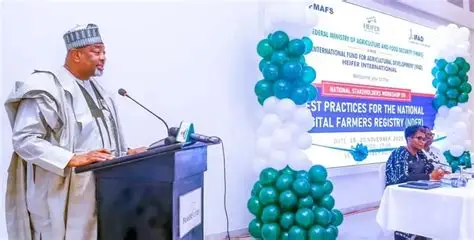
The Minister of Agriculture and Food Security, Sen. Abubakar Kyari, has called for a national digital farmers register to end duplication, target support to real farmers and secure food for over 200 million Nigerians.
The Minister made the call on Tuesday while declaring open the National Strategic Dialogue on AGROW Subcomponent 2.2 National Implementation Strategy and Digital Agriculture Architecture at the Abuja Continental Hotel.
Ezeaja Ikemefuna, Head, Department of Information, made this known in a statement yesterday.
He stated that Nigeria’s ambition to feed itself rests on knowing every farmer by name, farm location and what they grow, noting that a bag of fertilizer or a loan is only useful when the record directs it to the right farmer.
According to him, the work will build on what already exists, including the Ministry’s partnership with National Identity Management Commission (NIMC) to link farmers to their National Identity Number (NIN), the review of existing farmer databases with International Fund for Agricultural Development (IFAD), the Digital Villages project with Food and Agriculture Organization (FAO) of the United Nations, and the Ministry’s own data and mapping systems.
He charged states as essential owners to lead enumeration, verification and routine updates, while the Federal Ministry through Federal Department of Agricultural Data and Analytics (FDADA) and the National Project Coordination Office (NPCO) coordinates and enforces a single interoperable standard.
He stressed the need for one agricultural information ecosystem with agreed definitions, documented interfaces for authorized exchange, and clear data governance within Nigeria’s national digital infrastructure and data protection law.
Kyari added that State financing under AGROW will be linked to verified growth in farms registered, to ensure accuracy over mere numbers, and that the register must count every farmer including women, youth and those in areas without network coverage.
“We did not start talking about this today. Let this be the Dialogue that built Nigeria’s farmer registry,” he said.
In his remarks, the Minister of Budget and National Planning, Abubakar Atiku Bagudu stated that stated that the authentic farmers’ registry would ensure adequate planning and budgeting. Furthermore, it would foster proper coordination between the federated units and the Federal Government to achieve food and nutrition security.
Earlier , the Minister of State for Agriculture and Food Security, Senator Dr. Aliyu Sabi Abdullahi, CON, stated that Nigeria’s agrifood transformation cannot be built on fragmented data, noting that the Ministry missed several opportunities to build a robust agricultural data system since the Agricultural Databank Project of the 1990s (NIR/87/012).
Abdullahi, who described Agricultural Data and Analytics as productive infrastructure as fundamental as roads and power, situated the Dialogue within five national goals: food security, food sovereignty, agro-industrial growth, export development and foreign exchange earnings, and environmental sustainability.
He noted that traceable data is critical to stop rejection of Nigeria’s hibiscus, sesame, cashew, ginger and cocoa at foreign ports and to command premium markets.
Abdullahi warned that the greatest threat to transformation is not technology or funding but institutional rivalry and lethargy, describing siloed territorial protection of data as “the quietest form of corruption of purpose” that leaves farmers registered three times in three incompatible systems or not at all.
He announced that the Federal Ministry has finalized the establishment of Federal Department of Agricultural Data and Analytics (FDADA) to serve as the sector’s data gatekeeper and anchorage, noting that Nigeria has historically invested heavily at data collection level but under-invested at knowledge and intelligence levels.
Abdullahi disclosed that the financing window under AGROW is open now and must not be dissipated into fragmentation, urging MDAs to be prepared to concede duplication, States to bring their readiness realities to shape the architecture, development partners to hold government to one system, and private sector to accept the discipline of interoperability.
In his welcome address, the Permanent Secretary, Dr. Marcus Olaniyi Ogunbiyi stated that ‘’the AGROW Project provides an important opportunity to strengthen agricultural productivity, develop value chains, create jobs and improve food and nutrition security. Within this broader agenda, Component 2.2 on Strengthening the Digital Agricultural Ecosystem is particularly significant’’
Dr. Ogunbiyi pointed out that ‘’Agriculture is increasingly becoming data-driven. Reliable information on farmers, farms, soils, weather, markets and production systems is essential for effective planning, better service delivery and informed decision-making’’.
He revealed that ‘’One of the critical pillars of Component 2.2 is the development of a national digital farm and farmer registry. This presents an enormous opportunity to address a longstanding challenge in agricultural planning – the absence of sufficiently reliable, current and interoperable information on our farmers and farms’’.
The Dialogue was convened by the Federal Ministry of Agriculture and Food Security, the Bank of Agriculture and the World Bank under the AGROW programme.
Our Reporter
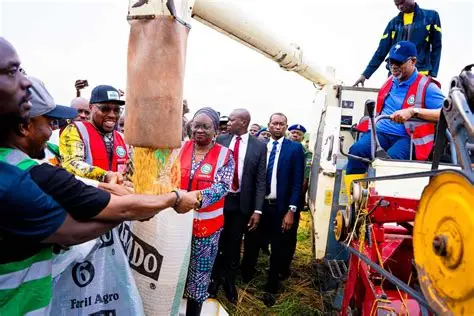
The South East Development Commission (SEDC) recently flagged off its South East Agro-Development Programme with the commencement of a 200-hectare integrated model farm at Nomeh Unataeze, Nkanu East Local Government Area of Enugu State.
The pilot project, implemented in partnership with the Enugu State Government is aimed at boosting food production, creating jobs, developing agricultural skills, improving livelihoods and strengthening agro-value chains across the South East.
The flag off was witnessed by Enugu State Deputy Governor, Barr. Ifeanyi Ossai who represented Governor Peter Mbah, Minister of Regional Development, Engr. Abubakar Momoh, SEDC Chairman, Dr. Emeka Wogu, Managing Director/CEO, Mark Okoye, traditional rulers and community leaders.
Ossai described the project as an example of what strategic collaboration between government institutions could achieve, particularly as food production and economic diversification remain major development priorities.
“The development of this agricultural facility in Nomeh demonstrates what is possible when government institutions work together around a clear development objective,” Ossai said.
He said the project would not only produce food but also create jobs, develop skills, support farmers and strengthen the agricultural value chain in Nkanu East, Enugu State and the wider South East.
The integrated facility will combine dairy, poultry, fisheries, fodder production, greenhouse farming, processing, mechanisation, renewable energy and practical agricultural training within one coordinated agricultural system.
SEDC said the project will provide for a 200 head dairy herd, poultry production of up to 20,000 birds per cycle, fisheries infrastructure, extensive fodder cultivation and silage production, alongside processing and demonstration facilities.
Okoye said the project was designed to demonstrate how land, technology, mechanisation, production, processing, training and markets could be brought together to build productive capacity in the region.
“The real impact is what happens around the farm and beyond the farm,” he said, adding that the programme would support young people, smallholder farmers, dairy producers and other participants in the agricultural value chain.
According to the Commission, the out-grower programme will initially target about 300 households within a 10-kilometre radius of the farm, while its training centre will accommodate between 100 and 120 trainees at a time.
The project is expected to support more than 1,000 direct jobs at maturity, while SEDC said the Nomeh facility would serve as a pilot for similar agricultural and agro-mechanisation interventions across the five South East states.
-
General News1 week ago
JOHESU demands: MHWUN puts FG on notice over fresh action
-

 Politics3 weeks ago
You have demonstrated diligence, loyalty, statesmanship in leadership, Ekechi salutes Shetimma at 60
-
 Politics2 weeks ago
2027: ASAF backs APC governors, rejects rainbow coalition
-

 Politics2 months ago
2027: Advertising experts raise concerns over irregular regulation of sector
-
FCT News1 month ago
2027: Hasana-Moneme pledges skills, empowerment, credit access for FCT women
-
General News2 months ago
2027: Dame Princess Esom-Nwafor Orizu confirmed as APC flagbearer for Nnewi North /South /Ekwusigo Federal Constituency as INEC releases names of candidates
-
Uncategorized3 months ago
Rescue of Oyo schoolchilden: Tinubu commends security agencies, says action breakthrough in fight against criminality
-
General News1 month ago
Chi-Jenco CEO, Jude Orji loses mother