
Main cover
Tinubu, NASS under fire for allocating over N22.15bn to renovate palaces, mosques, churches

***Atiku, CUPP raise alarm, accuse FG, NASS of misplacing priority
*** ₦780m church money meant for my Constituency aimed at curbing youthful vices
By Tony Chuddy
As the 2026 budget appropriations continue to face serious scrutiny, the federal government and the National Assembly have come under serious criticism over the alleged insertion of what the opposition and other groups have described as fictitious funds to some sections of the country in the budget.
This is as further scrutiny has revealed that the federal government allocated about N22.15 billion naira for the renovation of 106 palaces of Nigerian traditional rulers, just as about N1 billion was said to have been inserted for the purchase of musical instruments for some Nigerian churches, as well as over N8 billion for the construction and rehabilitation of mosques and churches across the country.
Reacting to the allocations, presidential candidate of the African Democratic Congress (ADC), Atiku Abubakar, berated President Bola Tinubu for alleged misplacement of priority in the budget.
The former vice president said the federal government has no constitutional business funding the construction and renovation of palaces for traditional rulers, describing the ₦22.15 billion allocated for 106 such projects in the 2026 Appropriation Act as a constitutional aberration and an instrument for illegality and official corruption.
Atiku in a statement issued on Thursday by his Senior Special Assistant on Public Communication, Phrank Shaibu, noted that the president took an oath of office and swore to protect Nigeria’s constitution, which he argued has remained unambiguous on the distribution of governmental responsibilities and does not confer on the federal government the powers to construct or renovate palaces belonging to traditional institutions.
He said, “President Tinubu swore an oath to preserve, protect and defend the Constitution, not to amend it through the Appropriation Act. Traditional institutions are matters within the constitutional competence of state and local governments. A federal budget cannot lawfully be used to assume responsibilities that the Constitution has assigned elsewhere.
“Under which provision of the Constitution is the Federal Government appropriating ₦22.15 billion from the Federation Account for the construction and renovation of 106 palaces? Which Constitution is President Tinubu operating?”
“The 1999 Constitution did not establish, fund or assign any executive responsibility over traditional institutions to the Federal Government. Indeed, its only reference to traditional institutions is in the Third Schedule, Part II, where it merely permits states to establish a Council of Chiefs to advise their governors on chieftaincy and customary law matters. Beyond this limited advisory role, the Constitution leaves the creation, administration and funding of traditional institutions to state governments and the laws enacted by their respective Houses of Assembly. President Tinubu cannot, by the instrument of an Appropriation Act, assume powers that the Constitution deliberately withheld from the Federal Government,” he said.
Atiku noted further that the refusal of the Federal Government to disclose the identities of the traditional rulers, the locations of the projects and the communities where the palaces are located was a breach of the constitution, and a “blank cheque for corruption,” adding that the secrecy surrounding the allocations creates the legitimate suspicion that the projects exist only on paper and that even the traditional rulers in whose names the funds were appropriated may never benefit from them.
“Our royal fathers deserve dignity and respect. They must not be used as unwilling instruments to legitimise opaque and constitutionally questionable budgetary allocations. If this administration truly respects the traditional institution, it should stop hiding behind it.
“The national treasury is not a Bourdillon-based private vault, and the Appropriation Act is not a license to suspend the Constitution. No government can claim to uphold the rule of law while appropriating public funds for projects it cannot constitutionally undertake and whose beneficiaries it refuses to identify,” he declared.
He called on the Presidency, the Budget Office and all relevant Ministries, Departments and Agencies, MDAs, to immediately publish the complete list of the 106 palaces, their locations, the amounts allocated to each project, the constitutional basis for the expenditure and the procurement process through which the contracts will be awarded.
In a similar condemnation, the Coalition of United Political Parties (CUPP) rejected the budgetary allocation of ₦22.15 billion for the construction and renovation of palaces in the 2026 budget, describing it as a misplaced priority amid economic challenges facing Nigerians.
National Secretary of CUPP, Peter Ameh, said the allocation for 106 palace projects was inappropriate at a time many citizens were struggling with rising living costs, food insecurity and poverty, describing it as misplacement of priority by the federal government
Ameh argued that government resources should be directed towards programmes with direct impact on citizens, citing the Subsidy Reinvestment and Empowerment Programme (SURE-P) introduced during the administration of former President Goodluck Jonathan as an example of a social intervention programme.
He emphasised that the effectiveness of government spending should be measured by its ability to improve the welfare of ordinary citizens through job creation, support for businesses and development of critical infrastructure.
“Such an approach would ultimately benefit everyone, including our traditional rulers, who would surely prefer to see their subjects empowered and their communities thriving,” he said.
The CUPP secretary described the palace allocation as a misalignment of priorities and urged the government to reconsider its spending plans in favour of initiatives that address pressing economic concerns.
He said government policies should focus on improving the welfare of Nigerians, adding that traditional rulers would also benefit from stronger and more prosperous communities.
Ameh cited Section 14 of the 1999 Constitution, which states that the security and welfare of the people shall be the primary purpose of government.
This is even as the Deputy Speaker of the House of Representatives, Benjamin Kalu, has defended the ₦780 million provision in the proposed 2026 budget for churches in Bende Federal Constituency, describing it as part of a broader youth re-orientation and social support programme aimed at curbing narcotics abuse, sexual offences and violent crimes among young people.
Kalu made the clarification in response to media reports alleging that ₦1 billion had been inserted into the budget solely for the procurement of musical instruments for churches in Bende, Abia State.
The Deputy Speaker in a statement issued by his Chief Press Secretary, Levinus Nwabughiogu, clarified that the actual allocation is ₦780 million after VAT and other tax deductions, adding that it is earmarked for a programme to be delivered through faith-based organisations across the constituency.
The statement explained that Bende Federal Constituency has 13 federal political and electoral wards and over 200 churches, with the first phase of the programme targeting 130 churches — approximately 10 churches per ward.
It noted that each selected church would receive between ₦5 million and ₦6 million to expand existing youth engagement platforms focused on character reform and community outreach.

General News
2027: In revised list, APC names Wike, Soludo, Adeleke, others in new Presidential Campaign Council
***Council to be inaugurated today
*** Inclusion of non APC members, President’s efforts in actualising his re-election bid, says Wike
By Eze Nnadi
The ruling All Progressives Congress (APC), on Tuesday, released a revised list of its 2027 Presidential Election Campaign Council, with few stakeholders from outside the party.
The new list, which included non APC members like former governor of Rivers State, currently the Minister of the Federal Capital Territory (FCT), Nyesom Wike, governors of Anambra and Osun states, Chukwuma Soludo and Ademola Adeleke respectively, also have former governors of Lagos state, Babatunde Raji Fashola and Akinwumi Ambode, as well as as Minister of Aviation, Festus Keyamo, among its members.
The revised list which was made available on Tuesday, after it was earlier withdrawal last month, still retained President Bola Tinubu as head of the campaign council, with Vice-President Kashim Shettima and APC National Chairman, Prof. Nentawe Yilwatda, serving as vice-chairmen.
Senate President Godswill Akpabio, Speaker of the House of Representatives Tajudeen Abbas and Kwara State Governor AbdulRahman AbdulRazaq are also listed as vice-chairmen.
Former Zamfara State Governor, Senator Abdulaziz Yari retained his position as Director-General, with Yobe State Governor, Mai Mala Buni, Senate Leader Opeyemi Bamidele, Deputy Senate President Barau Jibrin and Deputy Speaker Benjamin Kalu remained as deputy directors-general. Senator Adams Oshiomhole is listed as Deputy Director-General, Mobilisation.
Similarly, Imo State Governor Hope Uzodimma was named as the campaign council secretary with the National Secretary of the APC, Senator Ajibola Basiru as deputy secretary and Hadiza Bala Usman as assistant secretary.
Other officials include Femi Gbajabiamila, who will oversee administration; Ibrahim Kabir Masari, in charge of logistics and operations; former Speaker Aminu Masari, Deputy Director-General, Parliament Mobilisation; and David Umahi, who will oversee infrastructure mobilisation and sensitisation.
The council also listed zonal campaign coordinators and co-coordinators across the six geopolitical zones.
They include Governor Bassey Otu and Victor Giadom for the South-South; Enugu State Governor Peter Mbah and Ijeoma Arodiogbu for the South-East; Lagos State Governor Babajide Sanwo-Olu and Prince Oladiran Iyantan for the South-West; Muazu Bawa Rijau and Niger State Governor Umar Bago for the North-Central; Kaduna State Governor Uba Sani and Garba Datti Muhammad for the North-West; and former Borno State Governor Ali Modu Sheriff and Idris Suhaibu for the North-East.
At the state level, the list names governors and other political figures as campaign coordinators. They include Ahmadu Fintiri for Adamawa, Umo Eno for Akwa Ibom, Chukwuma Soludo for Anambra, Babagana Zulum for Borno, Sheriff Oborevwori for Delta, Hope Uzodimma for Imo, Abba Kabir Yusuf for Kano, Dapo Abiodun for Ogun, Ademola Adeleke for Osun, Nyesom Wike for Rivers and the Federal Capital Territory, and Dauda Lawal for Zamfara.
Former APC national chairmen Adebisi Akande and Abdullahi Adamu; as well as former Ogun State Governor Ibikunle Amosun; former Osun State Governor Iyiola Omisore; Senator Ibrahim Dankwambo; Senator George Akume; former Ogun State Governor Segun Osoba; and Wale Edun. Obafemi George are also listed as advisers
The Directorate of Election Planning, Coordination, Monitoring and Mobilisation, established ahead of the 2027 general election, has Faleke as Deputy Director-General, with Stella Okotete and Engr. Abdullahi Garba Ramat serving as Secretary I and Secretary II, respectively. Audu Maikori is also listed as a secretary.
Other members of the directorate include Soares Omotola, Bashir Dabo, Sheriff Mohammed Usman, Jibrin Bancir, Ayoola Peter Olajolo, Abubakar Sadiq Sada and Princess Folasade Ogunbiyi.
In the Directorate of General Logistics and Operations, Masari has been appointed Deputy Director-General, while Adeniyi Tinubu and Barr. Yakub Bashir Bello will serve as deputies. Prof. Kabiru Isa was named secretary.
Members of the logistics and operations directorate include Ekene Nwokoro Ogbonaya, Prof. Vincent Weli, Ambassador Olusola Iji, Amina Bello, Ahmed Zibiri, Annabel Isenyo, Terrence Kuanum, Prof. Latif Babatunde Ayeleru, Amarachi Ejike, Dr Aminu Ibrahim Tsanyawa and Prof. Shuaibu Abdullahi.
Others are Senator Bello Tukur, Senator Adegbonmire Adeniyi Ayodele, Taiwo Adebowale, Sunusi Muhammad Abdullahi, Wasiu Olaomo Ayeola, Chief Isaac Ijwo, Garba Gololo Mohammed, Biodun Ogunbi, Ayuba Ganiyu Adele, High Chief Edem Duke, Yusuf Capt. Buba, Oden Ewa, Prince Ademuviwa Adex, Makinde Peter Abiola, Chief Solomon Ogba, Senator Lawal Hassan Dan Iya, Ambassador Kelvin Peter, Maggadas Mohammed Muazu and Victor Agwu.
The revised campaign council will be insugursted today (Wednesday, 14 October, 2026, according to a statement by the Party’s National Publicity Secretary, Felix Morka,
Morka said the inauguration will take place at the Banquet Hall of the Presidential Villa, Abuja, marking a major step forward in the Party’s preparations for the presidential election.
Reacting to the new list, Minister of the Federal Capital Territory, FCT, Nyesom Wike, said Tinubu’s decision to accommodate individuals outside the ruling party showed that the president’s appreciation of efforts by some non APC members in actualising his re-election bid
Wike, who is the national leader of the Peoples Democratic Party (PDP), said president Tinubu’s re – election campaign should not be restricted to APC members but also include supporters willing to contribute to his victory.
The minister who spoke during his monthly media parley on Tuesday in Abuja, emphasised that the president recognised that some individuals who were not members of the APC had contributions to make towards his re-election and decided to accommodate them.
“So my thinking is that the president said, look, there are those who are not members of our political parties, but have something to offer for his re-election, and it will be proper to accommodate them so that we are able to offer whatever they may call it,” he said.
Wike explained that the arrangement reflected cooperation between APC members and supporters of Tinubu, despite their different political affiliations.
“Some don’t want to see the word coalition, but if you see that word PBAT slash APC, were the members of the party, and supporters of Mr President working together to achieve one purpose
“You can see Professor Soludo, Governor of Anambra State, who is the coordinator for Anambra State. You can see Governor Adeleke, who is not a member of APC, but the coordinator for Mr President, and then my humble self, who is not a member of APC, but a strong coordinator for the president in Rivers and the FCT.
“It tells you that it’s not necessarily just APC. Like we are saying that the re-election of Mr President should not just be about the APC,” he said.
Wike added that the arrangement demonstrated that Tinubu had supporters across political divides who wanted him to remain in office.
Wike, who defended his nutured Rainbow Coalition backing President Bola Tinubu’s re-election, dismissed concerns that the initiative could create divisions within the All Progressives Congress.
He said the coalition was designed to strengthen Tinubu’s electoral chances by bringing together APC members and supporters of the President from other political parties, rather than undermining the ruling party as claimed by some APC governors
“If you see that word, PBT/APC, it means those who are supporting the president who are not members of the party, together with the party, are working together to achieve that purpose,” Wike said.
He cited Borno State Governor Babagana Zulum and Osun State Governor Ademola Adeleke as examples of political figures associated with the coalition’s state-level coordination, alongside himself.
“The major thing is Mr President. Whatever we are going to do, whoever has any idea or anything to contribute is to the success of Mr President. That is the whole thing,” he clarified.
*** Orders withdrawal of Priests, Reverend Sisters, teachers, medical workers, other personnel
From Henry Tyonongo, (Makurdi)
Education and health received a major blow at Ihugh, the home town of Benue State Governor, Rev. Fr. Hyacinth Allia, following the suspension and closing of all schools and hospitals operating in the Vandeikya Local Government Area community by the Catholic Church.
The decision, which was announced on Tuesday by the Catholic Diocese of Gboko, Benue State, ordered the suspension of church institutions, including schools and hospitals, in the area over repeated attacks, arson, burglary and alleged harassment of its personnel.
The affected institutions are St Winifred Secondary School, St Winifred Nursery and Primary School, St Thomas Hospital, including Salus Mind Care Center and its chaplaincy, and St Winifred Parish.
The Diocese similarly directed the withdrawal of its personnel, including priests, Reverend Sisters, teachers, medical personnel and other workers from the institutions, effective October 12, 2026, until further notice.
The Gboko Catholic Diocese in a pastoral letter signed by the Bishop, Most Rev. William Avenya, and the Diocesan Chancellor, Rev. Fr. Marcellinus Wende, said the decision followed repeated attacks, including the burning of St Winifred Secondary School students’ hostels on October 28, 2025; May 10; May 15; and October 11, 2026.
It noted that “Over a considerable period, the Catholic institutions in Ihugh have suffered repeated disturbances, attacks and acts of destruction.
“Among these were the recent burning down of the students’ hostels of St Winifred Secondary School, Hugh, on October 28th, 2025; May 10th, 2026; May 15th, 2026; and October 11th, 2026, acts that have destroyed the shelter of young people entrusted to our care, wiped out the labour and sacrifices of many years, and placed the lives and safety of students, teachers, and staff in grave danger.
“The persistent burning down of St Winifred Secondary School students’ hostels was not an isolated event. The consistent burglary issues in St Winifred Parish, Ihugh, the repeated criminal incidents at St Thomas Hospital, Ihugh, and the hooliganism witnessed during the time of the reopening of St Thomas’ Hospital, Ihugh, on 21st June, 2024, wherein the people of Ihugh openly projected placards and chanting slogans that ‘They no longer want the Reverend Sisters to work in Ihugh’,” the letter stated.
The Diocese in it’s letter, described the incidents as “a systemic pattern of hostility and destruction directed at church-owned properties, alongside arson and harassment.” Each incident has left behind fear, loss and uncertainty among those who serve and are served by the Church.”
It regretted that its institutions, established to serve the public, had repeatedly been targeted, noting that
According to the Diocese, “the Church exists to bring life. Our schools, hospital and parish in Ihugh were established for the good of all, irrespective of creed or origin. It is therefore a source of profound grief that works meant for the common good have repeatedly become targets.”
The Diocese however stated that it had engaged the host community, traditional rulers, elders and security authorities in efforts to resolve the crisis.
“The Church does not take the path of withdrawal lightly, nor in haste. The Lord instructs us to be peacemakers, and we have laboured to be so. At every stage we sought dialogue rather than confrontation and reconciliation rather than recrimination.
“The Diocese has met with the host community, engaged the traditional rulers and elders of the land, and brought these grievances before the relevant civil and security authorities, all in the hope of finding a just and lasting peace.
“We have listened, we have appealed, and we have waited patiently. Sadly, these sincere efforts have not yielded the peace, security and guarantees that the continued presence of our institutions requires.
“The Church is a partner in development, not a victim to be repeatedly wounded. A partnership requires mutual respect, protection and good faith. When the very institutions that serve a community are burnt and their workers threatened, such a partnership cannot be sustained.
“The Church cannot, in conscience, continue to expose her priests, consecrated persons, teachers, medical personnel, students and patients to danger, nor continue to invest the resources of God’s people where they are not safe and are not valued.”
The Diocese stressed that the decision was not motivated by vengeance, saying, “We do so not in anger, nor in bitterness, nor in vengeance, but in sorrow, with prayer, and with the door of reconciliation left open.”
It assured that it’s students would be assisted to continue their education in other Catholic schools, while patients at St Thomas Hospital would be referred to other health facilities.
The Diocese similarly assured that its employees affected by the decision will be treated with justice and charity, in accordance with Church teaching on the dignity of labour.
“To the entire people of Ihugh, to its leaders and to its youth, we make no accusation against the innocent, and we hold no hatred in our hearts. We bear no ill will toward our brothers and sisters, many of whom have known only the good that these institutions brought.
“We say plainly that violence, arson and destruction are contrary to the Gospel, contrary to the dignity of the human person, and contrary to the good of the community itself. They impoverish the very people they claim to defend, depriving children of education, the sick of healing, and the faithful of worship.”
The Gboko Catholic Diosces however noted that the closure was not a final departure, adding, “This decision is a painful one, but it is not a final farewell. The Church leaves in sorrow, not in contempt.”
It said it would consider returning if there was “genuine repentance, restitution, a firm commitment to peace, and credible lasting assurances of safety” for its personnel and property.
***Pegs price at N1,350 per liter
…Says subsidy added N15.8trn to federation account in two years
*** It’s election package, Atiku taunts FG
By Sam Otuonye
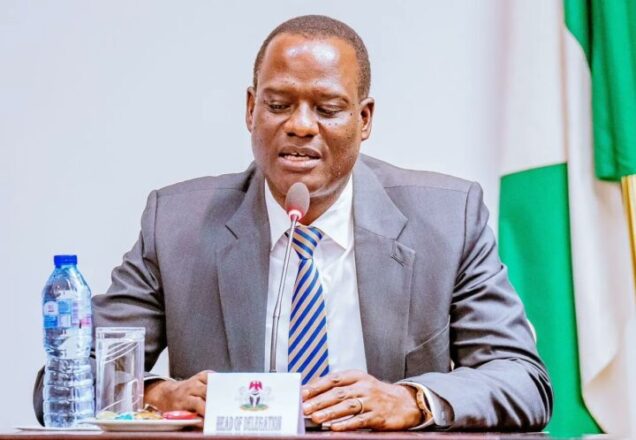
The Federal Government says it is offering a discount on petrol sold by the Nigerian National Petroleum Company Limited (NNPCL) for the next 30 days.
This was made known by the Minister of Finance and Coordinating Minister of the Economy, Taiwo Oyedele, at a press briefing on fuel prices and subsidy questions on Thursday, October 8, 2026, in Abuja.
The minister emphasized that the discount is not a subsidy, but an arrangement by the government to sell the petrol at cost.
Oyedele said, “We are offering a discount on petrol dispensed by NNPC limited for the next 30 days in the first instance with priority for public transporters nationwide. So, it’s not a subsidy, government is just saying we sell to you at cost.”
The Minister explained that the high fuel prices is caused by a global shock, felt by every country in the world without exception, owing to the conflict in the Gulf in the last eight months.
He noted that by mid-September, shipping through the Strait of Hormuz was running 13 percent of its pre-war level, with Brent crude trading at over 100 dollars a barrel, almost 50 percent higher than before the war.
According to him the squeeze was sharpest in refined products, with diesel exports from the Middle East and Russia down 75 percent from a year ago. On the other hand, Oyedele said crude tanker rates from West Africa reached record highs in September as the world scrambled for supply outside the Gulf.
Our petrol is already far cheaper than in most neighbouring countries.Widen that gap, and Nigerian taxpayers would be subsidising motorists across our borders, as we did for years. Cheaper fuel would also raise consumption at home, at a time when global supply is tight. Excess consumption any where means higher prices everywhere, and that comes back to us as imported inflation.
Unfortunately, the International Energy Agency expects the pressure on refined products to last for months.
No country has been spared, he added.
On fuel subsidy Oyedele criticized those promising and calling for the removal of fuel subsidy
“In recent weeks,there has been debate about proposals to return to fuel subsidy,including one described as a “production subsidy” for local refining. We do not question the motives of those who propose it. We agree on the problem. Where we differ is on the remedy.
He argued that a subsidy does not lower the cost of fuel but only changes how it is paid, and when, noting that Nigerians have paid that bill before, in scarcity, in inflation and in a collapsing currency.
“However it is described, a subsidy must be financed through salaries and pensions not paid on time, through higher taxes, or through the printing of money. Each of these has done great harm before. Short-term relief bought with long-term fragility is the most expensive money a government can spend.”
The Minister said that without the removal of subsidy, Nigeria would have witnessed a worse situation in the face of the conflict, stating that the impact of higher crude prices is mixed, as it supports the budget and Federation revenue, even as production is below forecast, and legacy crude commitments from the subsidy era absorb much of the gain.
“Its government suspended fuel duties to hold prices down.When that relief ran out this month, pump prices rose by about 24 percent in a single adjustment. Relief that cannot be sustained does not remove the pain. It postpones it, and then delivers it all at once, often with greater force.
“Our own numbers tell the same story. Before the conflict, with crude near 70 dollars a barrel, petrol sold for about 830 naira a litre.Today it averages about 1,400 naira.That increase was caused by a global conflict in which we had no say.
“Ironically, without the removal of subsidy, the impact would have been far greater. For Nigeria, the impact of higher crude prices is mixed. It supports the budget and Federation revenue. But production is below forecast, and legacy crude commitments from the subsidy era absorb much of the gain. At the same time, households and businesses face higher fuel, transport and logistics costs, and the burden falls hardest on the most vulnerable.”
He further justified the subsidy removal as he noted that in the face of the months of the conflict supply has been sustained which makes affordability easy.
“Yet there is one thing Nigerians have not faced through these months:queues. Fuel has remained available in every state. In a crisis of this kind, availability is the first form of affordability.”
Also counting the gains of subsidy removal Oyedele said it released N15.8 trillion to the Federation Account between June 2023 and December 2025. Of that, N10.4 trillion went to states and local governments.
“In May 2023, 27 states could not reliably pay salaries.Today, none is in that position. At the federal level, about two-thirds of the savings combined with additional independent revenue and borrowing were utilised on spending that went directly to average Nigerians, through higher wages, infrastructure, electricitysubsidyandsocialtransfers.Thebalance went to stabilising the economy, mainly by way of higher cost of servicing debt as interest rates went up to tame rising inflation.
“Return subsidy and the sequence is familiar. Weaker revenue invites a sovereign credit downgrade, as the rating agencies have already signalled. That would put at risk the upgrades we have recently earned, including our first from S&P in fourteen years.”
“It’s election package,” Atiku taunts FG
Former Vice-President Atiku Abubakar has described the federal governments 30 days petrol price reduction as a careful package by president Bola Tinubu’d to target the Nigerian voters ahead of the 2027 general election
Atiku in a statement issued Thursday by the Director of Strategic Communication of the ADC Presidential Campaign Council, Phrank Shaibu, condemned the proposal, describing it as a desperate, temporary gesture that cannot repair the damage caused by the crushing cost of fuel.
Atiku further decried what he described as the Tinubu administration’s attempt to dangle a fuel subsidy, adding that it was reckless, disgraceful and scandalous.
“Now, as the election draws closer, President Tinubu is dangling a temporary discount at the very epicentre of the cost-of-living crisis that has tormented households and businesses.”
“Atiku totally rejects this calendar-scheduled, election-laced subsidy package. Nigerians are not fools to be offered a month of discounted fuel after years of punishing prices and then expected to forget the hardship when the discount expires. This is shameless and heartless.
“What happens on Day 31? Nigerians wake up to the same brutal prices, the same punishing transport fares and the same rising cost of food. The government cannot manufacture relief for one month and expect Nigerians to applaud while the hardship remains,” he said.
He noted that the offer is limited to NNPC stations, while the government has yet to state how much motorists will save per litre or guarantee that any savings for transport operators will be passed on to passengers through lower fares.
The former Vice President said the administration’s sudden reversal on this sensitive social welfare issue was itself an admission of guilt over the hardship Nigerians have endured. It also exposed the weakness of the government’s repeated claims that meaningful relief was impossible.
“This volte-face proves that the production-support proposal I have advanced is workable, achievable and not complicated. The Tinubu government and its spin doctors have tried to make it sound impossible, yet they are now reaching for a temporary subsidy-style intervention because the pain has become impossible to ignore.
“Nigerians need lasting relief, not a countdown to the return of hardship. Tinubu’s government cannot spend years telling Nigerians to endure, then offer 30 days of relief and call it a solution,” he said.
-
 General News2 weeks ago
Rivers 2027: We are not part of Rainbow Coalition – APC Legacy Group slams Wike, Fubara meeting
-
General News1 month ago
JOHESU demands: MHWUN puts FG on notice over fresh action
-
 Politics1 month ago
2027: ASAF backs APC governors, rejects rainbow coalition
-

 Politics2 months ago
You have demonstrated diligence, loyalty, statesmanship in leadership, Ekechi salutes Shetimma at 60
-

 Politics2 months ago
2027: Advertising experts raise concerns over irregular regulation of sector
-
FCT News2 months ago
2027: Hasana-Moneme pledges skills, empowerment, credit access for FCT women
-
General News3 months ago
2027: Dame Princess Esom-Nwafor Orizu confirmed as APC flagbearer for Nnewi North /South /Ekwusigo Federal Constituency as INEC releases names of candidates
-
Uncategorized3 months ago
Rescue of Oyo schoolchilden: Tinubu commends security agencies, says action breakthrough in fight against criminality