
Business and Economy
MAN hails BOI for credit support, fair interest rate

By Sam Otuonye
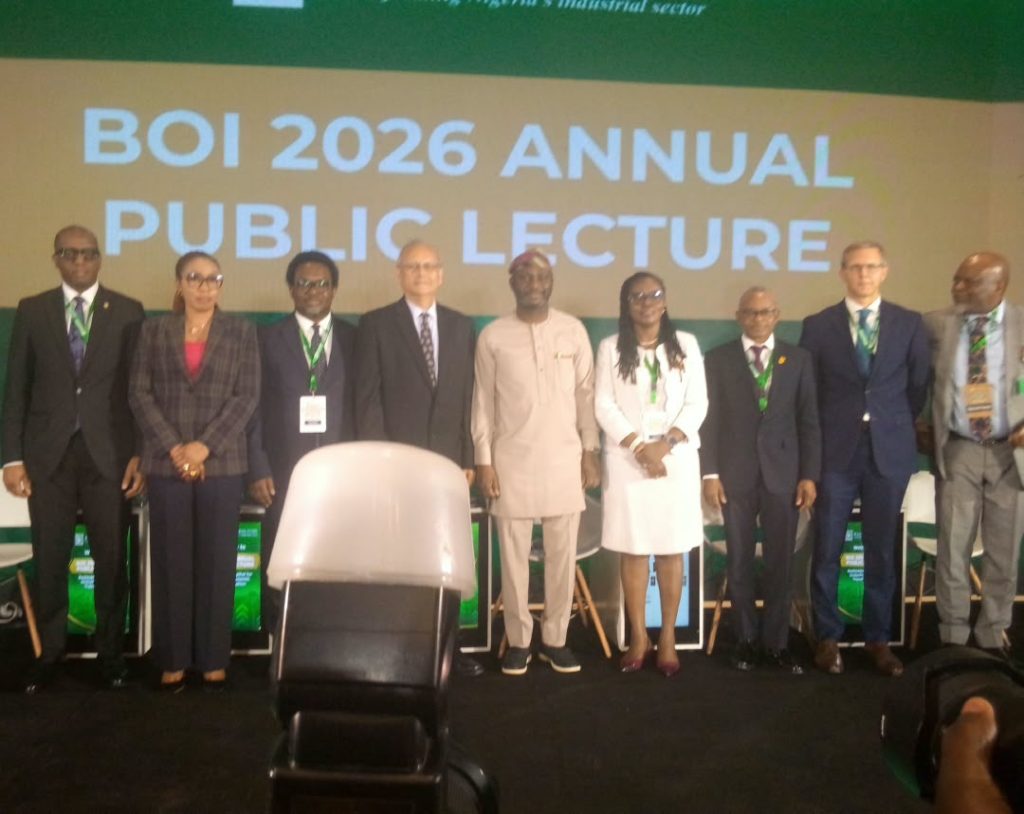
Manufacturers Association of Nigeria (MAN) has praised the Bank of Industry (BOI), for extending credit facilities at minimal interest rates and ease of processing to its members, even as the Managing Director and Chief Executive Officer (MD/CEO) of the bank, Dr Olasupo Olusi highlighted that the bank disbursed N465 billion, supported over 12,000 businesses and impacted 1.68 million jobs in 2025.
Speaking during a panel session at the BOI 2026 Annual Public Lecture in Abuja, on Tuesday September 29, 2026, with the theme: ‘Rethinking Capital for Inclusive Economic Transformation’, MAN okayed the rates at which BOI grants its members loan, even as it urged BOI to bring more members onto the single-digit interest rate loan bracket, and de-risk investment in the sector.
Director, MAN Abuja Liaison Office, Adeyemi Folorunsho, representing the Director-General, Segun Ajayi-Kadir, said: “The current management of BOI has been doing exactly what we want. What we are getting from BOI is fair enough. BOI loans have a good tenure,” he enthused.
Aligning with Folorunsho, Group Managing Director and Chief Executive Officer of Flour Mills of Nigeria, Omoboyede Olusanya, in representation, and MD/CEO InfraCredit, Chinua Azubike, represented by Daniel, a Senior staff member, respectively, commended BOI on their rising profile of supporting businesses, noting that cost of financing is key to improving productivity, inclusiveness, and economic transformation.
On her part, Executive Director, Policy Innovation Centre and a Senior Fellow at the NESG, Dr Osasuyi Dirisu, commended BOI but urged it to do more for the rural and underserved women.
The MD/CEO of BOI, Dr Olusi, in his opening remark, speaking to the theme of the lecture, stated that Nigeria needed capital that can support long-term industrial growth, reach underserved businesses, and attract private investment into the productive sector, noting that BOI has the mandate to spearhead Nigeria’s sustainable and inclusive industrial development.
“This requires us to think carefully about how capital is mobilized, structured and deployed, and the development outcomes it ultimately delivers.
“These issues are central to BOI’s mandate to spearhead Nigeria’s sustainable and inclusive industrial development. In 2025, the bank disbursed N465 billion, supported over 12,000 businesses and impact 1.68 million jobs.
“The scale of the opportunity ahead is significant. We need to mobilise more long-term capital, extend financing to businesses and sectors that remain underserved, use development finance to unlock greater private investment, and ensure that financing translates into measurable economic impact.”
The Keynote speaker, Dr Asad Alam, Adjunct Professor at Georgetown University, Washington, D.C, argued that there is more to capital than just accumulation and investment, noting that efficiency of capital is essential to drive impact and growth.
He stated that as countries grow, total capital productivity becomes more important, highlighting that human capital contribution remains modest but huge potential gives existing gaps with high income countries. He said that greater equity can support potential growth investments in technology and climate action with the potential to spur productivity and structural transformation.
The guest lecturer maintained that for Nigeria to maximize the impact of capital, it must make policies that would foster trade and market openness, innovation, competition, and sustainability.
He said that strong institutions is essential to ensure the enthronement of rule of law, effective State, service delivery, private enterprise, and regulations, adding that inclusiveness must give birth to equitable distribution of public good and job creation.


The Nigerian National Petroleum Company Limited, NNPCL, has increased its premium motor spirit, PMS, pump price following the announcement of a discounted fuel price.
Checks on Friday showed that NNPCL increased its petrol price to N1,405 per litre from N1,370 per litre.
Several fuel pump attendants, who spoke to an online medium Daily Post, on condition of anonymity, said the latest price increase was announced on Thursday but implemented on Friday.
This means that NNPCL’s petrol price increased by N35 per litre, although the state-owned oil company has not explained the reason for the adjustment.
The latest development means that petrol prices at the company’s filling stations have risen again despite the controversy surrounding the announced fuel discount.
On Thursday, the Minister of Finance, Taiwo Oyedele, announced a proposed fixed petrol gantry price of N1,375 per litre ahead of the January 16, 2027, presidential election.

By Our Reporter with agency report
The International Monetary Fund (IMF) has advised Nigeria against restoring broad petrol subsidy, recommending targeted support for vulnerable households to cushion the impact of rising energy costs.
IMF said blanket petrol subsidies were expensive, often benefited higher-income consumers disproportionately and could worsen fiscal pressures amid rising borrowing costs.
Rodrigo Valdés, director of the IMF’s fiscal affairs department, spoke during a press briefing on the fund’s fiscal monitor at the 2026 annual meetings of the IMF and World Bank in Bangkok, Thailand, on Wednesday.
His comments followed a question on how the fund could recommend allowing energy prices to reflect scarcity when higher fuel prices in Nigeria could raise transport costs, worsen inflation and deepen poverty, particularly when the government was facing calls to restore petrol subsidy ahead of an election year.
“Protecting people is not the same as protecting the price of fuels,” Valdés said.
He said fuel subsidies or measures preventing prices from adjusting fully to an energy shock had cost countries between 1 percent and 1.5 percent of gross domestic product (GDP) in 2026.
“It’s first fiscally very costly, and second, if you look at the pattern of consumption, it’s easy to see that that subsidy is readily regressive in many places,” he said.
Valdés said governments should instead use social safety nets and household data to identify people who need assistance.
“There are better tools to deal with this,” he said.
The federal government recently announced a 30-day petrol discount at Nigerian National Petroleum Company (NNPC) Limited retail stations, with priority for public transport operators, to cushion the impact of rising fuel prices.
Taiwo Oyedele, minister of finance, said NNPC retail would sell petrol at cost by foregoing its retail profit margin, describing the measure as temporary relief rather than a return to petrol subsidy.
The government also proposed negotiating a ceiling of N1,350 per litre on petrol’s ex-gantry or landing cost, subject to monthly reviews
IMF URGES FG TO REDIRECT SUBSIDY GAINS TOWARDS VULNERABLE PEOPLE
The IMF also recommended targeted interventions to cushion the effect of higher fuel prices on transportation costs.
Davide Furceri, a division chief in the fund’s fiscal affairs department, said governments could redirect some of the resources spent on blanket subsidies towards vulnerable consumers.
“For example, you mentioned transportation costs. Yeah, gasoline could go up, and perhaps bus fees may be subsidised in a way that is a much better policy at the end of the day than just a blanket subsidy for everybody,” Furceri said.
He also suggested alternatives such as school feeding programmes, geographical targeting and assistance for vulnerable farmers.
READ ALSO: Atiku accuses Tinubu of copying his fuel subsidy proposal
Furceri acknowledged that some countries lacked household registries and digital payment systems needed to deliver targeted support effectively.
However, he said governments could adopt alternative approaches in the short term while developing stronger systems.
He recommended that assistance should be limited, targeted and temporary.
Valdés explained that fuel subsidies could worsen global energy pressures by preventing demand from adjusting when supplies were constrained.
“When you subsidise, you don’t allow, at the end of the day, demand to adjust,” he said.
“And reality is that we have less fuels in the world economy. That means that someone else has to adjust more, and the market produces a higher price for that.”
The IMF official said subsidies were not only costly and regressive but could also have spillover effects on the global economy.
TheCable

The Nigerian Communications Commission (NCC) the telecoms industry regulator, has commended Globacom on its outstanding performance in consumer complaint management and resolution.
In a letter to the company, which was signed by Kabiru S. Haruna, Principal Manager, Consumer Protection & Advocacy
Consumer Affairs Bureau (CAB), the Commission expressed happiness at Globacom’s treatment and resolution of customer issues during the month of August, 2026.
The letter read in part: “We are pleased to note that your organization achieved and surpassed the Commission’s complaint resolution thresholds of 90% and 97% for Level 2 (L2) complaints. This accomplishment reflects your commitment to regulatory compliance, consumer satisfaction, and the continuous improvement of service delivery.”
NCC noted that Globacom’s dedication to timely complaint resolution and adherence to established Service Level Agreements (SLAs) put in place by the Commission has contributed significantly to enhancing consumer confidence and promoting a positive customer experience within the telecommunications sector.
The Commission further encouraged Globacom to sustain this level of outstanding performance while continuing to implement measures aimed at further improving service quality and consumer satisfaction.
Globacom noted that constant training of its customer-interfacing staff and investment in the latest technology were responsible for observed improvement. The company promised not to relent in this regard.
-

 General News2 weeks ago
Rivers 2027: We are not part of Rainbow Coalition – APC Legacy Group slams Wike, Fubara meeting
-
General News1 month ago
JOHESU demands: MHWUN puts FG on notice over fresh action
-

 Politics1 month ago
2027: ASAF backs APC governors, rejects rainbow coalition
-

 Politics2 months ago
You have demonstrated diligence, loyalty, statesmanship in leadership, Ekechi salutes Shetimma at 60
-

 Politics2 months ago
2027: Advertising experts raise concerns over irregular regulation of sector
-
FCT News2 months ago
2027: Hasana-Moneme pledges skills, empowerment, credit access for FCT women
-
General News3 months ago
2027: Dame Princess Esom-Nwafor Orizu confirmed as APC flagbearer for Nnewi North /South /Ekwusigo Federal Constituency as INEC releases names of candidates
-
Uncategorized3 months ago
Rescue of Oyo schoolchilden: Tinubu commends security agencies, says action breakthrough in fight against criminality