
Cover page
2027: ADC, APC clash over Tinubu’s steady electricity promise

***Tinubu failed on steady electricity promise – Atiku
***It’s work in progress, Tinubu replies
By Sam Otuonye
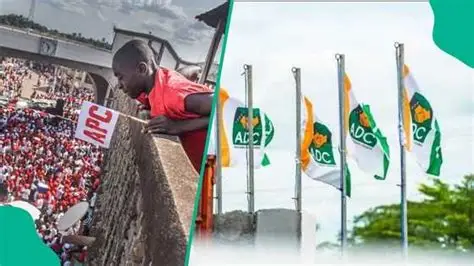
Ahead of the 2027 presidential election, the ruling All Progressives Congress (APC), and opposition Africa Democratic Congress (ADC), have dragged each other over President Bola Tinubu’s promise in 2023 to ensure 24 hours steady supply of electricity to all corners of the federation.
Tinubu had during his campaign in 2023, told Nigerians not to give him a second term, if fails to provide steady supply of electricity.
“Whichever way, by all means necessary, you will have electricity, and you will not pay for estimated bills anymore. A promise made will be a promise kept,” Tinubu had told Nigerians prior to the 2023 presidential election.
He added that Nigerians should not re-elect him if he failed to fulfil the promise without providing adequate reasons for the shortfall.
But barely three and half years into his APC- led administration, electricity has remained a major challenge, as several parts of the country have remained in darkness, amid high tariff
Former Vice President and presidential candidate of the opposition Africa Democratic Congress (ADC), Atiku Abubakar, has asked Nigerians to assess the president from his 3023 campaign promise on steady electricity supply, declaring that he has failed the nation.
Atiku accused Tinubu of failing to fulfil his electricity promise with a long recital of laws, committees, bonds and projects.
The former vice president in a statement issued by Phrank Shaibu, Director of Strategic Communication of the ADC Presidential Campaign Council, said: “The APC should spare Nigerians the spectacle of celebrating paperwork while homes and businesses remain in darkness. After three and a half years, families still struggle to keep their homes lit. Traders and small business owners spend scarce resources on alternative power, yet struggle to keep their businesses alive. Nigerians are billed for electricity they cannot rely on. President Tinubu promised steady power and an end to estimated billing. That promise has not been kept.
“Across Nigeria, consumers are placed in Bands A, B, C, D and E and charged different rates. In many areas, Band A customers pay about ₦209.50 per unit before VAT. Rates for the other bands vary by state and electricity provider. Yet across every band, the same hardship endures: the power fails, but the bill arrives. No family should have to weigh the cost of electricity against the cost of food. No business should be left to pay more while receiving less.
“The government now says it plans to end electricity subsidies from 2027, even as it insists there will be no immediate tariff increase. Nigerians are entitled to a clear answer: what will happen to their bills when the subsidy ends? I will work with state governments and regulators, within the law, to abolish the present band system and replace it with a fair, transparent and affordable framework that protects households and holds power companies accountable for the electricity they deliver. Steady power that Nigerians can afford will be a national priority.
“When President Tinubu campaigned in 2022, he made an unmistakable commitment. He said: ‘If I don’t give you constant electricity for four years, when I come back for a second term, don’t vote for me.’ Nigerians have lived through those four years. They do not need his campaign council to interpret his words for them. They need him to answer for them.
“His administration has not built a single new generation infrastructure of its own to increase Nigeria’s power capacity. Yet it has floated a multi trillion naira bond programme to settle legacy debts owed to generation companies, without showing Nigerians how this financial intervention has produced the steady electricity they were promised. Paying old debts is not the same as building new power infrastructure. Bonds cannot be presented as a substitute for power in people’s homes.
“Meanwhile, Nigerians face VAT on electricity, and the Nigeria Tax Act provides for a 5 per cent surcharge on certain fossil fuels, including petrol and diesel. The government says the surcharge has not been activated and would require a ministerial order. At a time when families already struggle to meet the cost of energy, Nigerians deserve to know why another potential charge has been placed before them.
“Dele Alake’s statement cannot light a home. Signing a law is not electricity. Raising a bond is not electricity. Approving a project is not power delivered. Nigerians cannot cook, study, work or sustain a business on announcements. President Tinubu invited Nigerians to judge him by his performance. They have done so. What they seek is simple: reliable electricity they can afford, and a government that keeps its word.”
But the APC Presidential Campaign Council has said that President Tinubu’s promise of 24 hours steady electricity supply accross the country is work in progress
Spokesperson of the APC Presidential Campaign Council, Dele Alake, admitted that President Bola Tinubu is yet to fully resolve Nigeria’s electricity challenges, but his administration remains committed to fulfilling its campaign promise of providing Nigerians with stable and reliable power supply.
Alake, acknowledged that fixing the country’s power sector remained unfinished work, three years after Tinubu assumed office.
Alake, who doubles as Minister of Solid Minerals Development, noted that the President had taken consistent steps to address the structural, institutional and financial challenges that have hindered the sector for more than five decades.
The APC Campaign Spokesperson in a statement on Sunday titled ‘Tinubu’s Electricity Pledge Must Be Considered in Full Context’, urged Nigerians to assess the President’s 2023 campaign promise alongside the administration’s interventions and the concluding qualification he made when he gave the pledge.
Alake said some recent commentaries had reproduced the President’s pledge without including the concluding qualification, arguing that a fair assessment should consider the full statement and the administration’s performance since 2023.
He cited Tinubu’s signing of the Electricity Act, 2023, on June 9, less than two weeks after assuming office, thereby allowing state governments to participate in electricity generation, transmission and distribution as a major stride to free electricity consumers from the frustration of service providers
He attributed the president’s intervention in the energy sector to the reason why several states, including Lagos, Enugu, Abia, Ekiti, Oyo, Kaduna and Niger states have begun taking advantage of the legislation by establishing their electricity regulatory agencies and attracting private investment into their power sectors.
Alake also said the administration inherited more than N6tn in accumulated legacy debts between 2015 and 2025 and had introduced measures to address the financial burden.
Alake further disclosed that the federal government established a N4tn bond programme to settle verified debts owed to 21 electricity generation companies and gas companies.
According to him, the first and second tranches of the programme have raised more than N1.2tn to settle part of the verified liabilities.
He added that the administration launched the Presidential Metering Initiative to address the country’s metering deficit, saying more than 1.5 million customers had received meters under the programme in the last three years.
The APC PCC spokesperson said the government had also adjusted electricity tariffs towards cost-reflective levels to improve liquidity in the market while introducing service bands and measures to protect low-income households.
On infrastructure, Alake said the administration was investing in substations and grid expansion while pursuing plans to modernise the Osogbo Grid Control Centre, which he said was built more than 60 years ago, and construct an East-West super grid.
He also highlighted the Rural Electrification Agency’s efforts to connect universities, hospitals and rural communities to solar power.
He explained that electricity infrastructure projects required long-lead equipment and could not be completed overnight.
The spokesperson also cited recent investments by power generation companies as evidence that the administration’s interventions were beginning to improve confidence in the electricity market.
He mentioned Geregu Power Plc’s announcement of investments in new power transformers to improve operations at its Geregu 1 Power Plant, adding that other companies were making similar investments.
Alake said the administration recognised the need to balance cost-reflective tariffs, which would improve operators’ financial viability, with affordable electricity for Nigerians.
He said the government would continue to explore measures to improve the commercial sustainability of the sector while protecting vulnerable households.
“Fixing the electricity market and power sector is ongoing work,” Alake said.
He assured ed that Tinubu had not abandoned his commitment to resolving the country’s electricity challenges, adding that the President would present his scorecard and explain outstanding issues to Nigerians as he seeks a second term

*** Says Rules must apply equally to all political parties
By Chidera Orji
Ahead of the 2027 general election, the ruling All Progressives Congress, APC, has urged the Independent National Electoral Commission, INEC, to strictly follow its published timetable for the 2027 general election, adding that the rules guiding the elections must apply equally to all political parties.
The party’s National Chairman, Prof Nentawe Yilwatda, made the call when he received a pre-election fact-finding mission of the Economic Community of West African States, ECOWAS, at the APC National Secretariat in Abuja.
Yilwatda, who received the delegation alongside members of the party’s National Working Committee, NWC, said the electoral process must remain fair, transparent and predictable.
He cautioned against any adjustment of electoral deadlines that could give one political party an advantage over others.
He urged INEC to adhere to its published timetable, stressing that all political parties should be treated equally and that electoral deadlines should not be altered in ways that could favour any party.
“We have inaugurated our campaign council, commenced campaign activities and uploaded our candidates to INEC’s portal. We have also presented candidates for all the positions we are contesting, unlike some opposition parties that have faced difficulties completing their submissions,” he said.
Yilwatda also highlighted the party’s membership and political structures, claiming that it had about 13 million registered members across the country’s local government areas.
He said the party had more than 261,000 executive members from the ward to the national level, adding that its membership cards were designed to allow verification through National Identification Numbers, NIN, and voter identification details.
On its elected representatives, he said the APC had 31 governors, 88 senators and 208 members of the House of Representatives.
The chairman, however, said the party’s size and political strength should not be used to undermine other parties or restrict their participation in the electoral process.
“Being the largest political party does not mean that we want to suppress anybody. We want a democratic environment in which every party can organise, campaign and seek the support of Nigerians without fear,” he said.
“We will not use our position to intimidate or suppress opposition parties. Every political party must have equal access to the media, campaign venues and other legitimate platforms to present its programmes to Nigerians,” he said.
***Orders APC, INEC to recognise ex governor as candidate for Imo west senatorial district
**” Uzodimma remains our candidate, party studying ruling, says APC
By Eze Nnadi
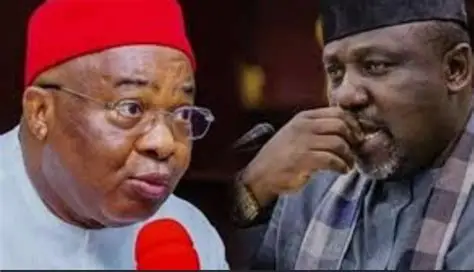
It was relieve for former Imo state governor, Rocha’s Okorocha as a Federal High Court in Abuja has asked the Independent National Electoral Commission (INEC) to recognise him as the candidate of the ruling All Progressives Congress (APC) for the Imo west senatorial district election in 2027
The Court, presided over by Justice Obiora Egwuatu, nullified the recognition of the current Imo State Governor Hope Uzodimma as the APC candidate and ordered INEC to publish the name of former governor Rochas Okorocha.
Okorocha had asked the court to declare him winner of the party’s primary election for the Imo West senatorial district, arguing that he won the primary election with arguing that the authentic document that was signed and released after the election proved that he won the primary with 150,780 votes.
Uzodimma was however declared the winner of the primary and his name was forwarded to INEC by the APC, which maintained that the official results showed that the governor polled 230,464 votes, while Okorocha scored 1,098 votes.
Delivering his judgement in the case marked FHC/ABJ/CS/1854/2026, challenging the outcome of the APC primary and INEC’s recognition of Uzodimma as the party’s candidate, Justice Egwuatu restrained Uzodimma from parading himself as the APC senatorial candidate for the January 16, 2027 election, holding that he did not win the party’s May 18, 2026 primary.
He declared that Okorocha emerged as the lawful winner of the primary, which was monitored by INEC, and directed the APC to submit his name to the electoral commission as its candidate.
Justice Egwuatu further declared that the nomination and submission of Uzodimma’s name to INEC by the APC contravened Sections 29 and 32 of the Electoral Act adding that it failed to comply with the APC’s guidelines for conducting primary elections.
Justice Egwuatu contended that a separate document submitted by a different NWC member, claimed that a direct primary was conducted for the same election
He described the conflicting accounts as significant, noting that votes were reportedly allocated to the aspirants despite the claim that Uzodimma emerged through consensus.
The judge subsequently ordered the APC to forward Okorocha’s name to INEC and directed the commission to replace Uzodimma’s name with that of the former governor.
Speaking with journalists following the judgment, counsel to the plaintiff (Okorocha), O.J. Aboje, described the judgment as a vindication of his client, whom he noted had been accused in the media of forging the results.
He said, “Firstly, we’re happy. You recall that in the last few weeks my client has been accused in the media of forging documents; he did this, he did all that. But you have all heard the court.”
Reacting to the ruling , Okorocha described it as victory for the Nigerian judiciary and democracy
The former governor in a statement issued on Thursday by his Special Adviser on Media, Sam Onwuemodo, described the judgment as a landmark decision.
He thanked President Bola Tinubu for “providing the enabling environment for the Judiciary and other Institutions to function for the nation’s rapid development and growth.”
Okorocha who expressed gratitude to the people of Imo State, particularly residents of Imo West Senatorial District, for their prayers, moral support and spontaneous celebrations following the judgment, also commended Uzodimma for being among the respondents in the case, describing his involvement in the proceedings as part of a historic judgment.
“This judgment, to say the least, is a resounding victory for the nation’s judiciary. It is a victory for the nation’s fast-growing democracy. It is an outstanding victory for the nation’s Constitution, as amended
“It is a remarkable victory for all lovers of what is right and haters of what is wrong. It is a notable victory for posterity and history. Finally, it is a victory for Imo people in general, and Imo West Senatorial District people in particular.”
But the Imo state chapter of the All Progressives Congress (APC), has declared that governor Hope Uzodimma remains the party’s candidate for the zImo west senatorial district election in 2027, even as it said the party’s legal unit is currently studying the ruling
The chapter in a statement issued by it’s Publicity Secretary, Onwuasoanya FCC Jones, in response to the court ruling on Thursday said it will is “aware of some unverified reports making the rounds across many social media platforms and being circulated by renowned opposition figures about a purported change in the candidacy of our Party for Imo West Senatorial District.
“The Party wishes to state without any confusion that His Excellency Distinguished Senator Hope Uzodimma, CON, remains the candidate of our Party for Imo West Senatorial District, having won the primaries of our great Party with the overwhelming support of the majority of our Party members.
“The Party’s legal department shall study the outcome of a legal intervention in this matter and act accordingly.
“We urge our teeming party members and supporters of our great Party to remain focused and undistracted and remain committed to working assiduously for the victory of our Party across all constituencies in the state.”
**”Says no retiree would be forgotten
*** Why we’re taking fresh loans – Tinubu
By Sam Otuonye
The federal government has disclosed that it has approved N758bn Pension Bond to settle accrued pension arrears , rights and strengthen the Pension Protection Fund.
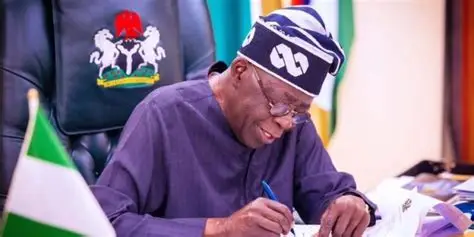
The approval was announced by President Bola Tinubu at the inaugural National Pension Week Leadership Summit held at Transcorp Hilton, Abuja, on Thursday
Represented by the Secretary to the Government of the Federation (SGF), Senator George Akume, the president also announced measures aimed at restoring dignity and financial security to retirees.
This is even as he assured Nigerian retirees that no citizen who has served the country will be forgotten in retirement
He further pledged to strengthen the Contributory Pension Scheme and improve pensioners’ welfare, adding that his administration regarded pension payments as an obligation to workers rather than a privilege granted by government.Follow Politics
The president , who spoke on the themed, “Pensions for All: Building a Secure Future Together,” emphasised that pension benefits represented earnings deferred by workers and held in trust for their retirement.
He noted that the bond would work as a restitution to Nigerians who served the country but were denied timely access to their retirement entitlements, adding that the measure is intended to address outstanding pension obligations inherited by his administration, including cases in which retirees had waited for years to receive their accrued benefits.
The President who also announced plans to implement the Minimum Pension Guarantee provision of the Pension Reform Act 2014, which he said had remained unimplemented for more than 11 years after the law was enacted, emphasised that the policy shift would strengthen retirement protection and provide greater assurance for pension contributors.
Tinubu further announced the launch of PenCare, a national retiree wellbeing programme designed to provide access to essential healthcare for low-income pensioners.Follow Politics
The initiative is expected to expand the scope of retirement protection beyond savings and benefit payments to include healthcare support for vulnerable retirees
However, he warned employers in the public and private sectors against deducting workers’ pension contributions without remitting them to the appropriate pension accounts, describing such practice as a breach of trust and urged employers to ensure that contributions were remitted fully and promptly.
Tinubu also charged the National Pension Commission to enforce pension regulations without fear or favour, while calling on Pension Fund Administrators and Custodians to improve their expertise, diversify investments responsibly and reduce costs.
He said the success of pension fund management should be measured by the benefits contributors ultimately received rather than the size of assets under management.
The President cautioned that retirement savings must generate returns capable of protecting contributors against inflation, stressing that capital preservation and disciplined growth should go hand in hand.
He added that although pension assets could contribute to national development through infrastructure and productive enterprises, investment decisions must prioritise the interests of contributors and meet rigorous risk-and-return requirements.
Tinubu also called for the expansion of pension coverage beyond the formal sector to include traders, artisans, farmers, transport workers and other self-employed Nigerians.Buy Maps
He urged Pencom to use the opportunity provided by the Personal Pension Plan and new distribution channels to provide more accessible opportunities for informal-sector workers to save towards retirement.
The President urged state governments, organised labour and other stakeholders to work towards expanding pension coverage, improving compliance and ensuring faster payment of benefits.
Meanwhile, President Bola Tinubu has defended the
Government’s efforts to secure loans from international financial institutions and banks, arguing that the value of investments financed by borrowing should matter more than the amount of debt incurred.
The President, responding to criticism from opposition leaders over the government’s borrowing plans, said the funds were intended to support critical infrastructure, stimulate economic growth and create opportunities for future generations.
In an article titled “From reforms to delivery: Our infrastructure investment and growth strategy”, Tinubu stated: “The real question is not how much we borrow, but what we build, what value we create and what future we leave behind.”
He listed the Lagos-Calabar Coastal Highway, Sokoto-Badagry Superhighway, Trans-Sahara Superhighway, electricity grid upgrades and the modernisation of major commercial ports in Lagos among the projects expected to strengthen Nigeria’s productive capacity.
According to the President, the projects, combined with investments in healthcare, education and vocational training, would improve connectivity between economic regions, lower transportation costs, expand agricultural and industrial activities and attract private-sector investment.
The article, which was made available to journalists on Thursday, projected that the Lagos-Calabar Coastal Highway could reduce logistics costs along its route by between 15 and 20 per cent.
It also estimated that the project could contribute up to two per cent to Nigeria’s Gross Domestic Product (GDP) through increased trade, tourism and industrial activities.
“The project is also projected to generate about 100,000 direct jobs in construction and engineering, alongside more than 150,000 indirect jobs in logistics, materials and related services.”
Explaining the broader economic significance of the infrastructure projects, Tinubu said: “We are not simply building highways. We are opening economic corridors, connecting markets, unlocking industries and reshaping Nigeria’s economic geography,” the President said.
He maintained that achieving the administration’s ambition of building a $1 trillion economy by 2030 would require sustained investment in infrastructure to improve productivity, promote industrialisation and facilitate trade.
“We cannot build a USD 1 trillion economy with infrastructure designed for an economy a fraction of that size,” Tinubu said.
The President argued that improvements in key economic indicators and rising confidence among international investors were creating opportunities for Nigeria to attract long-term capital for infrastructure development.
He attributed the progress recorded by the economy to reforms introduced by his administration in May 2023, including the removal of petrol subsidies, unification of the foreign exchange market, tax reforms and coordinated efforts to curb inflation.
According to him, the measures were designed to restore macroeconomic stability, strengthen public finances and improve Nigeria’s position in international financial markets.
Tinubu stressed that the proposed $1 trillion economy could not be achieved through declarations alone, but would depend on sustained investment, increased productivity, industrial growth and expanded trade.
He said infrastructure development would remain central to achieving the target within the administration’s 2030 timeline.
Citing recent economic indicators, the President said Nigeria’s real GDP grew by 4.43 per cent in the second quarter of 2026, while headline inflation declined to 14.63 per cent in September from 20.98 per cent recorded a year earlier.
He also disclosed that the country’s gross external reserves had risen to $55.1 billion as of October 9, 2026, including approximately $46 billion in net reserves.
Tinubu further said Nigeria’s tax-to-GDP ratio had increased to 12.5 per cent from seven per cent, describing the figures as evidence of progress in the government’s economic reform programme.
The President maintained that the administration’s infrastructure strategy was aimed at translating economic reforms into tangible benefits through job creation, stronger productive capacity and improved access to markets.
However, the debate over fresh borrowing comes amid concerns about Nigeria’s debt burden and the need to ensure that loans translate into productive investments capable of generating sufficient economic returns.
The effectiveness of the government’s borrowing strategy will therefore depend not only on the scale of infrastructure spending but also on project delivery, transparency, accountability and the economic benefits generated for Nigerians.
-
 General News4 weeks ago
Rivers 2027: We are not part of Rainbow Coalition – APC Legacy Group slams Wike, Fubara meeting
-
General News1 month ago
JOHESU demands: MHWUN puts FG on notice over fresh action
-
 Politics2 months ago
2027: ASAF backs APC governors, rejects rainbow coalition
-

 Politics2 months ago
You have demonstrated diligence, loyalty, statesmanship in leadership, Ekechi salutes Shetimma at 60
-

 Politics3 months ago
2027: Advertising experts raise concerns over irregular regulation of sector
-
FCT News3 months ago
2027: Hasana-Moneme pledges skills, empowerment, credit access for FCT women
-
General News3 months ago
2027: Dame Princess Esom-Nwafor Orizu confirmed as APC flagbearer for Nnewi North /South /Ekwusigo Federal Constituency as INEC releases names of candidates
-
Uncategorized4 months ago
Rescue of Oyo schoolchilden: Tinubu commends security agencies, says action breakthrough in fight against criminality