
Uncategorized
PCC Anambra Commissioner pays courtesy visit to FRSC sector commander


PCC Commisioner Hon Emmanuel Muoka (m) handing over a booklet to the FRSC boss in Anambra Asekhauno
By Ugbala Onyedi
As part of its commitment to strengthening inter-agency collaboration and enhancing effective public service delivery, the Honourable Federal Commissioner, Public Complaints Commission (PCC), Anambra State Office, Hon. Emmanuel Okechukwu Muoka, on Thursday, 9th July, 2026, paid a courtesy visit to the Sector Commander of the Federal Road Safety Corps (FRSC), Anambra State Sector Command, Corps Commander Bridget Asekhauno.
The Honourable Federal Commissioner was accompanied by the State Director of the Commission, Mr. Charles C. Ekwunife, alongside other officers of the Public Complaints Commission, Anambra State Office.

Also present to receive the delegation were senior officers of the FRSC, including the Deputy Corps Commander (Operations), DCC J. N. Nnamani; Deputy Corps Commander (Training), DCC C. A. Oliseh; Corps Route Commander (Monitoring and Evaluation), CRC I. Ezeala; Corps Route Commander (SERVICOM), CRC C. P. Dike; Sector Route Commander (Public Education), SRC I. Eke; SRC P. C. Ogu; and Deputy Route Commander (Protocol), DRC Sixtus C. Nwoke.
In his remarks, Hon. Muoka underscored the importance of collaboration, partnership, and institutional synergy among federal government agencies in the effective discharge of their statutory mandates. He explained that the Public Complaints Commission, Nigeria’s Ombudsman, is dedicated to promoting administrative justice, transparency, accountability, and the protection of the rights of citizens against acts of maladministration. According to him, closer cooperation between the Commission and the Federal Road Safety Corps will facilitate prompt resolution of public complaints, improve service delivery, and further strengthen public confidence in government institutions.
The Honourable Commissioner commended the Federal Road Safety Corps for its unwavering commitment to ensuring road safety, enforcing traffic regulations, and safeguarding lives and property on Nigerian roads. He reaffirmed the Commission’s readiness to work closely with the Corps in areas of mutual interest for the overall benefit of the people of Anambra State.
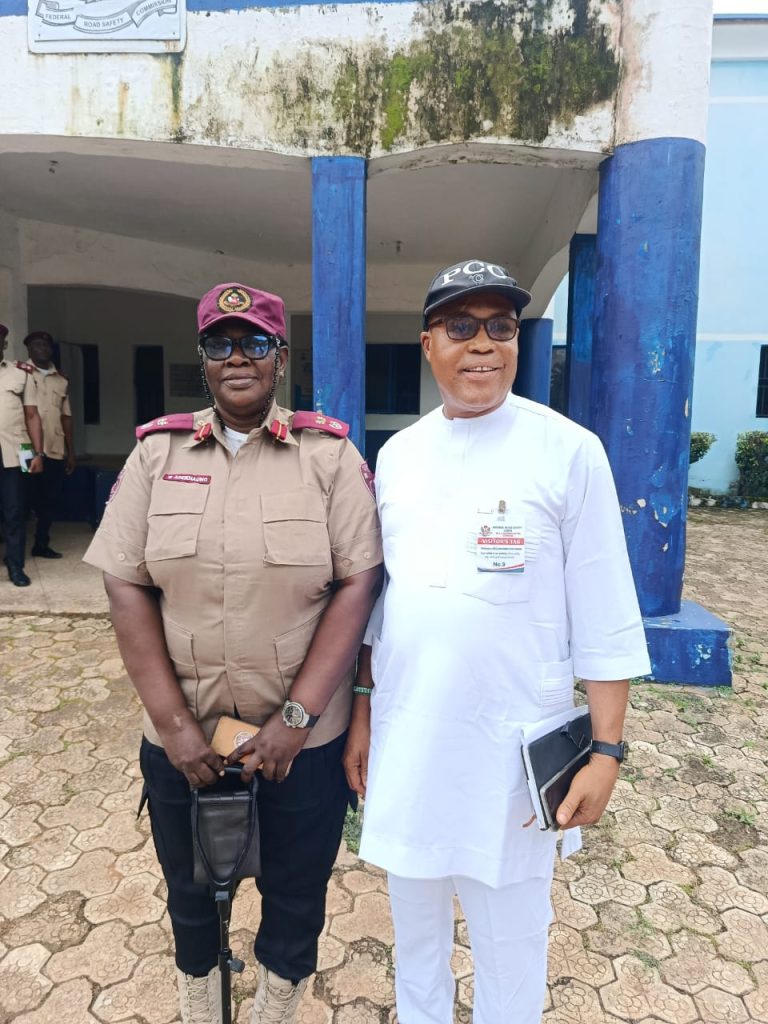
In her response, the Sector Commander, Corps Commander Bridget Asekhauno, warmly welcomed the delegation and expressed appreciation to the Honourable Federal Commissioner for the thoughtful visit. She reaffirmed the FRSC’s commitment to fostering productive partnerships with sister government agencies and assured the delegation of the Corps’ willingness to collaborate with the Public Complaints Commission in promoting efficient service delivery, administrative justice, and public trust.
The visit provided an opportunity for both agencies to engage in fruitful discussions on areas of mutual cooperation, institutional collaboration, experience sharing, and strategies for improving service delivery to the public. It concluded with the exchange of goodwill and a shared commitment to sustaining a cordial working relationship in the discharge of their respective statutory responsibilities.
The courtesy visit represents another significant milestone in the Public Complaints Commission’s ongoing efforts to build strategic partnerships with key stakeholders, promote good governance, and enhance efficient public service delivery in Anambra State and Nigeria at large.

By Sam Otuonye
The Comptroller-General of Customs (CGC), Adewale Adeniyi, has pledged the full support of the Nigeria Customs Service (NCS) for the realisation of Nigeria’s ambition to build a $1 trillion economy, stressing the need for institutions to translate national aspirations into concrete, measurable results.
CGC Adeniyi committed on Tuesday, 6 October 2026, while delivering a keynote address at the New Nigeria Festival at the Shehu Musa Yar’Adua Conference Hall, Abuja, saying the economic target was achievable if the plans and strategies developed to achieve it were properly implemented.
The CGC said the Customs had moved beyond ideas and discussions to taking practical steps in support of the national economic ambition, citing the Service’s ongoing Modernisation Reforms, including the deployment of B’Odogwu, the Authorised Economic Operator (AEO) programme and the Advance Ruling mechanism, as initiatives designed to facilitate legitimate trade, improve predictability in the trading environment and ultimately strengthen revenue generation.
“Execution is nothing if it is not concrete. We have to move from ideas to action and ensure that whatever we plan translates into results. That is how we can begin to see the kind of transformation we are talking about.” He said.
Adeniyi stressed that the responsibility for achieving the $1 trillion economy could not rest solely on government agencies, noting that the target required the collective commitment of institutions, businesses and citizens.
He said the Customs Service, by virtue of its responsibilities in revenue collection, trade facilitation and border management, remained strategically positioned to contribute to the country’s economic transformation.
CGC Adeniyi therefore called for a shift from rhetoric to implementation, stressing that the country’s economic ambition could be achieved only when institutions and citizens alike took ownership of their responsibilities and turned plans into practical, measurable action.
By Sam Otuonye
Africa Climate Forum (ACF), a climate change stakeholder group, has said that Africa’s climate ambitions must be matched with financial, coordination, and execution realities to achieve a measurable outcomes for the continent.
The group argues that as Africa’s climate ambitions are increasingly confronted with the realities of financing, coordination and execution, attention should shift to the harder issue of how commitments can be translated into action that delivers measurable results for the continent.This becomes the focus of their 2026 conference that will bring together policymakers, business leaders, investors and climate practitioners in Abuja on October 13 and 14.
The fourth in its edition, organised by the Global Centre for Law, Business and Economy (GCLBE), will hold at the Shehu Musa Yar’Adua Centre, Abuja, under the theme, “Implementing in Lockstep: Public-Private Action for Green Outcomes.”
The two-day event, which will feature both physical and virtual participation from across Africa and beyond, is expected to examine how governments, businesses, financial institutions and development partners can strengthen collaboration to accelerate the continent’s climate transition.
The Forum comes at a time when Africa’s climate ambitions are increasingly being confronted by challenges around financing, institutional coordination and implementation.
Among those expected at the event are Ambassador Philbert Abaka Johnson, Director and UNIDO Representative in Nigeria and ECOWAS; Mr Olasupo Shasore, SAN, Senior Partner at Africa Law Practice NG & Company; Hon. Sam Onuigbo, Governing Board Member and Chairman of the Committee on Security, Special Interventions and Climate Change at the North East Development Commission; Dr Salisu Dahiru, former Director-General of the National Council on Climate Change; and Engr. Chijioke Okwuokenye, Managing Director of Abuja Electricity Distribution Company.
Others include Dr Forster Boateng, Managing Director of C4Impact Advisory Group; Dr Gloria Boamah Kusi, Senior Sustainability Officer at the Jospong Green Transition Office; Dr Debany Fonseca Batista, Research Associate at Dalhousie University’s CERC.OCEAN Laboratory and Executive Director of the DOTCAN Institute; and Claudette Hutchinson, Chief Executive Officer and AI Implementation Architect at Owning My.
Speaking on the event, the Convener and Director-General of GCLBE, Prof. George Nwangwu, said climate action requires more than commitments, stressing the need for governments, businesses and financial institutions to work together to achieve measurable outcomes.
“Climate action requires more than ambition. It requires governments, businesses and financial institutions to move together. We have an opportunity to refine our partnerships, forge new ones, and make bold commitments that can translate into meaningful action,” he said.
The programme will feature plenary sessions addressing critical issues affecting Africa’s climate transition, including private-sector participation, carbon markets, energy access and natural gas, food security and adaptation, community-led climate action, human rights and the just transition.
Participants will also examine the role of artificial intelligence, data and digital technologies in improving climate planning, implementation and delivery.
A major component of the event will be the ACF Deal Room, designed to connect climate project developers and green businesses with investors and financial institutions. The initiative will run throughout the two-day event and is expected to provide opportunities for partnerships and access to climate finance.
The Forum will also host a Pulitzer Centre side event on Journalism, Climate Action and Civic Space Engagement, which will explore the role of public-interest journalism in strengthening climate accountability, improving public understanding and amplifying the experiences of communities affected by climate change.
The Abuja gathering follows climate conversations held by ACF in Accra earlier in the year, where stakeholders discussed climate partnerships, financing, just transition and public-private collaboration.
Since its inaugural edition in 2023, the Africa Climate Forum has provided a platform for policymakers, businesses, investors and development stakeholders to deliberate on Africa’s climate response.
commitment to delivery shift at ACF 2026 conference
By Sam Otuonye
Africa Climate Forum (ACF), a climate change stakeholder group, has said that Africa’s climate ambitions must be matched with financial, coordination, and execution realities to achieve a measurable outcomes for the continent.
The group argues that as Africa’s climate ambitions are increasingly confronted with the realities of financing, coordination and execution, attention should shift to the harder issue of how commitments can be translated into action that delivers measurable results for the continent.This becomes the focus of their 2026 conference that will bring together policymakers, business leaders, investors and climate practitioners in Abuja on October 13 and 14.
The fourth in its edition, organised by the Global Centre for Law, Business and Economy (GCLBE), will hold at the Shehu Musa Yar’Adua Centre, Abuja, under the theme, “Implementing in Lockstep: Public-Private Action for Green Outcomes.”
The two-day event, which will feature both physical and virtual participation from across Africa and beyond, is expected to examine how governments, businesses, financial institutions and development partners can strengthen collaboration to accelerate the continent’s climate transition.
The Forum comes at a time when Africa’s climate ambitions are increasingly being confronted by challenges around financing, institutional coordination and implementation.
Among those expected at the event are Ambassador Philbert Abaka Johnson, Director and UNIDO Representative in Nigeria and ECOWAS; Mr Olasupo Shasore, SAN, Senior Partner at Africa Law Practice NG & Company; Hon. Sam Onuigbo, Governing Board Member and Chairman of the Committee on Security, Special Interventions and Climate Change at the North East Development Commission; Dr Salisu Dahiru, former Director-General of the National Council on Climate Change; and Engr. Chijioke Okwuokenye, Managing Director of Abuja Electricity Distribution Company.
Others include Dr Forster Boateng, Managing Director of C4Impact Advisory Group; Dr Gloria Boamah Kusi, Senior Sustainability Officer at the Jospong Green Transition Office; Dr Debany Fonseca Batista, Research Associate at Dalhousie University’s CERC.OCEAN Laboratory and Executive Director of the DOTCAN Institute; and Claudette Hutchinson, Chief Executive Officer and AI Implementation Architect at Owning My.
Speaking on the event, the Convener and Director-General of GCLBE, Prof. George Nwangwu, said climate action requires more than commitments, stressing the need for governments, businesses and financial institutions to work together to achieve measurable outcomes.
“Climate action requires more than ambition. It requires governments, businesses and financial institutions to move together. We have an opportunity to refine our partnerships, forge new ones, and make bold commitments that can translate into meaningful action,” he said.
The programme will feature plenary sessions addressing critical issues affecting Africa’s climate transition, including private-sector participation, carbon markets, energy access and natural gas, food security and adaptation, community-led climate action, human rights and the just transition.
Participants will also examine the role of artificial intelligence, data and digital technologies in improving climate planning, implementation and delivery.
A major component of the event will be the ACF Deal Room, designed to connect climate project developers and green businesses with investors and financial institutions. The initiative will run throughout the two-day event and is expected to provide opportunities for partnerships and access to climate finance.
The Forum will also host a Pulitzer Centre side event on Journalism, Climate Action and Civic Space Engagement, which will explore the role of public-interest journalism in strengthening climate accountability, improving public understanding and amplifying the experiences of communities affected by climate change.
The Abuja gathering follows climate conversations held by ACF in Accra earlier in the year, where stakeholders discussed climate partnerships, financing, just transition and public-private collaboration.
Since its inaugural edition in 2023, the Africa Climate Forum has provided a platform for policymakers, businesses, investors and development stakeholders to deliberate on Africa’s climate response.
-
General News2 weeks ago
JOHESU demands: MHWUN puts FG on notice over fresh action
-

 Politics3 weeks ago
2027: ASAF backs APC governors, rejects rainbow coalition
-

 Politics1 month ago
You have demonstrated diligence, loyalty, statesmanship in leadership, Ekechi salutes Shetimma at 60
-

 Politics2 months ago
2027: Advertising experts raise concerns over irregular regulation of sector
-
FCT News2 months ago
2027: Hasana-Moneme pledges skills, empowerment, credit access for FCT women
-
General News2 months ago
2027: Dame Princess Esom-Nwafor Orizu confirmed as APC flagbearer for Nnewi North /South /Ekwusigo Federal Constituency as INEC releases names of candidates
-
Uncategorized3 months ago
Rescue of Oyo schoolchilden: Tinubu commends security agencies, says action breakthrough in fight against criminality
-
General News1 month ago
Chi-Jenco CEO, Jude Orji loses mother