
Uncategorized
Insecurity: US Congress approves suspension of financial support to Nigeria over Christian persecution

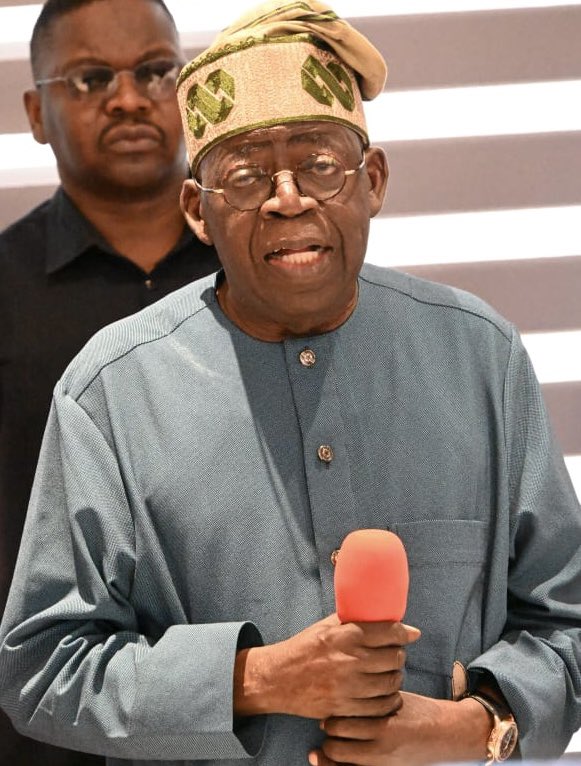
President Tinubu
*** Says Nigeria “has faced a horrific wave of violence, corruption”
*** Motion awaits US Senate backing
By Nkem Okereh (With agency report)
The United States of America (USA), may have beamed its searchlights on activities in Nigeria, as the country’s House of Representatives has voted on Thursday for a total withholding of all financial supports to Nigeria for allegations of Christian genocide in the country.
Recall that a prominent member of the US Congress, Riley Moore had recently accused the Nigerian government of not doing much to protect the nation’s citizens from unending killings by Islamic militants, who he accused of carrying out genocide against Christians in Nigeria.
The allegations were serially denied by the President Bola Tinubu-led All Progressives Congress (APC) administration, which also sent a team of the executives, led by the National Security Adviser (NSA), Nuhu Ribadu, to address the US House of Representatives and other stakeholders on the matter.
President Donald Trump had in 2025, redesignated Nigeria as a Country of Particular Concern over allegations of Christian persecution.
US Congressman, Riley Moore similarly led some other congressmen and women, including religious leaders to visit Nigeria on a fact finding trip in December 2025, touring security flashpoint states like Benue and Plateau.
The visits led to the establishment of a security partnership between Nigeria and the US, against terrorist groups operating in northern Nigeria.
Following the security partnership agreement, the US army swiftly launched several attacks on December 25, 2025, targeting the terrorist Islamic State of West African Province (ISWAP), killing most of its lead commanders, an attack the Donald Trump administration said was towards the protection and stopping further attacks on Nigerian Christians my Islamic militant groups.
But the Congress went further on Wednesday to seek the protection of Nigerian Christians, as it adopted an amended motion sponsored by congressman Gregory Steube to withhold all US assistance to Nigeria until the country meets specific conditions to tackle violence.
The amendment, which was approved by a voice vote on Wednesday, was added to the fiscal 2027 State Department spending bill, which the House later passed 217-209 largely along party lines.
Sponsor of the motion, Gregory Steuben announced the Congress vote on X, wrote, “My amendment to withhold 100% of U.S. aid to Nigeria until its government stops the slaughter of Christians has passed.
“American taxpayers should never bankroll governments that turn a blind eye while Christians are abducted, tortured, and murdered. No more wasteful foreign aid!”
The bill proposed withholding funds appropriated for Nigeria until the US Secretary of State certifies that the country has taken “effective steps to prevent and respond to violence and hold perpetrators accountable.”
Steube told the Congress that Nigeria “has faced a horrific wave of violence that its corrupt government has failed to address,” and argued that withholding only half the funding meant rewarding a government that “fails to meet such a basic obligation.”
He said the amendment does not add new conditions but “only strengthens” the existing ones, and framed it as a matter of accountability.
“Foreign aid should never be a reward for failure,” he said.
Steube also linked his push to America’s finances, asking why the country should keep sending money to Nigeria “as our national debt is fast approaching $40 trillion.”
However, implementation of the House of Representatives adopted motion will still wait until it gets a similar backing from the Senate, and also be signed by the President Trump.

ByLemmy Ughegbe, Ph.D
Nigeria speaks passionately about fighting corruption. Yet it repeatedly struggles to prove its most celebrated corruption allegations in court.
We have built an elaborate anti-corruption architecture. We have enacted laws, created specialised investigative units and committed considerable public resources to prosecuting financial crimes. Still, when the most consequential cases reach judgment, the outcome often raises uncomfortable questions about the competence of those entrusted with enforcing the law.
The latest judgment in the long-running Malabu Oil saga brings those questions back into national focus.
On Thursday, 15 October 2026, the Federal High Court in Abuja discharged and acquitted businessman Aliyu Abubakar, Malabu Oil and Gas Limited and six other defendants of money laundering charges linked to Oil Prospecting Licence 245. Justice Inyang Ekwo held that the Economic and Financial Crimes Commission (EFCC) failed to prove its case beyond reasonable doubt.
The decision closes another chapter in one of Nigeria’s most controversial oil-related prosecutions. It also exposes investigative and prosecutorial weaknesses that deserve serious public scrutiny.
Malabu is no ordinary financial dispute. At its centre is OPL 245, an immensely valuable offshore block first awarded in 1998 and later entangled in disputes involving government officials, multinational oil companies and allegations of illicit payments. The 2011 settlement involving the Federal Government, Malabu, Shell and Eni was valued at about $1.3 billion. For years, the affair drew international attention and came to symbolise Nigeria’s struggle to enforce accountability in its petroleum sector.
Yet the real significance of this judgment lies less in the size of the transactions than in the court’s assessment of the prosecution.
Justice Ekwo faulted the EFCC for pressing charges despite a 2018 advice from the Office of the Attorney-General of the Federation against prosecution for insufficient evidence. The court also found that the investigation had not been concluded before the charges were filed. In related proceedings involving Abubakar, it noted deficiencies in forensic evidence, including reliance on photocopies rather than original documents.
These are not trivial procedural lapses. They strike at the foundations of criminal justice.
One principle must be stated plainly. An acquittal is not a licence to keep treating defendants as criminals in the court of public opinion. The presumption of innocence is a constitutional guarantee, not an inconvenience to be discarded whenever public anger runs high.
The defendants were entitled to insist that the prosecution prove every essential element of its case. It did not. The judgment must therefore be respected, however strongly anyone feels about the wider Malabu controversy.
But respecting an acquittal does not require silence about institutional performance.
If investigators pursue complex financial crime allegations without completing the necessary groundwork, what mechanism exists to catch such failures before defendants endure years of litigation? Who reviews the evidential foundation of major prosecutions? Who decides whether the prospect of conviction justifies the public expense? And when courts identify serious investigative failings, what consequences follow?
Nigeria must stop measuring anti-corruption success by the number of arrests, the prominence of suspects or the drama surrounding charges.
An arrest is not a conviction. An allegation is not evidence. A press conference is no substitute for a properly assembled prosecution brief.
The credibility of criminal justice rests on patient investigation, competent forensic analysis, admissible evidence and prosecutors able to present a coherent case that meets the demanding standard of proof beyond reasonable doubt.
There is also a constitutional question about the relationship between the EFCC and the Attorney-General.
Section 174 of the Constitution vests the Attorney General of Federation with wide powers over federal criminal proceedings, including the power to institute, take over or discontinue prosecutions, having regard to the public interest, the interests of justice and the need to prevent abuse of legal process. The EFCC, for its part, holds statutory investigative and prosecutorial powers.
Effective law enforcement requires both institutions to operate within their mandates, without bureaucratic rivalry or political interference.
Equally, the Attorney-General’s authority must never become a shield against legitimate investigation. Advice against prosecution may be entirely justified where evidence is weak, but it must itself serve the public interest. The right response is neither blind obedience nor reckless defiance. It is a transparent, legally defensible process guided by evidence, constitutional authority and professional judgment.
Repeated failures in high-profile cases carry a double danger.
They expose individuals to prolonged prosecution without adequate evidential basis. They also erode public confidence in the state’s capacity to pursue genuine wrongdoing. Both outcomes injure justice. The innocent deserve protection from wrongful prosecution, just as society deserves competent investigation where credible evidence exists.
The EFCC should treat this judgment as an occasion for serious institutional reflection, not merely another unfavourable ruling.
A thorough review of the investigation, evidential preparation and prosecution strategy is warranted. That review should separate genuine professional failings from reasonable decisions that simply did not persuade the court. Not every acquittal proves incompetence, just as not every prosecution is justified because the allegations sound grave. The distinction matters.
The National Assembly also has a legitimate oversight role. It should examine whether our anti-corruption agencies have the forensic capacity, technical expertise and internal safeguards that complex financial investigations demand.
Crimes involving multinational transactions, offshore structures and intricate banking records cannot be prosecuted on assumptions or shortcuts. They require specialised knowledge, international cooperation and painstaking preparation.
The Malabu judgment should prompt a more mature national conversation about what success in the anti-corruption fight truly means.
Nigeria does not need agencies that merely look formidable before television cameras. It needs institutions whose investigations are rigorous, whose prosecutions are fair and whose conduct inspires confidence even when verdicts disappoint the public.
The real scandal would be to learn nothing from the failures the court has identified.
The fight against corruption must itself be governed by competence, accountability and the rule of law. Otherwise, Nigeria risks becoming a country where allegations make headlines, prosecutions consume years, and justice is left to explain why the evidence was never good enough.
Lemmy Ughegbe, Ph.D, FIMC, CMC
Email: lemmyughegbeofficial@gmail.com
WhatsApp ONLY: +2348069716645

A man and his son were burnt to death on Sunday when a commercial tricycle conveying their family caught fire following a collision with a bus at Sabon Barki, in Jos South Local Government Area of Plateau State.
The victims were reportedly burnt beyond recognition in the inferno, while the man’s wife sustained a broken leg. Their other child and the tricycle rider also sustained injuries. The three survivors were rushed to hospital for treatment. The family was returning from church at about 4:20 p.m. when the accident occurred.
The tricycle was reportedly hit by a bus, causing it to somersault before bursting into flames.
A witness, Kefas Gyang, who arrived at the scene shortly after the crash, said he was returning from work when he noticed people crying and moved closer to find out what had happened.
He said he saw people struggling to rescue the victims from the burning tricycle, but the intensity of the fire made it difficult to save those trapped inside.
“It was then that I saw people trying to rescue the victims, but the fire was too much for us to handle. It was beyond our strength, and we could not do much to rescue them from the burning tricycle. I didn’t witness the actual collision, but the man and his son were burnt beyond recognition in the inferno,” Gyang said.
He added that the driver of the bus reportedly fled the scene after the accident.
Efforts to reach the Plateau State Public Relations Officer of the Federal Road Safety Corps (FRSC), Yakubu Longsan, for comment were unsuccessful, as his telephone line was unavailable
…As Yiaga Africa insists on accurate data for political stability
By Sam Otuonye
Amid the emergence of Artificial Intelligence (AI) and its innovative and automative competences, the Chairman of the Independent National Electoral Commission (INEC), Prof. Joash Amupitan, has declared that algorithms will not decide the outcome of the 2027 general elections.
Amupitan insisted that the will of the Nigerian people, expressed through the ballot, remains the sole determinant of who governs the country.
He made the declaration while speaking at the AI and Democracy Forum 2026 in Abuja, themed “Will Algorithms Determine the 2027 Vote?: Safeguarding the 2027 General Elections in the Age of Artificial Intelligence,” organized by Yiaga Africa in partnership with INEC, Google, Microsoft, European Union, UK Int’l Development, and among others.
He said technology, however sophisticated, must remain an instrument for serving human agency, institutional efficiency, and administrative transparency.
The INEC Chairman declared that “AI must remain servant, not master, of Nigerian democracy.
“Algorithms will not, and must never, decide the 2027 vote,” he asserted.
“The choice of who leads Nigeria belongs exclusively to the Nigerian people. Algorithms may predict patterns; they may optimise routes, and they may even suggest preferences. But they do not have a conscience, they do not have a country, and they do not have a vote.”
Amupitan also noted that the greatest threat to elections today is not just hacking of the process but hacking of voters’ mind through generative AI.
With exactly 92 days to the 2027 General Elections, the INEC Chairman acknowledged that AI will undeniably shape the information environment, influence electoral logistics, and alter the tactics of both democratic actors and anti-democratic disruptors.
“While algorithms will not decide the vote, AI will undeniably shape the information environment in which citizens form their choices, influence the speed and security of electoral logistics, and alter the tactics of both democratic actors and anti-democratic disruptors,” he said.
Prof. Amupitan described the 2027 General Election as the largest democratic exercise on the African continent and one of the most complex administrative undertakings in the world, with over 103 million registered voters, 176,846 polling units across 774 Local Government Areas, and multi-tiered balloting spanning presidential, national assembly, governorship, and state assembly elections.
He noted that INEC has already executed ten of the fourteen major operational milestones stipulated by the Electoral Act 2026, procured additional BVAS units, digitised candidate nominations through the INEC Candidates Nomination Portal (ICNP), processing over 15,000 nominations across 22 political parties, and introduced online voter registration for the first time in Nigeria.
The INEC Chairman outlined opportunities for AI to optimise election administration, including predictive logistics and route optimisation, automated result audit assistance, biometric database hygiene, multilingual voter engagement through Natural Language Processing, and AI-driven cybersecurity defence.
He, however, affirmed the Commission’s commitment to the Human Oversight Principle, stressing that no critical electoral decision, result collation, voter accreditation, or candidate qualification will ever be fully automated or delegated to an autonomous system.
“Human accountability, statutory oversight, and judicial review will remain paramount at every stage of the electoral chain,” he said.
In his opening remark, the Executive Director, Yiaga Africa, Samson Itodo, insisted that data integrity is paramount to achieving credible elections, emphasizing on aggregating and sharing of accurate data. He stressed that accurate data is a significant tool for political stability.
According to Itodo, methodological integrity, verification for transparency, and other portable tools are critical and inspire trust and confidence in the process.
The event witnessed a wide turnout of both local and international personalities within the electoral ecosystem, including the Chairperson of the ECOWAS Network of Electoral Commissions and Chairman of Senegal’s Electoral Commission, Abdoulaye Sylla; members of the diplomatic corps; National Commissioners and Resident Electoral Commissioners; heads of sister election management bodies across Africa; international development partners; political party leaders; civil society organisations; media executives; security agencies; technology companies; and members of the academic community.
-
 General News2 weeks ago
Rivers 2027: We are not part of Rainbow Coalition – APC Legacy Group slams Wike, Fubara meeting
-
General News1 month ago
JOHESU demands: MHWUN puts FG on notice over fresh action
-

 Politics1 month ago
2027: ASAF backs APC governors, rejects rainbow coalition
-

 Politics2 months ago
You have demonstrated diligence, loyalty, statesmanship in leadership, Ekechi salutes Shetimma at 60
-

 Politics2 months ago
2027: Advertising experts raise concerns over irregular regulation of sector
-
FCT News2 months ago
2027: Hasana-Moneme pledges skills, empowerment, credit access for FCT women
-
General News3 months ago
2027: Dame Princess Esom-Nwafor Orizu confirmed as APC flagbearer for Nnewi North /South /Ekwusigo Federal Constituency as INEC releases names of candidates
-
Uncategorized3 months ago
Rescue of Oyo schoolchilden: Tinubu commends security agencies, says action breakthrough in fight against criminality