
General News
Kalu seeks urgent FG intervention as erosion swallows houses in Bende

Tella Onah
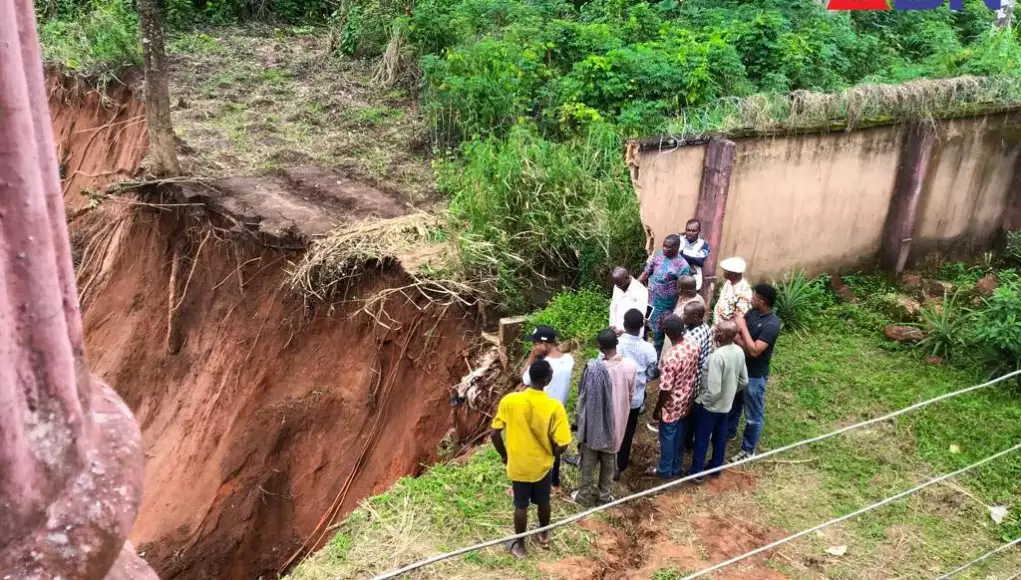
More than 10 houses have been swallowed by massive gully erosion in Bende Local Government Area of Abia State, displacing scores of residents as the disaster continues to expand across Uzuakoli and Ozuitem communities.
The Deputy Speaker of the House of Representatives, Benjamin Kalu Wednesday led officials of the Ecological Project Office, including the Director of Soil and Erosion Flood Control, B’aba Bomoi, to assess the affected sites.
The erosion now stretches about four to five kilometres and is threatening more homes, roads and farmlands.
Kalu called for urgent Federal Government intervention, saying the scale of the disaster had overwhelmed the capacity of the state government.
“This is not what a state can do. I know many people have been saying the state government should come and intervene. I think this is beyond the state,” he said.
The Deputy Speaker said he had earlier applied for ecological intervention when the erosion was less severe, but noted that the situation had since deteriorated significantly.
“Honestly speaking, I came here about two or three years ago, it was not this massive,” he said.
According to him, the funding initially projected for the project would no longer be sufficient to address the expanded disaster.
“The amount I was asking for to solve this will be a far cry from what would be used in solving this. In fact, it is about twenty times over what I had projected,” Kalu said.
He urged the Ecological Project Office to carry out a fresh assessment and develop a lasting solution to the crisis.
“We have to do a reassessment of what this has become and find a way of giving a lasting solution to it,” he said, while calling on President Bola Tinubu’s administration to urgently respond.
Kalu recalled that he had previously secured federal intervention for a similar erosion challenge in Nkpa after moving a motion on June 13, 2019, which was followed by the construction of a bridge during the administration of former President Muhammadu Buhari.
The Deputy Speaker said the South-East continued to bear a significant burden of ecological disasters, particularly gully erosion.
“This is affecting mainly the South East. We are counting on the federal government, counting on Mr. President to see this as a real need of our people,” he said.
Bomoi, who led the technical team, described the situation as dangerous to lives, property and the environment.
“This one is quite threatening, not only to the environment, not only to the property, even lives,” he said, adding that the erosion had already encroached on a large portion of farmland.
The Ecological Project Office is expected to submit its assessment report to guide Federal Government intervention, following the inspection.
The development comes after women from the affected communities recently staged a mass walk to demand urgent action to halt the destruction and prevent further displacement.


By Our Reporter
Governor Monday Okpebholo of Edo State says he will sign the death warrants of the four kidnappers recently sentenced to death by the state’s Special Criminal Court.
The governor, however, said the death warrant would be signed if the kidnappers fail to appeal within 30 days.
Okpebholo stated this while recounting his administration’s efforts to tackle kidnapping, cultism and other criminal activities at the God’s People Worldwide Prayer Ministry, Ekpoma, on Friday.
DAILY POST recalls that the criminals were sentenced to death by an Edo State Special Criminal Court on September 29, over the abduction of a woman at the vegetable market along Airport Road, Benin.
The governor said insecurity was a major concern when he assumed office and he decided to prioritise tackling it after raising the issue with President Bola Tinubu, who urged him to go ahead.
“When the kidnappers attacked the vegetable market area, I told the commissioner of police that I wanted them arrested without delay ,” he said.
The governor said the suspects had been sentenced to death and expressed hope that they would not appeal the judgment.
“If within 30 days they don’t appeal, I will execute,” he added.

By Our Reporter
The Ebonyi State Government has sealed the Jimoh Guest House in Abakaliki, the state capital.
The action followed an operation that led to the arrest of more than 30 persons, while substances suspected to be hard drugs, were also recovered.
The operation was jointly conducted by security operatives, a task force from the state Ministry of Internal Security, and the Ministry of Capital City and Urban Planning.
It was part of efforts to address perceived illegal activities going on in the Guest House, and enforce urban planning regulations in the capital city.
The facility was also sealed over security concerns, and alleged use of a building for Guest House without the necessary approvals from relevant government authorities.
The Ebonyi State Commissioner for Capital City and Urban Planning, Richard Idike told journalists during the operation that there was concern over reported illegal activities at the premises.
He said the decision was taken to protect residents and maintain public safety.
The commissioner explained that the inspection was part of efforts of the state government to ensure that buildings within the state capital complied with approved development plans, and were used for purposes authorised by the relevant authorities.
He explained that substances suspected to be hard drugs, including materials allegedly identified as ‘Colos’ and Indian hemp, were recovered during the operation.
Iidike said, “the suspected substances were handed over to security operatives for further investigation, while the individuals arrested during the exercise were taken into police custody for questioning.
“The state government is determined to prevent the use of unapproved hotel at buildings for activities that could compromise public safety, security and the orderly development of the state capital.”
The commissioner urged property developers, landlords and property owners to obtain necessary approvals from the Ministry of Capital City and Urban Planning before commencing construction or converting existing buildings to other uses.
He noted that the government would continue to enforce relevant regulations and to take appropriate actions against property owners who failed to comply with established building and urban planning requirements.
He further ordered the indefinite sealing of the Guest House pending clarification of the circumstances surrounding it, including outstanding regulatory issues.
Meanwhile, the owner of the guest house whose name has remained anonymous, was also directed to report to the ministry for questioning, and possible clarification of the allegations.
In a remark, the Commissioner for Internal Security, Etta Uka Ude, reaffirmed the commitment of the state government towards the protection of lives and property of residents of the state, and the maintenance of law and order across Ebonyi State.
The Commissioner warned that the state government would not tolerate business premises being used as havens for criminal activities or becoming potential threats to the safety and security of residents.
Ude said the administration of Governor Francis Nwifuru was6 determined to sustain peace and security across the state, adding that security agencies had been encouraged to strengthen surveillance and monitoring of establishments suspected of engaging in unlawful activities.
He also called for greater cooperation among government ministries, security agencies, property owners and members of the public, to identify and address potential security threats before they escalate.
At the time of this report, the identities of the arrested suspects, and the outcome of police investigations had not been made public, while the owner of the guest house was still unknown.

By Ikenna Okoli
Globacom on Wednesday drew the curtain on the 2026 Ofala Festival with a Royal Banquet in honour of the Obi of Onitsha, Igwe Alfred Nnaemeka Achebe, Agbogidi.
The elegant event, which was attended by the monarch, cabinet chiefs, Glo trade partners and high net-worth customers, marked the grand finale of the festival sponsored by the telecommunications and digital solutions company

Mike Ehumadu, Globacom’s Divisional Head, South East, said that, by hosting the event, the company underscored the enduring value of partnerships between corporate organizations and traditional institutions in sustaining the country’s cultural legacy.
He congratulated Igwe Achebe, the Ofala Festival organizing committee and the people of Onitsha on the successful celebration of this year’s event, and restated the company’s commitment to initiatives that celebrate Nigeria’s cultural diversity, strengthen community bonds and project the nation’s rich heritage to the world.
The evening was a rich blend of culture, music and comedy, with guests treated to performances by Aniweta Mazeli, Boy o Boy and the Groove Band, while comedian MC Ezegetive brought laughter and excitement to the gathering. Their stagecraft complemented the grandeur of the occasion, and created memorable moments for the royal household, community leaders and other guests.
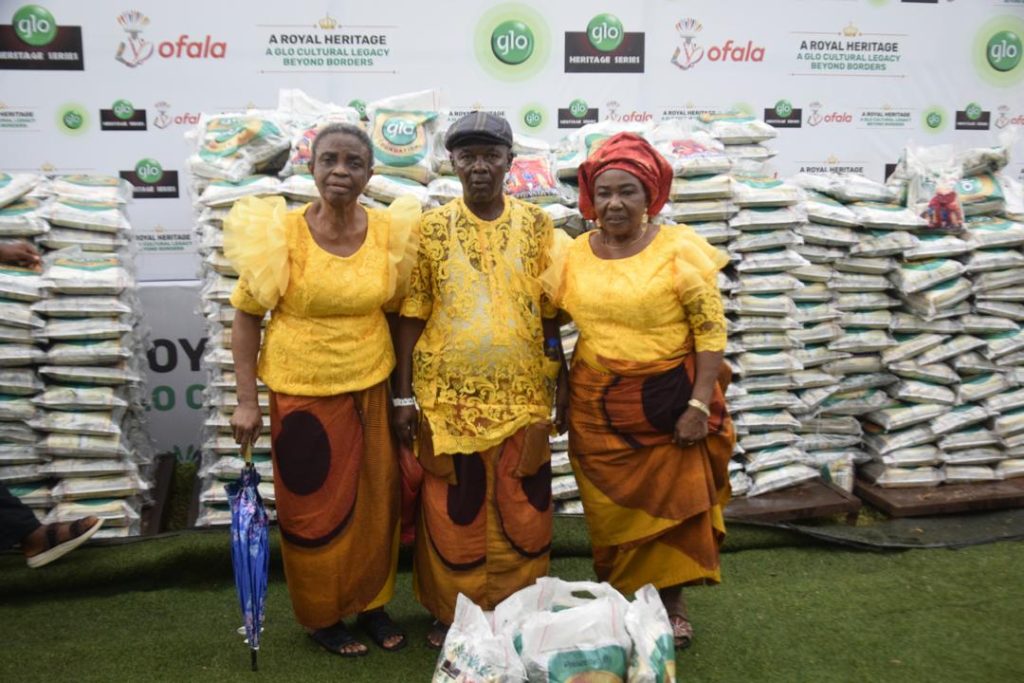
Globacom also used the occasion to celebrate the competitive spirit, discipline and community pride demonstrated by the various Onitsha age grades during the festival by rewarding those who won the different competitions with cash prizes and trophies. It also presented hundreds of bags of special Basmati rice to all the members of the different age grade associations.

The company’s continued association with the Ofala celebration demonstrates how private-sector investment can help traditional institutions preserve heritage, while expanding the social and economic values of cultural events.
-
 General News2 weeks ago
Rivers 2027: We are not part of Rainbow Coalition – APC Legacy Group slams Wike, Fubara meeting
-
General News1 month ago
JOHESU demands: MHWUN puts FG on notice over fresh action
-

 Politics1 month ago
2027: ASAF backs APC governors, rejects rainbow coalition
-

 Politics2 months ago
You have demonstrated diligence, loyalty, statesmanship in leadership, Ekechi salutes Shetimma at 60
-

 Politics2 months ago
2027: Advertising experts raise concerns over irregular regulation of sector
-
FCT News2 months ago
2027: Hasana-Moneme pledges skills, empowerment, credit access for FCT women
-
General News3 months ago
2027: Dame Princess Esom-Nwafor Orizu confirmed as APC flagbearer for Nnewi North /South /Ekwusigo Federal Constituency as INEC releases names of candidates
-
Uncategorized4 months ago
Rescue of Oyo schoolchilden: Tinubu commends security agencies, says action breakthrough in fight against criminality