
General News
Nigeria’s development bleeds as illicit financial flows thrive- ANEEJ


Our Reporter
Nigeria’s development continues to suffer massive setbacks as illicit financial flows, corruption, tax evasion, procurement fraud and other forms of financial crimes divert resources meant for infrastructure, education, healthcare, job creation and improved living standards, the Africa Network for Environment and Economic Justice (ANEEJ) has warned.
The Executive Director of ANEEJ, Rev. David Ugolor, raised the alarm in Uyo, Akwa Ibom State, at a two-day training workshop for journalists and civil society organisations (CSOs) on combating illicit financial flows (IFFs).
The workshop, organised by a coalition of non-governmental organisations led by ANEEJ, with support from the European Union (EU) and SeCFin Africa, a France-based organisation, is themed “Strengthening CSOs and Media Capacity to Contribute to the Fight Against Illicit Financial Flows (IFFs).”
Ugolor said IFFs remained one of the most persistent obstacles to Nigeria’s economic development, noting that billions of naira that should be deployed to improve public services and lift communities out of poverty were continually lost through illegal and fraudulent financial practices.
He identified corruption, money laundering, tax evasion, trade misinvoicing, procurement fraud, profit shifting and other illicit practices as major channels through which resources were diverted from productive use.
“The scale of these losses on a yearly basis should trouble everyone of us, because the burden falls hardest on the ordinary citizens,” he said.
According to him, resources that should have expanded public services and lifted communities out of poverty were instead diverted from national and state development priorities.
He said the consequences were evident in weaker public institutions, declining trust in government, widening inequality and worsening insecurity.
Ugolor cited the troubled Benin-Sapele-Warri road project as an example of the consequences of alleged financial mismanagement and weak accountability in public infrastructure projects.
He alleged that the contractor handling the project had abandoned the road after reportedly receiving N140 billion, lamenting that the development had subjected Nigerians to untold hardship.
“The Benin-Sapele-Warri failed road project has caused untold hardship to Nigerians. This is a clear case of illicit financial flows as the people continue to suffer,” he said.
The ANEEJ chief noted that Nigeria had established several legal, policy and institutional mechanisms to tackle financial crimes, including the Economic and Financial Crimes Commission (EFCC), Independent Corrupt Practices and Other Related Offences Commission (ICPC), Nigeria Financial Intelligence Unit (NFIU), Code of Conduct Bureau and Bureau of Public Procurement.
He, however, regretted that illicit financial practices continued despite the existence of these institutions and legal frameworks.
According to him, the persistence of IFFs demonstrates that laws and government agencies alone cannot effectively tackle the problem without active citizen engagement, civil society vigilance and informed public scrutiny.
Ugolor consequently charged journalists to strengthen their capacity to investigate financial crimes and expose illicit financial networks, stressing that the media had a critical role to play in holding powerful individuals and institutions accountable.
He said the nature of illicit financial flows was becoming increasingly sophisticated, requiring journalists to understand beneficial ownership, money-laundering typologies, digital and cross-border transactions, international financial networks and data-driven investigative techniques.
“Your responsibility goes beyond reporting events as they happen. It includes helping ordinary citizens make sense of issues that shape their lives, digging beneath the surface to uncover further details and illicit transactions, and amplifying voices that would otherwise go unheard,” he said.
He urged participants to use the knowledge acquired at the workshop to produce evidence-based and credible investigations capable of driving transparency, accountability and policy reforms.
Also speaking, Operations Coordinator of the SeCFin Africa Project, Philippe Pacaud, warned that illicit financial flows posed not only an economic threat but also a security risk.
Pacaud said some illicit funds from Nigeria and other African countries were being used to finance terrorism and other criminal activities.
“It is known to us that illicit funds flows are used to sponsor terrorism and we must tackle it immediately,” he said.
Representing the EFCC, the Head of its Corporate Affairs Department, Theresa Nwosu, stressed the need for stronger synergy and coordination among anti-corruption agencies, CSOs and the media.
Nwosu said greater collaboration was necessary to effectively identify, investigate and disrupt illicit financial activities.
In a presentation titled “Understanding Illicit Financial Flows and Financial Crimes in Nigeria,” the SecFin Africa Programme Representative, Prof. Abdullahi Shehu, defined IFFs as cross-border movements of funds that are illegally earned, transferred, owned or utilised.
He said such financial outflows were often facilitated by weaknesses in law enforcement, institutional coordination and accountability systems, resulting in the loss of public resources and erosion of state capacity.
Shehu identified three major characteristics of IFFs as the illegality of the source or origin of funds, illegality of their movement or transfer, and illegality of their ownership or use.
He also distinguished IFFs from money laundering, explaining that while money laundering involves proceeds that are illegal, IFFs can also involve funds that were legally earned but subsequently moved or used illegally.
Shehu said combating IFFs was a collective responsibility necessary for strengthening democracy, good governance and sustainable development.
He called for stronger anti-money laundering and counter-financing of terrorism frameworks, improved compliance, effective customer due diligence and Know Your Customer procedures, expanded monitoring of suspicious transactions and tougher penalties for financial crimes.
He also urged government to improve transparency in public finance by publishing budgets, procurement contracts and expenditure records.
Other measures recommended included transparent electronic procurement systems, regular audits of government agencies and stronger oversight by legislative and anti-corruption institutions.
On taxation, Shehu advocated the digitisation of tax collection systems, stronger transfer-pricing regulations for multinational corporations and improved information sharing between tax authorities and financial institutions.
He stressed that the objective should not simply be to increase taxes but to reduce tax-related illicit financial flows and opportunities for evasion.
The professor further urged government agencies to deploy artificial intelligence and data analytics to identify unusual transactions, integrate databases across institutions and monitor cross-border financial movements in real time.
He also advocated expansion of digital payment systems capable of leaving auditable records.
Shehu said tackling illicit financial flows required a coordinated response involving government institutions, the media, CSOs, citizens and international partners.
He warned that without sustained and holistic action, Nigeria and other African countries would continue to lose valuable resources to illicit financial practices while grappling with poverty, insecurity, weak infrastructure and underdevelopment.

By Our Reporter
Governor Monday Okpebholo of Edo State says he will sign the death warrants of the four kidnappers recently sentenced to death by the state’s Special Criminal Court.
The governor, however, said the death warrant would be signed if the kidnappers fail to appeal within 30 days.
Okpebholo stated this while recounting his administration’s efforts to tackle kidnapping, cultism and other criminal activities at the God’s People Worldwide Prayer Ministry, Ekpoma, on Friday.
DAILY POST recalls that the criminals were sentenced to death by an Edo State Special Criminal Court on September 29, over the abduction of a woman at the vegetable market along Airport Road, Benin.
The governor said insecurity was a major concern when he assumed office and he decided to prioritise tackling it after raising the issue with President Bola Tinubu, who urged him to go ahead.
“When the kidnappers attacked the vegetable market area, I told the commissioner of police that I wanted them arrested without delay ,” he said.
The governor said the suspects had been sentenced to death and expressed hope that they would not appeal the judgment.
“If within 30 days they don’t appeal, I will execute,” he added.

By Our Reporter
The Ebonyi State Government has sealed the Jimoh Guest House in Abakaliki, the state capital.
The action followed an operation that led to the arrest of more than 30 persons, while substances suspected to be hard drugs, were also recovered.
The operation was jointly conducted by security operatives, a task force from the state Ministry of Internal Security, and the Ministry of Capital City and Urban Planning.
It was part of efforts to address perceived illegal activities going on in the Guest House, and enforce urban planning regulations in the capital city.
The facility was also sealed over security concerns, and alleged use of a building for Guest House without the necessary approvals from relevant government authorities.
The Ebonyi State Commissioner for Capital City and Urban Planning, Richard Idike told journalists during the operation that there was concern over reported illegal activities at the premises.
He said the decision was taken to protect residents and maintain public safety.
The commissioner explained that the inspection was part of efforts of the state government to ensure that buildings within the state capital complied with approved development plans, and were used for purposes authorised by the relevant authorities.
He explained that substances suspected to be hard drugs, including materials allegedly identified as ‘Colos’ and Indian hemp, were recovered during the operation.
Iidike said, “the suspected substances were handed over to security operatives for further investigation, while the individuals arrested during the exercise were taken into police custody for questioning.
“The state government is determined to prevent the use of unapproved hotel at buildings for activities that could compromise public safety, security and the orderly development of the state capital.”
The commissioner urged property developers, landlords and property owners to obtain necessary approvals from the Ministry of Capital City and Urban Planning before commencing construction or converting existing buildings to other uses.
He noted that the government would continue to enforce relevant regulations and to take appropriate actions against property owners who failed to comply with established building and urban planning requirements.
He further ordered the indefinite sealing of the Guest House pending clarification of the circumstances surrounding it, including outstanding regulatory issues.
Meanwhile, the owner of the guest house whose name has remained anonymous, was also directed to report to the ministry for questioning, and possible clarification of the allegations.
In a remark, the Commissioner for Internal Security, Etta Uka Ude, reaffirmed the commitment of the state government towards the protection of lives and property of residents of the state, and the maintenance of law and order across Ebonyi State.
The Commissioner warned that the state government would not tolerate business premises being used as havens for criminal activities or becoming potential threats to the safety and security of residents.
Ude said the administration of Governor Francis Nwifuru was6 determined to sustain peace and security across the state, adding that security agencies had been encouraged to strengthen surveillance and monitoring of establishments suspected of engaging in unlawful activities.
He also called for greater cooperation among government ministries, security agencies, property owners and members of the public, to identify and address potential security threats before they escalate.
At the time of this report, the identities of the arrested suspects, and the outcome of police investigations had not been made public, while the owner of the guest house was still unknown.

By Ikenna Okoli
Globacom on Wednesday drew the curtain on the 2026 Ofala Festival with a Royal Banquet in honour of the Obi of Onitsha, Igwe Alfred Nnaemeka Achebe, Agbogidi.
The elegant event, which was attended by the monarch, cabinet chiefs, Glo trade partners and high net-worth customers, marked the grand finale of the festival sponsored by the telecommunications and digital solutions company

Mike Ehumadu, Globacom’s Divisional Head, South East, said that, by hosting the event, the company underscored the enduring value of partnerships between corporate organizations and traditional institutions in sustaining the country’s cultural legacy.
He congratulated Igwe Achebe, the Ofala Festival organizing committee and the people of Onitsha on the successful celebration of this year’s event, and restated the company’s commitment to initiatives that celebrate Nigeria’s cultural diversity, strengthen community bonds and project the nation’s rich heritage to the world.
The evening was a rich blend of culture, music and comedy, with guests treated to performances by Aniweta Mazeli, Boy o Boy and the Groove Band, while comedian MC Ezegetive brought laughter and excitement to the gathering. Their stagecraft complemented the grandeur of the occasion, and created memorable moments for the royal household, community leaders and other guests.
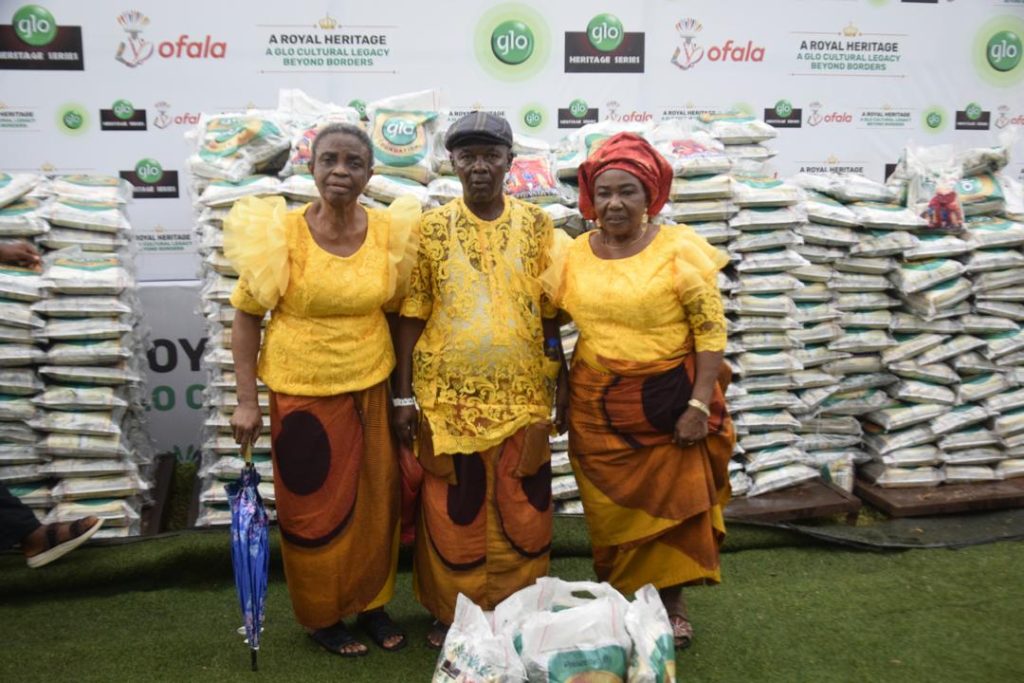
Globacom also used the occasion to celebrate the competitive spirit, discipline and community pride demonstrated by the various Onitsha age grades during the festival by rewarding those who won the different competitions with cash prizes and trophies. It also presented hundreds of bags of special Basmati rice to all the members of the different age grade associations.

The company’s continued association with the Ofala celebration demonstrates how private-sector investment can help traditional institutions preserve heritage, while expanding the social and economic values of cultural events.
-
 General News2 weeks ago
Rivers 2027: We are not part of Rainbow Coalition – APC Legacy Group slams Wike, Fubara meeting
-
General News1 month ago
JOHESU demands: MHWUN puts FG on notice over fresh action
-

 Politics1 month ago
2027: ASAF backs APC governors, rejects rainbow coalition
-

 Politics2 months ago
You have demonstrated diligence, loyalty, statesmanship in leadership, Ekechi salutes Shetimma at 60
-

 Politics2 months ago
2027: Advertising experts raise concerns over irregular regulation of sector
-
FCT News2 months ago
2027: Hasana-Moneme pledges skills, empowerment, credit access for FCT women
-
General News3 months ago
2027: Dame Princess Esom-Nwafor Orizu confirmed as APC flagbearer for Nnewi North /South /Ekwusigo Federal Constituency as INEC releases names of candidates
-
Uncategorized4 months ago
Rescue of Oyo schoolchilden: Tinubu commends security agencies, says action breakthrough in fight against criminality