
Main cover
Petrol price hits N1,450 in FCT, N1,500 in S’east

*** No plans to revisit subsidy removal policy, Presidency insists
By Sam Otuonye (With agency report)
The pump price of Premium Motor Spirit (PMS), popularly known as petrol, is nearing N1,500 per litre in the nation’s capital as rising global crude oil prices and higher logistics costs continue to put pressure on the downstream petroleum market.
The latest development followed an N85 per litre increase in the gantry price of petrol by Dangote Petroleum Refinery, from N1,265 to N1,350, effective September 12, 2026.
DISCLOSURE News survey showed that as of Sunday, most filling stations in Lagos were dispensing petrol between N1,400 and N1,430 per litre, while in Abuja, pump prices ranged from N1,400 to N1,450 per litre.
In the South east, check by our correspondents in Owerri , Awka and Enugu, reviewed that both the NNPCL and MRS, an outlet of Dangote refinery have adjusted their pump prices to N1420, while other independent marketers are selling between 1450 to N1500
This is as the Presidency has maintained that it has no plans to revisit the petrol subsidy removal policy, despite the debate that greeted the campaign pledge by the opposition African Democratic Congress (ADC), and it’s presidential candidate, Atiku Abubarkar, that it would return subsidy, if elected president in the 2027 general election
Special Assistant to the president on Information and Strategy, Bayo Onanuga, said on Sunday that the call by former Vice-President Atiku Abubakar to bring back fuel subsidy will undermine the reforms already undertaken in the petroleum sector.
According to the Presidency, it will also create legal and fiscal complications, and potentially discourage investment in domestic refining, including the Dangote Refinery and other modular refineries.
The adjustment marks another increase in domestic fuel prices, which have risen sharply from around N830 per litre before the Middle East crisis earlier this year to over N1,300 in many parts of the country.
The latest price movement follows a surge in international crude oil prices, with Brent crude climbing above $100 per barrel and reaching $107 per barrel on Thursday.
According to oilprice.com, Brent crude traded at $104.61 per barrel as of Sunday, more than 50% higher than levels recorded before the escalation of tensions in the Middle East.
Prior to the crisis that began on February 28, crude oil traded below $69 per barrel. However, disruptions to global supply chains and concerns over reduced oil flows through the Strait of Hormuz have pushed prices significantly higher, increasing costs across global energy markets.
The rise in crude prices has translated into higher costs for domestic refiners and fuel importers, prompting fresh adjustments to petrol prices across Nigeria.
The latest increase has triggered concerns among consumers, many of whom fear petrol prices could rise further in the coming days.
In July, Dangote Refinery stated that its pricing model was not directly tied to daily fluctuations in international crude oil prices, explaining why retail fuel prices do not immediately decline when global oil benchmarks fall.
The refinery said crude oil is often purchased weeks or months before processing under commercial supply contracts linked primarily to monthly average pricing mechanisms.
According to the company, this procurement structure means changes in international oil prices are not instantly reflected in local fuel prices.
This is as there are heightened fears that prices could hit between N1500 to N1600 per litre in northern cities such as Kano, Kaduna and Jos, depending on product availability, transportation costs and supply routes.
The National Publicity Secretary of the Independent Petroleum Marketers Association of Nigeria (IPMAN), Chinedu Ukadike, said marketers had been forced to review their pump prices following successive adjustments by Dangote Refinery.
According to him, the frequent changes were creating uncertainty for marketers and consumers because the cost of replacing products could change within a short period.
The latest increase represents the fourth upward adjustment to Dangote Refinery’s petrol gantry price since August 21.
Onanuga, who described Atiku’s move as retrogressive, fiscally unsustainable and a product of “desperation to win the presidency,” said that Nigeria’s petroleum landscape had changed fundamentally since President Bola Tinubu announced the removal of petrol subsidy.
Atiku, who had also supported the removal of petrol subsidy during the 2023 campaigns, has. however, made the restoration of petrol subsidy a major part of his 2027 campaign, arguing that Nigerians have not seen sufficient benefits from the subsidy removal.
The former vice president alleged that the funds generated from the subsidy removal had not translated to food on the table of Nigerians as well as impacted on their lives.
On the oil and gas sector, he said that a new intervention should be designed around domestic refining, with support capped, budgeted and tied to verifiable production and consumer benefits.
According to him, every barrel of crude allocated under his proposal will be targeted and tracked to ensure that Nigerians benefit from the intervention.
Atiku said that his proposal was not a return to the opaque subsidy regime of the past, but a controlled mechanism that would support Nigerian refineries while ensuring that the benefits of cheaper crude feedstock were transmitted to consumers.

General News
Independence Anniversary: Workers expect wage increase, reduction in petrol price, others, says Union
***Reaffirms Sept. 30 ultimatum, strike threat
By Sam Otuonye
As President Bola Tinubu gets set to address Nigerians on Thursday, October 1, to commemorate the country’s 66th year of Independence, the Nigerian public servants have listed wage increase and reduction in the price of Premium Motor Spirit ( PMS), otherwise known as petrol as the things expected to dominate the speech and make them renege on their earlier threat of embarking on a strike action.
Nigerian public servants under the aegis of Joint National Public Service Negotiating Council (JNPSNC), which made the declaration in a statement on Tuesday, reaffirmed their September 30, 2026 ultimatum to the federal government over the rising cost of petrol as well as their demand for a wage award and the commencement of negotiations for a new national minimum wage.
The workers union, which issued a three-day warning strike notice to the Federal Government, beginning October 2, said they would have no other option than to commence their warned strike action, if the government fails to slash the price of petrol, announce a wage award and introduce other measures to cushion the crushing hardship in the country.
The statement, which listed members of the JNPSNC to include the Nigerian Civil Service Union (NCSU); Medical and Health Workers Union (M&HWU); Association of Senior Civil Servants of Nigeria (ASCSN); and National Association of Nigerian Nurses and Midwives (NANNM), Amalgamated Union of Public Corporations, Civil Service Technical and Recreational Employees (AUPCTRE); Nigeria Union of Public Service, Reportorial, Secretarial, Data Processors and Allied Workers (NUPSRAW); National Union of Printing, Publishing and Paper Products Workers (NUPPPPROW); and National Union of Agriculture and Allied Employees (NUAAE), said it had mobilised public servants across the country for a three-day warning strike if the Federal Government failed to address the issues raised in its letter to President Bola Tinubu before the deadline.
The union in its statement, signed by the National Secretary of the JNPSNC and General Secretary of the Nigeria Civil Service Union, Olowoyo Gbenga, noted that it had earlier written to President Bola Tinubu on September 21, demanding that the price of petrol be slashed to N500, the immediate announcement of a wage award and the beginning of negotiations for not less than N500,000 minimum wage from 2027, among others.
The statement warned that if the president fails to address the unions demands during the Independence anniversary speech, “public servants nationwide would commence a three-day warning strike beginning October 2, 2026”, stressing that the concerns of Nigerian workers should no longer be ignored.
According to the statement, “the three critical issues requiring urgent attention are as follows: reduction of fuel price to N500 per litre. The Federal Government should take urgent steps to bring down the price of Premium Motor Spirit (PMS) to N500 per litre.
“This can be achieved through the provision of an intervention fund to address landing costs and support oil and gas operators.
“It is equally important for the Federal Government to ensure the sale of crude oil to the Dangote Refinery and operators of modular refineries at appropriate terms in order to facilitate increased domestic refining and help bring down the price of petroleum products.
“The current price of PMS, ranging from N1,450 to N2,000 and, in some locations outside major communities and cities, as high as N2,500 per litre, is unacceptable to Nigerian workers.
“The Council maintains that the economic hardship occasioned by the high cost of fuel is placing the survival of Nigerian workers, their dependants and the general populace under severe pressure, making it increasingly difficult for Nigerians to live normal and dignified lives.
Continuing, the union demanded that “the federal government should urgently approve a wage award for Nigerian workers to cushion the effects of the prevailing harsh economic conditions being experienced by workers, their dependants, and vulnerable Nigerians.
“The Council believes that urgent action on this demand will further enable public servants to consolidate their loyalty, commitment and productivity within the public service ecosystem.
“The Federal Government should urgently establish a tripartite committee to commence and facilitate negotiations for the new National Minimum Wage expected to become due in 2027.
“The Nigerian workers’ demand for the immediate constitution of the committee is informed by the need to avoid any administrative or procedural delay that could affect the implementation of the new National Minimum Wage once it is eventually negotiated and passed into law by the National Assembly.
“Consequently, the Council states that failure by the Federal Government to take the necessary steps to address these issues on or before 30th September 2026 will leave Nigerian workers with no option but to commence a three-day warning strike, with effect from Friday, 2nd October 2026, to press home their demands.
“It is imperative to state clearly that the Independence Day address of the president of the Federal Republic of Nigeria should adequately address these critical issues.
“Failure to address the concerns raised by the Council, will attract the displeasure of Nigerian workers and their dependants, as well as other vulnerable Nigerians who continue to bear the brunt of the prevailing economic hardship,” the union warned
From Lawrence Davids (Lagos)
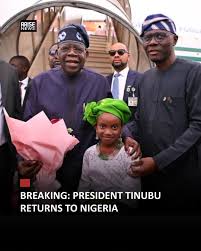
President Bola Tinubu returned to the country, Tuesday evening, after a four- week working vacation in Europe, declaring himself healthy, sound and ready to go.
The President arrived at the Presidential Wing of the Murtala Muhammed International Airport, Ikeja, where he was received by Lagos State Governor Babajide Sanwo-Olu and other dignitaries.
Responding to journalists about his health condition, the President said he remained fit and prepared to continue his duties.
“Rumours will always be emanate from politics. I am hale and strong. I am ready to work. The fact remains that I am here, healthy, sound and ready to go,” Tinubu said.
Tinubu had left Abuja on August 30 for the working vacation, spending one week in London before travelling to Paris, where he spent additional one three weeks.
According to a statement issued on Tuesday by the President’s Special Adviser on Information and Strategy, Bayo Onanuga, Tinubu departed Paris for Lagos, where he is expected to hold strategic meetings with political leaders and associates.
“While in Lagos, President Tinubu will also hold strategic meetings with political leaders and associates over several days in preparation for the 2027 elections,” the statement read.
The Presidency said Tinubu chose to travel to Lagos first to honour the memory of the late Chief MKO Abiola, winner of the June 1993 presidential election and a prominent figure in Nigeria’s democratic struggle.
“On October 1, Independence Day, the President would attend the premiere of a movie honouring Abiola at the Wole Soyinka National Theatre, Iganmu, Lagos,” the statement added.
The President had departed Nigeria on August 30 for London before travelling to Paris, with the Presidency describing the trip as a working vacation. He later extended his stay by a few days before returning to Nigeria on Tuesday.
The President is expected to remain in Lagos for the 66th Independence Anniversary celebrations.
He is scheduled to attend official engagements in the state, including activities marking Nigeria’s independence on October 1, before returning to Abuja.
*** Another N1.63 trillion missing public funds
*** Says magnitude of findings requires urgent, independent, transparent action
By Chidera Orji
The Socio-Economic Rights and Accountability Project, SERAP, has given the Central Bank of Nigeria, CBN, seven days to account for $6.23 million election money and over N1.63 trillion missing public funds.
SERAP made the demand in a letter dated September 26, 2026, signed by its Deputy Director, Kolawole Oluwadare.
According to SERAP, the Auditor-General’s 2023 report published on August 7, 2026, exposed the missing funds.
SERAP listed the funds as N1.25 trillion unrecovered intervention loans given to state governments; N116.18 billion loans to distressed and liquidated banks; N262.86 billion shared under Anchor Borrowers Programme; and $6.23 million payment linked to alleged election funding request said to be made by former President Muhammadu Buhari.
SERAP asked the CBN governor, Olayemi Cardoso, and the apex bank to explain how over N1.25 trillion intervention loans given to states and N116.18 billion loans to distressed banks disappeared, and to publish names of those who collected the money and how they plan to recover it.
The group also told CBN to give full details of the N262.86 billion shared under Anchor Borrowers Programme, including names of beneficiaries, how much each person got, how the money was used and how CBN wants to recover it.
On the $6.23 million election money, SERAP asked Cardoso and CBN to explain how the money was spent after an alleged request by former President Buhari, and to publish a report of internal investigation, who is responsible and how the money will be recovered.
“The accountability of public institutions, including the CBN, is a crucial pillar of Nigeria’s constitutional democracy.
“The magnitude and nature of these findings require urgent, independent and transparent action, as they raise fundamental questions about the custody, expenditure, accounting, safeguarding and recovery of public resources,” parts of the letter read.
-
General News2 weeks ago
JOHESU demands: MHWUN puts FG on notice over fresh action
-
 Politics3 weeks ago
2027: ASAF backs APC governors, rejects rainbow coalition
-

 Politics1 month ago
You have demonstrated diligence, loyalty, statesmanship in leadership, Ekechi salutes Shetimma at 60
-

 Politics2 months ago
2027: Advertising experts raise concerns over irregular regulation of sector
-
FCT News2 months ago
2027: Hasana-Moneme pledges skills, empowerment, credit access for FCT women
-
General News2 months ago
2027: Dame Princess Esom-Nwafor Orizu confirmed as APC flagbearer for Nnewi North /South /Ekwusigo Federal Constituency as INEC releases names of candidates
-
Uncategorized3 months ago
Rescue of Oyo schoolchilden: Tinubu commends security agencies, says action breakthrough in fight against criminality
-
General News1 month ago
Chi-Jenco CEO, Jude Orji loses mother