
General News
UN chief Guterres, calls for end to U.S-Iran conflict

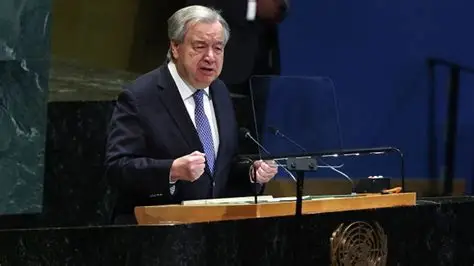
UN Secretary-General António Guterres, on Tuesday, called for an end to the United States-Iran war and the toll it has taken on global trade, as he began an official visit to Pakistan.
Guterres made the call at a joint press conference with Pakistani Deputy Prime Minister Mohammad Dar at the Ministry of Foreign Affairs in Pakistan’s capital city, Islamabad.
Guterres is in Pakistan on a two-day visit.
“From Islamabad, I want to send a loud and clear message to all parties.
“End the conflict. Return to diplomacy. Fully restore navigational rights and freedoms in accordance with international law,’’ he said.
The crisis began in late February following joint U.S.-Israeli strikes on Iran.
In response, Tehran launched retaliatory attacks on targets in Gulf countries and Jordan, and blocked transit through the Strait of Hormuz chokepoint.
The maritime corridor is critical for global trade in crude oil, fertilisers, and liquefied natural gas. Hundreds of ships and their crews have been stuck at sea for months.
Meanwhile, fighting has spread to Yemen’s Red Sea coast where Iran-backed Houthi forces are battling Government troops, supported by Saudi Arabia, for control of the crucial Bab al-Mandab Strait.
The secretary-general saluted Pakistan for its leadership in helping to create the conditions for dialogue between the U.S. and Iran.
“Your efforts helped deliver the June 17 Islamabad Memorandum of Understanding, the subsequent ceasefire, and the framework for further negotiations,” he said, adding that “every Pakistani should be proud of that pivotal role.”
Addressing wider issues, Guterres said that “there will never be peace in the region until the right of self-determination of the Palestinian people is fully realised – as Pakistan has long championed”
He expressed hope for regional peace and prosperity, “anchored in dialogue and cooperation.”
The secretary-general praised Pakistan for being “a source of solidarity and solutions.”
For decades, the country has sheltered millions of Afghans fleeing conflict and instability, and he underlined the UN’s commitment to work with Pakistan to ensure that returns are voluntary, safe, and dignified.
He recalled that Pakistan has been a member of the UN Security Council for the past two years.
“At a time of growing division and mistrust around the world, Pakistan values multilateralism, dialogue, mediation, and diplomacy,” he said.
Guterres added that Pakistan is also among the world’s longstanding and largest contributors to UN peacekeeping. He paid tribute to the more than 180 Pakistani blue helmets who “gave their lives in the service of peace.”
Pakistan and Denmark also took the lead on UN Security Council resolution 2,823, which strengthens accountability for crimes against UN peacekeepers.
He noted that 153 countries co-sponsored the document, making it “the largest number of co-sponsors for a Security Council resolution in United Nations history.”
The secretary-general also acknowledged the “immense suffering” Pakistan has endured due to deadly terrorist attacks.
Guterres concluded by addressing the climate crisis, recalling that his last visit to Pakistan came during the catastrophic floods in 2022.
“Pakistan is on the frontlines of climate chaos despite contributing only a tiny fraction of global emissions,” he said, but “it is also on the frontlines of the response.”
He pointed to the country’s leadership in establishing the Loss and Damage Fund and its growing need for clean energy transition.
The UN chief used the occasion to reiterate the call for developed countries to take the lead in ensuring a “drastic reduction” in global emissions this decade. (NAN).


Minister of Works and former Ebonyi State Governor, David Umahi, has dismissed the presidential ambition of former Anambra State Governor, Peter Obi, insisting that the South-East has no consensus presidential candidate ahead of the 2027 general elections.
Umahi described Obi as “nobody”, questioning his political superiority over other prominent Igbo leaders, including himself, former Senate President Anyim Pius Anyim, former Minister of Education Sam Egwu and former Chairman of the Revenue Mobilisation, Allocation and Fiscal Commission, Chief Elias Mbam.
The minister urged South-East residents to support President Bola Tinubu’s re-election bid in 2027, arguing that such support would strengthen the region’s chances of producing a Nigerian president when its turn comes.
He made the remarks on Sunday in Abakaliki during a town hall meeting organised by the Directorate of Infrastructure, Mobilisation and Sensitisation of the All Progressives Congress Presidential Campaign Council.
Umahi also appealed to religious and traditional leaders in the region to openly support Tinubu rather than remain politically neutral.
Addressing the gathering, he said, “I want to tell our religious leaders and Christian Association of Nigeria (CAN), do not stay on the fence. I know when I was struggling to be Governor, CAN took a decision and said justice must prevail. CAN, don’t keep quiet; let us toe the path that must sustain our freedom.
“There is no way an Igbo man, after staying for 60 years, will want to be President for four years. There is nobody that can accept that. The North has not accepted to be President for four years. Somebody was telling me that Atiku’s son bought buses and donated to President Bola Ahmed Tinubu and said this is a personal donation.
“Igbo man needs wisdom, not sentiments. Igbo man should not allow people to be dishing hate speeches on social media on their behalf. Today, our people in commerce, we clear our goods with ease. Today, our roads are being revived in the path of economic activities. Today, we can boldly say we have been integrated. The last time they were choosing service chiefs, it was the Naval Chief. This time, it is Chief of Air Staff, Minister of Works, other Ministers, SSAs, what else? When I say South-East have been fully integrated and included, I mean it.
“My mouth will not shut up because I am telling our people for a reference for tomorrow. We are supporting President Bola Ahmed Tinubu to finish his remaining four years so that the South-East would have strategically supported another region. So that when it is our turn, we will not get this thing by hate speeches; they will not give to us by sentiments. If strategic leaders of the South-East say this, you will now insult them.
“You insult anybody who is not supporting Peter Obi. Anybody who is not supporting Peter Obi is a saboteur; you insult the person. Who is Peter Obi better than? Who is he better than? Is he better than Sam Egwu? Is he better than Elias Mbam? Is he better than the Lion of the South-East, myself? Is he better than Anyim Pius? Who is better than?
“So, I don’t want us to be deceiving ourselves. We don’t have any presidential candidate in the South-East. We have people who are vying; Ebonyi has a right to make a choice. Traditional fathers, do not stay on the fence; religious leaders, do not stay on the fence. Our people in the North do not; our people in the South-West, they do not. Guide our people, let them know what,” the minister stated.
Umahi further declared his readiness to mobilise 1.3 million votes for Tinubu and Ebonyi State Governor Francis Nwifuru in the 2027 elections.
He said he would not allow opposition parties to take control of the state, describing as unrealistic the expectations of those seeking to unseat Nwifuru.
The minister, who put Ebonyi’s registered voters at 1.8 million, said the state would be doing itself a disservice if it failed to deliver the projected votes for the President and the governor.
He said, “We have 1.8 million registered voters in Ebonyi State. Let me tell you, if we are not donating 1.3 million votes for the President, for the Governor, we are doing ourselves a disservice.”
(PUNCH
Feature
kidnapping, unsafe roads others reasons for staying away from Nigeria – US-based Nigerian healthcare worker

By Chidera Orji
As the country grabbles with so many socio-economic problems, a United States-based Nigerian Mrs Nkechi Eze (née Nzelu), has identified insecurity as one of the major reasons many Nigerians who are based outside the country are unwilling to return home, adding that the fear of kidnapping, violent attacks and unsafe roads makes visiting home increasingly difficult.
Nkechi, who is practicing healthcare professional in USA, stated this when she spoke with some selected journalists via zoom, said although she personally remains emotionally connected to Nigeria and wishes to reunite with family members, the safety of her children and other loved ones remains her foremost consideration whenever she contemplates travelling home.
She said that her concern goes beyond the possibility of being attacked, stressing the need to be confident that she and her family could travel safely, move around freely and access emergency assistance if anything went wrong.
According to her, staying away from Nigeria does not diminish her love for the country but reflects her responsibility to protect her family from avoidable risks.
As a healthcare professional, Mrs Nkechi Eze expressed particular concern over the growing threats to the lives of medical personnel, noting that health workers should not have to risk kidnapping or death while carrying out their duties.
She observed that insecurity affects healthcare delivery at several levels, as patients may be unable to travel to hospitals at night, medical personnel may struggle to reach their workplaces, and ambulances may avoid dangerous routes.
She warned that such disruptions could have serious consequences for pregnant women experiencing emergencies, accident victims and patients requiring urgent referrals to better-equipped medical facilities.
Eze also noted that financial constraints, transportation difficulties and delays in identifying hospitals capable of providing appropriate treatment could further worsen emergencies in an already challenging environment.
On what would make her reconsider visiting Nigeria, she said sustainable improvements in security, safer roads, effective emergency response systems and credible investigations into criminal activities would be necessary.
She maintained that assurances of safety must be backed by verifiable improvements in the specific communities and locations people intend to visit.
Speaking on banditry, kidnapping and farmer-herder conflicts, Eze said the challenges reflect the need for stronger protection of ordinary citizens, urging authorities to identify and prosecute individuals responsible for criminal activities rather than unfairly blaming entire ethnic or occupational groups.
She called for improved intelligence gathering, stronger collaboration among security agencies, better-equipped and properly supervised local policing structures, as well as efficient investigations and judicial processes.
She also advocated preventive measures, including education, employment opportunities and fair mechanisms for resolving disputes, while emphasizing the importance of respecting human rights to build public confidence in security institutions.
Comparing her experience in the United States with the situation in Nigeria, Eze acknowledged that the US was not free from crime but said the predictability of its security and emergency response systems gave residents greater confidence to plan their daily activities.
She said Nigerians deserved an environment where people could go to work, visit relatives and seek medical attention without living under constant fear or depending on private security arrangements.
On healthcare administration, she highlighted the US emergency care system, where hospitals are required to screen and stabilize patients experiencing medical emergencies regardless of their immediate ability to pay.
She clarified that this does not mean emergency treatment is entirely free, but stressed that urgent medical attention should not be delayed while patients or their relatives search for money.
Turning to Nigeria’s electoral process, Eze said her experience voting in the United States had exposed her to an organized system characterised by voter privacy, clear procedures and mechanisms for verifying election results.
She explained that although voting methods differ across US states, the processes generally provide for identification, private voting, verification and audits to strengthen confidence in the outcome.
While acknowledging the efforts of hardworking electoral officials and citizens in Nigeria, she expressed concern over allegations of electoral violence and manipulation, saying such issues must be addressed through transparent processes and evidence-based investigations.
She, however, cautioned against treating every allegation of electoral malpractice as an established fact, insisting that institutions must make relevant evidence accessible and clearly explain disputed outcomes to the public.
Eze argued that credible elections could contribute to improved governance by giving citizens the opportunity to reward or remove political leaders through the ballot.
However, she stressed that elections alone would not resolve insecurity or reverse the migration of skilled professionals, adding that sustainable progress would also require effective governance, responsible public spending, enforcement of laws and improved working conditions for professionals.
On diaspora voting, she supported extending voting rights to Nigerians living abroad, provided adequate safeguards were introduced to ensure credible registration, proper identity verification, prevent multiple voting and guarantee transparent counting.
She nevertheless maintained that strengthening the credibility and security of votes cast within Nigeria should remain an immediate priority.
Eze said the effectiveness of Nigeria’s security response should ultimately be measured by practical outcomes, including whether farmers could safely return to their farmlands, nurses could work night shifts without fear and victims of kidnapping could receive prompt and professional responses from security agencies.
She maintained that Nigerians deserved dependable public institutions capable of protecting lives, safeguarding livelihoods and restoring confidence in the country’s future.

*** Urges people experiencing symptoms associated with Ebola to seek immediate medical attention
By our reporter
The Nigeria Centre for Disease Control and Prevention (NCDC) has ruled out Ebola Virus Disease (EVD) in two individuals suspected of having the infection in Yola, Adamawa State, after two rounds of laboratory testing returned negative results.
Jide Idris, NCDC Director-General, who disclosed this in a statement, added that there is currently no laboratory-confirmed Ebola case in Adamawa.
The suspected cases were reported to the Adamawa State Public Health Emergency Operations Centre in the early hours of October 30, 2026, after two individuals presented with symptoms requiring further investigation.
According to Idris, the individuals were isolated and appropriate public health measures initiated while samples were collected for laboratory analysis.
“Fortunately, the samples turned out negative for EVD after two rounds of testing,” he said.
Idris said the NCDC was working closely with the Adamawa State Government, through the State Ministry of Health and Human Services, to investigate the report and strengthen response operations.
He commended the state government for its prompt response, particularly the efforts of the Commissioner for Health and his team.
“At this juncture, I wish to commend the efforts of the Adamawa State’s Commissioner for Health and his team for their proactive approach,” the NCDC director-general said.
He added that the agency would continue to provide technical support to the state government to strengthen its response and ensure effective monitoring of the situation.
Idris clarified that the index case previously confirmed in the Federal Capital Territory (FCT) remained the only laboratory-confirmed Ebola case reported in Nigeria.
He urged Nigerians to remain calm and avoid spreading unverified information or speculation about the suspected cases.
“We urge members of the public to remain calm and avoid sharing unverified information or speculation about the situation,” he said, advising the public to rely on official government and public health communication channels for accurate information.
The NCDC boss also urged people experiencing symptoms associated with Ebola, including fever, severe weakness, headache, muscle pain, vomiting, diarrhoea or unexplained bleeding, to seek immediate medical attention, particularly if they had a relevant exposure history.
He advised individuals to inform healthcare workers about any relevant travel or contact history, avoid self-medication and follow professional medical advice.
Ebola Virus Disease is a serious infectious disease that requires early detection, prompt clinical management and effective infection prevention and control measures.
Idris said the NCDC, in collaboration with the Adamawa State Government and other relevant stakeholders, would continue to monitor the situation and provide updates as verified information became available.
He reaffirmed the commitment of public health authorities to protecting Nigerians through early detection, evidence-based interventions, transparent communication and a coordinated national response.
-

 General News3 weeks ago
Rivers 2027: We are not part of Rainbow Coalition – APC Legacy Group slams Wike, Fubara meeting
-
General News1 month ago
JOHESU demands: MHWUN puts FG on notice over fresh action
-

 Politics1 month ago
2027: ASAF backs APC governors, rejects rainbow coalition
-

 Politics2 months ago
You have demonstrated diligence, loyalty, statesmanship in leadership, Ekechi salutes Shetimma at 60
-

 Politics3 months ago
2027: Advertising experts raise concerns over irregular regulation of sector
-
FCT News3 months ago
2027: Hasana-Moneme pledges skills, empowerment, credit access for FCT women
-
General News3 months ago
2027: Dame Princess Esom-Nwafor Orizu confirmed as APC flagbearer for Nnewi North /South /Ekwusigo Federal Constituency as INEC releases names of candidates
-
Uncategorized4 months ago
Rescue of Oyo schoolchilden: Tinubu commends security agencies, says action breakthrough in fight against criminality