
Cover page
Insecurity: EU pledges €20million defence support to Nigeria


*** FG refutes W’Bank’s 124% interest payment on revenue
By Sam Otuonye
Nigeria’s defence ministry has revealed that the European Union (EU) has pledged a €20 million defence support to the country’s Armed Forces, under the European Peace Facility (EPF)
The pledge comes as Nigeria seeks to strengthen its military operations against terrorists and other security threats across the country
The EU proposed assistance, according to a statement issued at the weekend, was discussed when the Minister of Defence, General Christopher Musa (Rtd), met with the EU Ambassador to Nigeria and the Economic Community of West African States (ECOWAS), Gautier Mignot, at Ship House in Abuja.
The statement, which was issued by Special Assistant to the Minister of Defence on Media, Leah Katung-Babatunde, noted that the meeting focused on key bilateral defence agreements and a review of security cooperation between Nigeria and the EU.
According to the statement, Mignot commended Musa’s efforts to improve the country’s security situation and invited him to a meeting of defence ministers scheduled to hold in Brussels later in the year.
It added that discussions also centred on arrangements for the EU’s €20 million assistance package to the Nigerian military under the EPF.
The ambassador, she said, disclosed that an EU technical delegation would visit Nigeria in November to agree on the details of the proposed support.
Musa thanked the EU for its continued support for Nigeria and reaffirmed President Bola Tinubu’s commitment to protecting lives and promoting national development.
The minister said relative peace was gradually returning to some troubled parts of the country through the efforts of the armed forces and other security agencies.
He, however, identified kidnapping along major highways and attacks on isolated communities as persistent security challenges.
Musa also disclosed that Nigeria was expecting the delivery of 10 attack helicopters, unmanned aerial vehicles (UAVs) and other military equipment to strengthen security operations.
On regional security, the minister identified the shrinking of the Lake Chad Basin, which supports more than 50 million people, as a factor contributing to instability in the region.
He said denying terrorists access to holding areas on islands in Lake Chad remained a key operational priority for the Multinational Joint Task Force (MNJTF), which coordinates regional efforts against insurgency.
On the disarmament, demobilisation and reintegration (DDR) programme, Musa said the initiative would prioritise victims of the conflict, including military personnel affected by the fighting.
This is as the Federal Government has disputed claims that its interest payments reached 124% of revenue in the first half of 2026, arguing that the figure presents an incomplete picture of its fiscal position because it excludes some government revenue and combines debt obligations across different tiers of government.
The Federal Ministry of Finance, in a press statement issued on Sunday, October 18, said the ratio cited in recent analysis based on the World Bank’s October 2026 Nigeria Development Update was misleading because it compared federal interest payments with an incomplete revenue base.
The ministry said the interest figure includes debt serviced by the Federal Government on behalf of other tiers of government, including external loans to states, while the revenue figure excludes independent revenue earned by government agencies and enterprises but not yet remitted to the Treasury.
FG also argued that federal revenue typically increases in the second half of the year because of the statutory timing of certain tax payments, making a half year comparison an unreliable measure of the government’s overall debt sustainability.
“The reported revenue is also incomplete. It excludes independent revenue already earned by government agencies and enterprises but not yet remitted to the Treasury. In addition, more revenue is typically earned in the second half of the year than in the first due to the statutory timing of certain tax payments.
“This is why the ratio stood at 156% in H1 2025, while the full-year 2025 debt-service-to-revenue ratio was below 60%, down from 97% before the reforms.
“This is a clear sign of the progress delivered by the current administration’s reforms,” the Ministry stated.
The ministry said federal revenue increased by 72% year on year to N6.2 trillion in the first half of 2026, compared with N3.6 trillion in the same period of 2025.
Interest payments, meanwhile, rose by 38% to N7.7 trillion from N5.6 trillion over the same period.
The difference between interest payments and revenue consequently narrowed to N1.5 trillion from N2 trillion a year earlier, according to the ministry.
It said the figures showed that revenue was growing almost twice as fast as interest costs, contributing to a 32 percentage point decline in the interest to revenue ratio.
In its 2026 Nigeria Development Update (NDU) titled ‘Beyond the Federal Purse: How Higher Revenues Reshaped State Priorities,’ the World Bank said Nigeria’s interest payments rose to N7.7 trillion in the first half of 2026, from N5.6 trillion in the corresponding period of 2025.
According to the bank, the interest payment gulped 124.19 percent of the federal government revenue.
The bank said interest payments increased to 3.1 percent of gross domestic product (GDP) from 2.5 percent a year earlier.
However, the Finance Ministry argued that debt sustainability should be assessed using full year figures rather than a six month snapshot.
It cited the World Bank’s projection that Nigeria’s total debt service, covering both interest and principal repayments, would amount to 46% of revenue in 2026.
The ministry described this as a more appropriate benchmark for assessing the government’s debt servicing position, distinguishing it from the 124% ratio based on interest payments and revenue in the first half of the year.
The ministry also cited the decline in the full year debt service to revenue ratio to below 60% in 2025, compared with 156% in the first half of that year and 97% before the current administration’s reforms.
It attributed the improvement to the government’s fiscal reforms and the stronger revenue performance recorded since their implementation.
The concern with the World Bank’s claims came as the government says Nigeria is beginning to change how it is perceived internationally, pointing to its tax overhaul and broader economic reforms as evidence that the country is moving towards sustainable growth and shared prosperity.
Minister of Finance and Coordinating Minister of the Economy, Taiwo Oyedele, said this as he explained his “Nigeria rising” narrative at the 2026 IMF-World Bank Meetings in Thailand.
According to him, the Nigeria Rising narrative was designed to communicate the changes taking place in the country and challenge perceptions that do not reflect the government’s assessment of its economic progress.
Speaking at the closing press briefing of the Meetingss in Bangkok, Thailand, Oyedele said he observed growing interest in Nigeria among international stakeholders during the meetings, which he attributed to the country’s ongoing reform programme.

***Says nobody can pretend life is easy at the moment
***Launches 2027-2031 political roadmap, “From Reforms to Prosperity”
By Sam Otuonye
The federal government on Tuesday,
admitted that Nigerians are currently facing bitting economic hardship, despite President Bola Tinubu’s intervention policies.
Chief of Staff to the president and former Speaker of the House of Representatives, Femi Gbajabiamila, admitted that nobody should pretend that life is easy at the moment in the country, even as he noted the impact of the federal government’s economic reforms.
The Chief of Staff, who made the admittance during the unveiling of the administration’s 2027–2031 electoral roadmap, titled, “From Reforms to Prosperity Agenda”. however, defended the policies of the Tinubu administration.
He explained that the president feels the people’s plight, adding that he deliberately chose to govern as a statesman rather than a politician by confronting longstanding economic challenges despite the immediate political consequences.
Gbajabiamila emphasised that President Tinubu’s decision to remove the petrol subsidy and unify the foreign exchange market was informed by the need to address structural weaknesses in the economy and secure the country’s long-term economic future, even as he acknowledged that the policies had placed considerable pressure on households.
Describing the president as a statesmen who make decisions based on the long-term interests of the country, the former House of Representatives Speaker argued that Tinubu had the option of maintaining existing economic policies to avoid immediate public backlash but instead chose to confront the country’s economic distortions.
“Now, those decisions have placed real pressure on households. We must speak honestly about that experience because the people living through it deserve to be heard. And nobody should have to pretend that life is easy at the moment.
“If he came in as a politician and decided to govern as a politician, he would have continued on the cruise, on the path that we were taking.
“But instead, knowing full well the immediate consequences, he decided he would govern as a leader,” he said.
He added that the ultimate justification for the reforms would be their ability to translate structural economic improvements into better living conditions for ordinary Nigerians.
Gbajabiamila described the administration’s new electoral roadmap as an ambitious document reflecting Tinubu’s political philosophy and commitment to long-term national development, adding that it’s objective was to build an economy where hard work guarantees a decent livelihood and every Nigerian has a fair opportunity to succeed.
“At the heart of this manifesto is my abiding conviction that every Nigerian should be able to share. Your country should give your best efforts a fair chance.
“A manifesto, in its strictest sense, is simply a contract between the people and the leader,” Gbajabiamila said.
He listed interventions in human capital development, social protection, taxation and electricity as evidence of president Tinubu’s efforts to expand economic opportunities.
He added that initiatives such as N-Power and the student loan scheme are designed to improve access to opportunities and ease the financial burden on young Nigerians.
He said the ruling party must be prepared to account for its performance and convince voters through its achievements rather than relying on political rhetoric.
“The party asking to continue in government must be prepared to answer the people whose mandate it seeks.
“We must earn support through the quality of work, through the quality of our case and the seriousness of our conduct,” he said, adding that the 2027 general election would offer Nigerians an opportunity to decide whether to sustain the administration’s reform agenda or return to what he described as short-term political approaches.
INEC under fire as Wike, Betara splash billions at APC councilors, candidates
***It’s not vote-buying, APC, Wike defend N10m offer to deliver Tinubu
***Stakeholders demand probe, accuse INEC of paying lip service
By Nkem Okereh and Okoromadu Buddy Okoromadu (Maiduguri)
The Independent National Electoral Commission (INEC) has come under fire over its alleged lip service attitude and inactivity towards the monitoring of election campaign funding and spendings ahead of the 2027 general election.
This is as stakeholders have criticise the recent pronouncements of N10 million offered to councillors of the six area councils in the Federal Capital Territory (FCT) by the FCT Minister, Nyesom Wike, to deliver President Bola Tinubu in the 2027 general election, as well as the monetary gift of N1billion to all candidates of the All Progressives Congress (APC) in Borno State by House of Representatives member, Hon. Muktar Betata.
The FCT minister had, while addressing stakeholders, traditional leaders, and political actors in Kwali Area Council on Monday, pledged to mobilise the councilors with N10 million each to deliver their various political wards to the president.
Wike said the initiative was part of a broad grassroots mobilisation strategy designed to rally maximum support at the grassroots level.
He said, ‘For the councillors, you have a task. I will hold a meeting with you again, and I will now say the way I am going to mobilise you, but I will give you a bet, like what is happening in the stars; it’s a competition.
“Anybody who delivers his ward, if you deliver your ward, that is what the Rainbow Coalition has decided to do as mobilisation and support for Mr President; we have to start in the FCT (I couldn’t say so when the president came because they gave me only two minutes to talk). But now that I have time to talk, let me say that the Rainbow Coalition all over the federation, as a form of mobilisation for Mr President to win this election, is saying that any councillor that delivers his ward will come and take N10 million. We want to mobilise for Mr President. So, go to your wards, and go and see your leaders. I know only you cannot do it, but we are using you as an instrumentality for your leaders. Go and meet your leaders and say, ‘Look, oh, there is something that has come.’ We must not allow this thing to go. Let’s dedicate our ward for Mr President’. So, that is for that.”
In a similar development a ranking member of the House of Representatives, Muktar Betara Aliyu, on Sunday, announced N1.06 billion in financial support for All Progressives Congress (APC) candidates contesting national and state assembly seats in Borno State.
Betara, who has represented Biu/Bayo/Shani/Kwaya Kusar Federal Constituency since 2007, said the support would also cover serving lawmakers who lost their bids during the party primaries.
He announced the package in Maiduguri during the inauguration of the Borno State APC Campaign Council.
According to him, 10 APC candidates and outgoing members of the House of Representatives would receive N50 million each, amounting to N500 million.
He further announced that 28 APC candidates and outgoing members of the Borno State House of Assembly would receive N20 million each, bringing the total support for the state legislators and candidates to N560 million.
Betara said the financial support was aimed at strengthening the party’s structures and mobilising grassroots support for its candidates.
“We can’t win elections from elsewhere. We should go back to our people at the grassroots, seek their forgiveness, and canvass support for our party candidates from the presidency down to the state assembly,” he stated
The financial supports have, however, raised concerns over the capability of INEC to monitor and take actions in on political parties and their candidates campaign spendings.
Stakeholders have warned that uncontrolled excessive use of campaign funding could deeply kill, monitise and influence the 2027 general election, leaving it on into the hands of the highest bidders.
While several Civil Society Organisations (CSOs), a social crusader, Isaac Fayose has come hard at the FCT Minister, describing his N10 million offer to councillor as promoting vote buying. Several analyst have similarly taken a swipe at the Borno House of Representatives member, even as they question the source of the financial largesse to APC candidates.
Fayose, had in a video posted on his Facebook page, blasted the Minister of the Federal Capital over the N10 million offer to FCT councillors to deliver for President Bola Tinubu in the 2027 election, describing it as vote buying.
He described the development as unacceptable, adding that the money was not given for development but to buy loyalty and to make the councillors work for Tinubu ahead of the election.
“Offering N10 million to FCT Councillors to deliver for Tinubu is vote buying,” he said.
He regretted that rather than using money to fix FCT Area Council roads, water, and schools, the minister preferred to share the people’s common wealth among politicians for his interest.
Fayose said Wike should focus on his work as FCT Minister and leave vote buying, adding that Nigerians are watching and they will not be fooled by money.
Also faulting Betara’s gifts, a political analyst, Dr Lawan Cheri, said the N1.06 billion support package raised questions about the source of the lawmaker’s wealth, arguing that the amount was far beyond the cumulative legitimate salary and allowances of a parliamentarian.
He told journalists: “I don’t see any fault in people asking the fundamental question of: Where did he get the money from? And what are the implications of that on the fight against corruption?
“People will try to recoup what they invested, and this will result in failing to provide the services needed by communities,” he said.
He emphasised that politicians must not see campaign spending and donations as financial investments that could be recovered after assuming public office, either directly or through the use of political influence.
Cheri said failure by the Independent National Electoral Commission (INEC) to monitor and regulate such spending could have wider implications for governance beyond elections.
“If INEC is not controlling such spending, it will have implications on governance itself, not only politics, because it will be viewed as a political investment,” he said.
But both the FCT minister and the National chairman of the ruling All Progressives Congress (APC) have shrugged off criticisms about the donations.
Wike, while defending his actions said he never asked councillors to buy votes with the N10 million he promised those who deliver their wards in the 2027 general election.
He made the clarification on Tuesday during an inspection of ongoing infrastructure projects in Abuja, declaring that the promise was an incentive for hard work and not an attempt to buy votes.
Wike who argued that rewarding political commitment does not amount to offering money to voters in exchange for their support, said the councillors were challenged to prove their commitment through effective mobilisation.
To make his case, he pointed to athletes who are promised houses or other benefits if they return from international competitions with trophies. He asked why a similar reward in politics should automatically be read as bribery.
He also faulted sections of the media for failing to tell legitimate rewards apart from vote-buying. Political parties and candidates, he argued, routinely spend money on campaign advertisements without facing the same scrutiny.Follow Politics.
The minister, who further differentiated between a financial inducement meant to sway voters and rewards promised to political mobilisers for hitting set targets, insisted that mobilisation should rest on commitment
“I didn’t tell them, ‘Take this money and go and buy votes.’ I said, ‘Go and work. Show commitment. Demonstrate that you really mean what you are talking about. When you win, come, and we are going to reward you,” he said.
Also, national chairman of the All Progressives Congress, Nentawe Yilwatda, defended the N10 million reward promised by the Minister of the Federal Capital Territory, Nyesom Wike, to councillors to deliver their wards for President Bola Tinubu and other APC candidates
Professor Yilwatda, who spoke on Channels Television’s Politics Today, on Monday, said the money was intended to motivate councillors and would be paid after the election, once the result had been established.
“He was speaking to the FCT councillors in the forum, and I’m sure it’s addressing something about 62 or 60-something councillors in the FCT.
“Which political party doesn’t release money for mobilisation? Which political party? So, tell me one. No, it’s not for votes. The same reward for you to deliver Tinubu in your ward,” he queried.
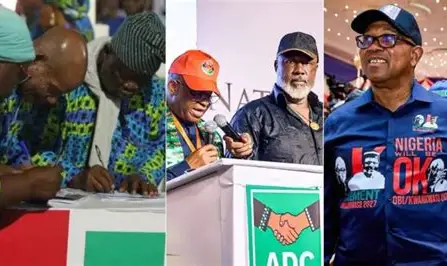
** Voting Tinubu a religious obligation, Jigawa assembly speaker charges residents
*** ‘Obi’ chants greet Reps’ Deputy Speaker, Kalu, at Abia cultural festival
*** OK Movement demands probe as police confirm one dead, five injured in NDC rally attack in Delta
By Our Correspondents
The battle for votes among political parties ahead of the 2027 general election has received different reactions across the country, as the candidates intensify efforts to woo electorate using both religious, ethnic and other methods.
For example, residents of Jigawa State have been to told that they have a religious obligation to fulfil in voting the incumbent president and candidate of the ruling All Progressives Congress (APC), Bola Tinubu’s, who is of the same Islamic faith with them.
Speaker of the Jigawa State House of Assembly, Haruna Dangyatin, declared that, it is compulsory for the state residents to vote for Tinubu in the election because he is a fellow muslim.
The Speaker, who made the declaration on Saturday during the inauguration of the All Progressives Congress (APC) presidential and governorship campaign council in Dutse, cited Tinubu’s Muslim faith, his Muslim running mate and what he described as the President’s support for the North as reasons residents should vote for him.
It was however a different scenario at Abia State, where the Deputy Speaker of the House of Representatives, Benjamin Kalu, faced a crowd embarrassment, as the teeming crowd that graced a cultural festival kept chanting Obi! Obi! Obi, when he was speaking.
The Jigawa assembly Speaker, who took turn to role out President Tinubu’s benevolence and support to northern Nigeria, recalled the president’s role in facilitating the emergence of late former President Muhammadu Buhari, saying the North should reciprocate the support.
He said, “Tinubu is our fellow Muslim and a leader who has the interest of Jigawa State at heart. That is why we must vote for him and support the APC at all levels.”
The Speaker expressed confidence in the APC’s strength, citing the presence of former governors, senators, and federal lawmakers at the campaign council inauguration as major advantage in winning the state for the president and the APC
He said the turnout demonstrated the party’s broad support across the state.
Dangyatin, who also coordinates the City Boy Movement in Jigawa, said the group would intensify grassroots mobilisation ahead of the elections.
He disclosed that members of the movement would embark on house-to-house campaigns to promote the activities of Tinubu and Jigawa State Governor Umar Namadi.
“We will take the City Boy Movement across Jigawa, going from house to house to tell the people what President Bola Ahmed Tinubu and our governor are doing,” he said.
In Abia, the Deputy Speaker of the House of Representatives, Benjamin Kalu, was greeted with a vociferous crowd, chanting Obi! Obi, as he mounted the podium, trying to use the Item Okpi cultural festival occasion to canvass support for President Bola Tinubu in Abia State, as captured in a viral trending video on social media
The chant was a reaction that greeted Kalu as he addressed the gathering and appealed to the people to support Tinubu’s re-election bid.
However, Peter Obi, who is the presidential candidate of the Nigeria Democratic Congress (NDC), was not present at the occasion.
Kalu told the crowd that “President Tinubu has remembered us. He has remembered the South East. He has remembered Bende. The only way to say thank you is to vote him for a second time,.”
But the Deputy Speaker’s:appeal was interrupted by repeated and thunderous chants of “Obi kererenke” and boos from members of the crowd which almost turned the event into a rival political campaign, as the supporters of President Tinubu, led by the Deputy Speaker, responded with chant of “on your mandate we shall stand,” which is associated with the APC presidential candidate.
In another development, the Obi/
(OK) Movement has demanded for an immediate investigation into the alleged attack on Nigerian Democratic Congress (NDC) supporters during their One Million-Man March in Asaba, Delta State capital.
Delta state Coordinator of the Movement, Favour Emerue, made the demand at a news conference on Saturday, where he called for the arrest and prosecution of those responsible, including their alleged sponsors and financiers.
Emerue alleged that armed hoodlums disrupted the peaceful procession, attacking participants with sticks, knives, machetes and other dangerous weapons, adding that several supporters sustained varying degrees of injuries and were receiving medical attention in hospitals across Delta.
He described the incident as an assault on democratic participation and citizens’ constitutional rights to freedom of assembly and association.
The OK Movement coordinator accused the perpetrators as NDC political opponents in Delta state, who were frightened and unsettled by the massive turnout of the party’s supporters from Delta’s 25 local government areas of the state
He called on Gov. Sheriff Oborevwori to order a comprehensive, transparent and impartial investigation into the incident, while calling on the Inspector-General of Police, Department of State Services (DSS) and other security agencies to apprehend the perpetrators
Emerue, who urged security agencies to guarantee the safety of political actors and ensure campaigns were conducted without intimidation, further appealed to the international community to monitor developments and support efforts to protect democratic participation in Nigeria.
He emphasised that every political party deserved the freedom to mobilise supporters and participate in democratic activities without intimidation.
This is as the Delta State Police Command has confirmed the death of one person and five others injured as violence marred a political rally organised by the Obedient/OK Movement in support of the presidential candidate of the Nigeria Democratic Congress (NDC), Peter Obi, in Delta State.
The police said in a statement on Sunday that it had launched an investigation into the violent incident which happened during the rally at the weekend
He said the organisers were briefed on the identified security threats and advised against holding an open road procession
The Delta state Police Command Publication c Relation Officer, SP Bright Edafe, said in the statement issued on Sunday, that it had received intelligence reports indicating the likelihood of violence before the rally and consequently invited the organisers to a security meeting
Edafe added that they were also encouraged to conduct their political activities at a designated venue where adequate security arrangements could be provided.
“However, the organisers allegedly ignored the advice and proceeded with the road procession, leading to a violent incident along Nnebisi Road, Asaba, which resulted in the death of a victim whose identity was yet to be ascertained.” the command said
According to the police, upon receiving a distress call, officers were mobilised to the scene and took the injured victims to the hospital for medical attention, while security was reinforced in the area to prevent further breakdown of law and order.
The statement noted further that the State Commissioner of Police, CP Samuel Erale, condemned the violence and reiterated that political parties were free to conduct lawful campaigns and other political activities.
He, however, advised political parties and their supporters to avoid road processions in the interest of public safety and liaise with the police ahead of political gatherings to ensure adequate security arrangements.
He assured residents of the command’s commitment to a thorough and impartial investigation, urging anyone with useful information to contact the command.
-
 General News1 month ago
Rivers 2027: We are not part of Rainbow Coalition – APC Legacy Group slams Wike, Fubara meeting
-
 Politics2 months ago
2027: ASAF backs APC governors, rejects rainbow coalition
-
General News2 months ago
JOHESU demands: MHWUN puts FG on notice over fresh action
-

 Politics2 months ago
You have demonstrated diligence, loyalty, statesmanship in leadership, Ekechi salutes Shetimma at 60
-

 Politics3 months ago
2027: Advertising experts raise concerns over irregular regulation of sector
-
FCT News3 months ago
2027: Hasana-Moneme pledges skills, empowerment, credit access for FCT women
-
General News3 months ago
2027: Dame Princess Esom-Nwafor Orizu confirmed as APC flagbearer for Nnewi North /South /Ekwusigo Federal Constituency as INEC releases names of candidates
-
Uncategorized4 months ago
Rescue of Oyo schoolchilden: Tinubu commends security agencies, says action breakthrough in fight against criminality