
Feature
North west Compass with Abubarki Ibrahim

*SITUATION REPORT: THE POLITICAL SITUATION IN KATSINA STATE –
Katsina, the home state of late President Muhammadu Buhari, has entered a critical phase ahead of the February 6, 2027 governorship election.
While Governor Dikko Umaru Radda (APC) has secured his party’s ticket by consensus and inaugurated the Tinubu/Dikko 2027 Campaign Council, the state is witnessing an unprecedented internal APC battle and a resurgent opposition led by ADC.
Unlike Kaduna where APC dominance is consolidating, Katsina is a case of dominance under stress.
*PRESENT SITUATION*
The Ruling APC – Strength on Paper, Cracks Within:
*Consolidation:* Governor Radda was affirmed by 2,872 delegates at People’s Square, Government House. All 34 members of the State House of Assembly and National Assembly members from Katsina led by Sada Soli Jibia have endorsed him for second term. INEC has listed him with Deputy Gov. Faruk Lawal as running mate.
*Campaign Structure:*
On October 17, 2026, he inaugurated the Tinubu/Dikko Campaign Council chaired by himself, with Deputy Gov. Faruk Lawal as Co-Chair, Sen. Hadi Sirika as Co-Chair II, and Arc. Ahmed Musa Dangiwa as Director-General.
Campaign kick-off is fixed for October 28.
Former Governors Aminu Masari and Ibrahim Shema are listed as Grand Patrons.
Former Gov. Masari donated N160m to ward-level mobilizers.
*The Internal Rift:*
The biggest challenge is not opposition, but a rift between Radda’s camp and the camp of *Ibrahim Kabir Masari, Special Adviser to President Tinubu on Political Affairs* (the Abuja-Katsina camp). Within days (Oct 5-6), five key appointees resigned: Commander-General Hisbah, Dr. Abu Ammar, his Deputy Muhammad Shitu Maslaha, Chairman Pilgrims Board Kabir Bature, SSA on Project Monitoring Fadila Dalhatu, and SA on Youth Development Abubakar Soja Tsanni. Sources link them to Masari’s camp.
The rift escalated when Radda’s ADC, SP Abdulganiyu Bello, and CSO, DSP Hassan Bello, were quizzed by police in Abuja over destruction of billboards bearing Masari and Tinubu along Modoji Junction Road.
The governor himself recently warned politicians to “deliver your wards to Tinubu or face consequences” and asked for forgiveness, signaling anxiety.
The Opposition – ADC as Main Challenger:
Sen. Ahmad Babba Kaita (Katsina North) is governorship candidate with Aminu Yar’Adua as deputy. The party unveiled a 141,107-member structure across 34 LGAs for Atiku Abubakar’s presidential bid.
Kaita is campaigning on insecurity, poverty and bad governance, calling 2027 a chance to “vote out bad leaders” as Katsina marks 39 years of creation.
However, ADC faces a legitimacy crisis: A rival, Salisu Uli, has challenged Kaita’s nomination in court, claiming no valid primary was held on the stipulated date.
INEC listed Kaita, but court hearing is set for October 19.
Former SSG Mustapha Inuwa also left ADC in August.
Regional Compact:*
Kaita joined 6 other North-West ADC candidates (led by Abubakar Malami) to sign the North-West Compact 2027-2031, pledging N110,000 minimum wage, reintroduction of fuel subsidy, and a technology-enabled surveillance network across 21 senatorial districts.
They cited alarming data: over 16,000 lives lost to insecurity between June 2023-Aug 2026, 1,583 kidnappings, and 533,000 hectares of farmland abandoned in Zamfara and Katsina alone.
PDP:
Garba Yakubu Lado is INEC-listed candidate.
PDP remains relevant because it won Katsina in the 2023 presidential election despite losing governorship.
Wike’s backing for Tinubu complicates its 2027 outlook.
WHO HAS THE UPPER HAND?
Technically, APC still has the upper hand* due to control of government, LGA structures, and federal alignment. But *psychologically, the upper hand is contested:*
In Kaduna, APC’s challenge is *external opposition* . In Katsina, APC’s challenge is *internal civil war*
If the Radda-Masari rift is not contained, it could split votes at ward level, as Masari controls significant grassroots network from Daura and beyond.
ADC’s 141k structure is real, but its ability to convert anger over banditry and hunger into votes depends on whether it resolves its court case and presents a united front.
Katsina voters are less concerned with billboard dominance and more with: _Can I go to my farm? Can my child go to school?_ 45% of Nigeria’s out-of-school children are in North-West.
HOW TO CONTAIN OR SUBDUE TENSION
*For APC Leadership:*
*Immediate reconciliation meeting* between Gov. Radda and Ibrahim Masari brokered by former Govs. Masari and Shema and President Tinubu.
The public quarrel over billboards and Hisbah resignations must stop.
Stop threats of “consequences” for non-delivery of wards; instead, encourage forgiveness as the governor himself preached.
Unify campaign council — include all three zonal directors (Katsina South – Bature Masari, North – Gwajo-Gwajo, Central – Prof. Charanchi) in decision-making.
*For Opposition:*
ADC must resolve Kaita vs Uli quickly through internal mechanism before court decides, or risk being disqualified.
Focus campaign on security solutions, not just criticism.
The North-West Compact is a good start but must be localized to Katsina’s 34 LGAs.
*For Security Agencies:*
Katsina has suffered more than most from banditry. Sustained military operations must continue in Batsari, Jibia, Kankara, Dutsin-Ma axis to allow farmers to return before dry season.
Police must remain neutral in APC intra-party dispute and not be used to harass either camp.
*For INEC and Traditional Institutions:*
Emir of Katsina and Emir of Daura should convene peace meeting of all candidates.
INEC should monitor premature vote-buying through the N160m ward donation.
*5. CONCLUSION*
Katsina’s politics has moved from “Buhari’s bloc vote” to “Radda vs The Rest Within APC.”
Governor Radda has the structures, but structures without unity cannot deliver.
The ADC has the message of insecurity and hardship, but message without unity cannot win.
Whoever contains his own internal crisis first will have the upper hand in February 2027.
Katsina, more than Kaduna, needs statesmanship now.

Feature
Christmas comes early for Ondo community as LG Electronics donates 21st solar-powered borehole
By Adagwa Unari
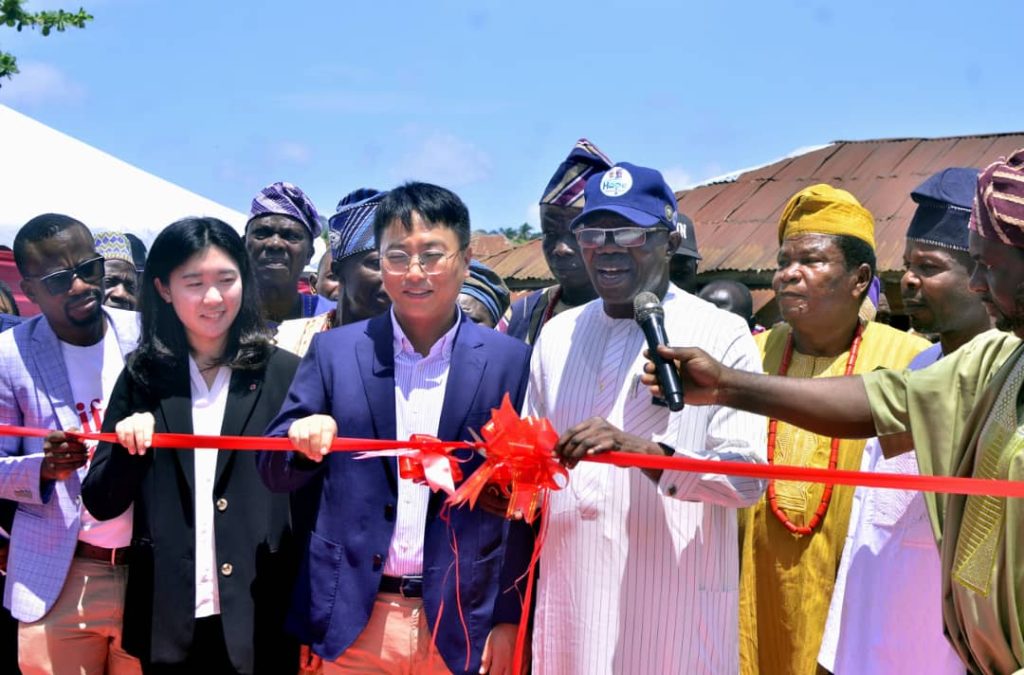
What began as a commitment to bring clean water closer to underserved communities has reached a significant milestone for LG Electronics with the commissioning of its 21st solar-powered borehole at Osan Agba, Oke Oka Akoko, Ondo State.
In Oke Oka Akoko, however, the significance of the intervention is not simply in the number. It is in what reliable access to water means in everyday life: less time spent searching for water, greater convenience for households, improved hygiene and a dependable resource that can serve the wider community.
The new facility extends LG Electronics’ community water initiative into another part of Nigeria, combining access to clean water with renewable energy infrastructure designed to operate independently of the national electricity grid. It also reflects the evolution of the company’s approach to corporate citizenship—from individual interventions to a growing footprint of sustainable community infrastructure built around identified local needs.
At the commissioning, the Akoko South West Local Government Chairman, Hon. Ayọ Ajana, said the intervention demonstrates the value of collaboration between the private sector and communities in addressing practical development needs.
“Water is fundamental to the well-being of every community, and this is the kind of intervention whose impact people can feel every day. What LG Electronics has done in Oke Oka Akoko complements the work of government and shows what responsible private-sector participation in community development can achieve. We welcome this investment, and our responsibility is to ensure that the community takes ownership of it and protects it for the generations that will come after us,” Ajana said.
Hon. Ologunbaba Ruben (Ṣóyọ), the Adedibu of Osan Àgbà Oka, described the facility as an intervention whose value would extend well beyond the commissioning ceremony.
“For us, this is more than the commissioning of a borehole. It is about meeting a need that touches our people every day. Families will use this water, our children will benefit from it, and the entire community has a responsibility to preserve what has been provided. We appreciate LG Electronics for looking beyond the major cities and recognising that communities such as ours also matter,” he said.
Chief Darusa Adedibu, Olugbedere of Igbedere, Osan Àgbà Oka, said the project underscores the importance of bringing development closer to the people.
“Development becomes meaningful when it reaches people where they live. Clean water touches health, hygiene, our homes and the general well-being of the community. We appreciate LG Electronics for bringing this project here. Our responsibility now is to protect it and ensure that it continues to serve everyone,” Adedibu said.
Hon. Ajulo Tayo, Chairman of Udẹ̀ Osan Àgbà Oka, also emphasised the everyday relevance of the project and the need for collective stewardship.
“There are projects people hear about, and there are projects they experience in their daily lives. Water belongs in the second category. This borehole will serve our people every day, and that makes it deeply relevant to this community. Our appreciation to LG Electronics must therefore be matched by our commitment to look after the facility and ensure that its benefits are shared responsibly,” Tayo said.
From One Community to Twenty One
The Oke Oka Akoko commissioning represents the 21st solar-powered borehole delivered by LG Electronics across communities in Nigeria, following the company’s 20th installation in Nariya Rigasa, Kaduna State. The growing programme reflects a deliberate effort to use sustainable technology to address a basic human need while reducing dependence on grid electricity.
For Mr. Hyoung Sub Ji, Managing Director, LG Electronics Nigeria, represented by Mr. Choongbae Seok, General Manager, Media Entertainment Solutions, TV Department, LG Electronics Nigeria, the milestone is significant because of the lives and communities represented by the number.
“Twenty-one communities is an important milestone for us, but the real story is not the number. It is the people behind those twenty-one communities and what reliable access to water can mean to their everyday lives. At LG, we believe innovation has its greatest value when people can feel its impact. Sometimes that is through the technology in their homes; at other times, it means applying technology and our resources to a fundamental need such as clean water,” Seok said.
He added: “The solar-powered model is particularly important because sustainability has been considered from the outset. We are not interested in infrastructure that works only on commissioning day. The objective is to create something relevant, practical and capable of continuing to serve the community. Oke Oka Akoko is another important chapter in that journey.”
By powering the facility with solar energy, LG brings together two dimensions of sustainable development: addressing a basic social need and using renewable energy to support long-term functionality. Just as importantly, the initiative places emphasis on community participation and stewardship, recognising that infrastructure delivers lasting value when the people it serves have a stake in sustaining it.
A borehole can be commissioned in a day. Its real value is measured in the years that follow. From its earlier interventions to Oke Oka Akoko, LG Electronics’ expanding clean-water footprint is turning individual CSR projects into a broader model of community investment where technology, sustainability and local participation meet.
For the people of Osan Agba, the measure is simpler: clean water is now closer to home.
Feature
From Import Dependence to Domestic Supply: PETROAN deepens engagement with indigenous refiners through strategic visit to Azikel Refinery

By Sam Otuonye
For most of its history as an oil-producing nation, Nigeria has lived with a paradox that is as costly as it is familiar: abundant crude at the wellhead, and a persistent reliance on foreign refineries to convert that crude into the fuels on which the economy runs.
The Petroleum Products Retail Outlets Owners Association of Nigeria (PETROAN) believes that paradox is now, at last, becoming solvable, and that retailers have both a commercial interest and a national responsibility in helping to solve it.
It is in this spirit that the National President of PETROAN, Dr. Billy Sotubo Gillis-Harry, led a delegation of the Association’s national executives on an official site inspection and commercial engagement with Azikel Refinery at Obunagha, Yenagoa, Bayelsa State.
The purpose of the engagement:
The visit forms part of PETROAN’s continuing programme of industry oversight and stakeholder engagement. Its objectives were threefold: to assess, at first hand, the state of emerging domestic refining capacity; to open a structured dialogue with an indigenous refiner on the practical terms of collaboration;and to identify commercially viable arrangements that can improve the availability, reliability and distribution of locally refined petroleum products to Nigerian consumers.
The delegation received a comprehensive presentation on the Azikel Refinery covering its development history, operational planning, refining capacity, product slate and the avenues open for partnership with the retail segment of the value chain.
Towards a structured offtake framework:
Central to the discussions was a proposed structured offtake arrangement under which PETROAN members would access petroleum products directly from the refinery on mutually agreed commercial, technical and operational terms.
The significance of such an arrangement should not be understated. Nigeria’s downstream sector has long been characterised by long and often opaque supply chains,in which the distance between the point of production and the retail forecourt is filled by intermediaries, uncertainty and cost.
A direct relationship between domestic refiners and organised retailers compresses that distance. It gives refiners a predictable, aggregated market for their output, and gives retailers a dependable source of supply insulated, to a meaningful degree, from the volatility of international product markets and foreign exchange. The beneficiary, ultimately, is the consumer.
The Azikel Refinery:
The Azikel Refinery has been re-engineered from its original design capacity of 12,000 barrels per day to a 25,000 barrels-per-day full-slate hydro-skimming facility,configured to process crude oil and condensate into Premium Motor Spirit, automotive gas oil, kerosene, aviation turbine fuel and liquefied petroleum gas. Recent reports indicate that the project has entered an advanced stage of construction and integration following the arrival and installation of its 200-tonne Crude Distillation Unit.
PETROAN regards the emergence of facilities of this kind as a structural, rather than incidental, development. Each additional domestic refinery broadens the national supply base, introduces competition among suppliers, and strengthens the resilience of a downstream sector that has, for too long, been exposed to shocks originating far beyond Nigeria’s borders.
Remarks by the National President:
Speaking during the engagement, Dr. Gillis-Harry reaffirmed PETROAN’s commitment to working with indigenous refiners in building a sustainable and commercially sound domestic petroleum products supply chain. He observed that the growth of local refining capacity presents Nigeria with a genuine and progressive pathway out of import dependence, one that must be pursued deliberately and on terms that are workable for all parties.
“As retailers, we want to build practical partnerships with indigenous refineries thatcanimproveproductavailability,strengthensupplychainsandcreategreatercertaintyfor businesses and consumers,” he said.
He emphasised that PETROAN’s objective is not merely to secure supply for its members, but to establish enduring commercial relationships that are equitable and beneficial to refiners and marketers alike.
Response from Azikel Group:
In his response, the President and Chief Executive Officer of Azikel Group, Dr. Eruani Azibapu Godbless, welcomed the delegation and affirmed the refinery’s readiness to build strategic relationships with petroleum products retailers as the facility advances towards commercial operations.
He underscored that collaboration between refiners and retail outlet owners is indispensable to efficient distribution and to securing market access for locally refined products.
Both parties agreed on the necessity of sustained engagement to resolve the commercial, technical and operational requirements on which the proposed offtake partnership will depend.
A broader strategy:
PETROAN wishes to make clear that its engagement with Azikel is one element of a wider strategy to deepen collaboration with indigenous refineries and with stakeholders across the entire downstream value chain.
The Association holds firmly to the view that Nigeria’s refining future must rest on multiple reliable sources of supply, on transparent market participation, and on constructive collaboration among refiners, marketers, regulators and all who have a stake in the sector’s health. Concentration of supply in any single source, however large, carries its own risks; diversity of supply is the surest guarantee of both competition and security.
As projects such as Azikel move from ambition to operation, PETROAN remains committed to supporting every credible initiative that expands domestic refining capacity, improves product availability, strengthens competition, and contributes to amore stable, sustainable and self-reliant petroleum products market for Nigeria.

How an alumnus of Federal Polytechnic Oko moved from engineering and entrepreneurship to philanthropy, human capital development and community service, writes Ijeoma Nwajiobi
There are moments in a person’s journey when an award is more than just an award. It becomes a pause, an opportunity to look back at the road travelled, the obstacles encountered, the people touched along the way, and the possibilities that lie ahead.
For Amb. Dr. Ikebunwa Fidelis Lotanna, Saturday, September 26, 2026, was one such moment. At a gathering that brought together generations of alumni, academics, public figures, professionals and friends of Federal Polytechnic Oko, Ikebunwa returned to the institution as more than a former student. He returned as a Polytechnic Star, and in the same breath, as an Oko Polymath.

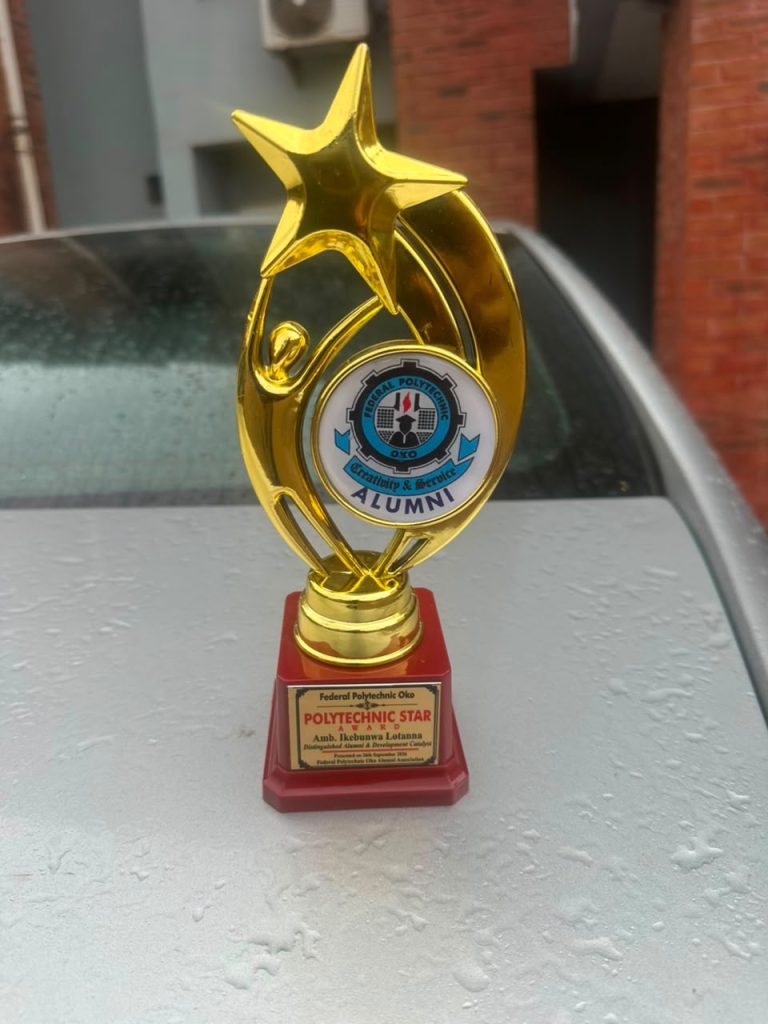
The Federal Polytechnic Oko Alumni Association, celebrating four decades of its existence, honoured him with the prestigious Polytechnic Star Award and inducted him into the Oko Polymath Hall of Fame at a ceremony held at ChyBen Leisure Hotels & Resort, Awka, Anambra State.
The occasion, marked by the “1986–2026” anniversary identity, was a celebration of institutional memory. But for Ikebunwa, it also became a personal reflection on a journey that has taken him considerably beyond the classroom.
A HOMECOMING WITH A DIFFERENCE
For many alumni, returning to an alma mater is an exercise in nostalgia. For Ikebunwa, it was also a moment of recognition. The award citation described him as a distinguished alumnus whose service, achievements and contributions have advanced the development and ideals of Federal Polytechnic Oko.
The honour was presented during an anniversary programme that featured an anniversary lecture, keynote address, goodwill messages, the presentation of the association’s 40th-anniversary commemorative historical book, awards and honours, and an anniversary toast.
For Amb. Ikebunwa, the recognition reflected a journey that has increasingly been expressed through enterprise, education, philanthropy and community development.
THE MAKING OF A POLYMATH
The word “polymath” evokes breadth, a person whose interests, knowledge and activities refuse to remain confined to one discipline. That breadth is central to the profile presented at Ikebunwa’s induction into the Oko Polymath Hall of Fame.
His professional journey has been associated with engineering, lecturing, entrepreneurship and real estate development, while his wider public activities have extended into youth empowerment, humanitarian initiatives and community mobilisation.
It is a trajectory that does not fit neatly into a single professional description. An Engineer, Entrepreneur, Educator, Philanthropist, Community development advocate, and Public figure.
Each description captures a significant part of his story, but none tells the entire story. The Hall of Fame recognition effectively brings these different strands together under one institutional banner.
WHEN POLITICS DID NOT END THE JOURNEY
Perhaps one of the more revealing chapters of Ikebunwa’s recent public journey is his experience in politics. He contested the House of Representatives primaries for the Nnewi North, Nnewi South and Ekwusigo Federal Constituency under the platform of the NDC.
During the primary election, he was regarded by all as the leading contender in the Parties Primaries. However, the exercise became contentious, with allegations of irregularities that affected the outcome and denied him the party ticket, but the political chapter did not become the end of his public engagement.
Instead, Ikebunwa increasingly turned his attention towards a different form of public participation, one focused less on electoral contests and more on human capital and community development. That shift has found expression in scholarships, support for startups and new businesses, and assistance to vulnerable members of society.
His interventions have extended across Nnewi North, Nnewi South and Ekwusigo Local Government Areas, as well as other parts of Anambra State. The philosophy behind these interventions is rooted in his belief that development is ultimately about people.
To Ikebunwa, a scholarship can alter the direction of a young person’s life. Capital can help keep a small business alive. Support can give an entrepreneur the confidence to expand, while assistance to a vulnerable family can help restore dignity at a difficult moment.
It is through these seemingly individual interventions that Ikebunwa’s post-political chapter has increasingly taken shape.
INVESTING IN PEOPLE
In an era when public conversations about development often revolve around roads, buildings and physical infrastructure, the less visible investment in human beings can easily be overlooked. Yet education, enterprise and opportunity remain among the foundations upon which communities can build sustainable futures.
Ikebunwa’s recent philanthropic activities have therefore centred substantially on people, students requiring educational assistance, entrepreneurs seeking support, young people looking for opportunities, and vulnerable members of communities in need of help.
His scholarship interventions have provided educational support, while funding and assistance to startups and businesses have sought to create or preserve economic opportunities.
These activities have become an important component of the public profile surrounding his name. They also provide context for the Hall of Fame description of him as a personality associated with entrepreneurship, leadership and service.
THE 40-YEAR OKO POLY STORY
The timing of the honour could hardly have been more symbolic. The Federal Polytechnic Oko Alumni Association was not simply celebrating another anniversary. It was marking 40 years, 1986 to 2026.
Four decades provide enough time for an institution to accumulate stories: stories of students who arrived with dreams, graduates who built careers, entrepreneurs who created businesses, academics who shaped minds, and professionals who carried the name of their alma mater into different corners of society.
The anniversary programme sought to capture some of that history through the presentation of the commemorative publication, “Oko Polymaths.” The book, presented as part of the anniversary activities, chronicles aspects of the institution’s alumni history and achievements. It was against this backdrop that Ikebunwa’s induction became even more significant.
He was not being recognised in isolation. His name was being placed within a broader institutional story, the continuing story of what graduates of Federal Polytechnic Oko have gone on to accomplish.
A LEGACY STILL IN MOTION
There is an interesting irony in celebrating a journey while it is still unfolding. Legacy is usually discussed in the past tense, but Ikebunwa’s story is still being written.
His transition from political participation to a greater emphasis on philanthropy and human capital development suggests a public journey that continues to evolve.
The scholarships, business support, startup interventions and assistance to vulnerable people represent one chapter. The Polytechnic Star Award and Oko Polymath Hall of Fame now form another.
The significance of September 26, 2026, lies precisely there. It was the day an alumnus returned to the community from which part of his journey began and received institutional recognition for the road he has travelled since.
THE ROAD AHEAD
For Federal Polytechnic Oko, its 40th anniversary is ultimately about continuity, preserving the memories of the past while looking towards the future.
For Ikebunwa, the twin honours offer a similar reflection. The road has moved through engineering and entrepreneurship, education and real estate, politics and philanthropy, professional pursuits and community engagement.
There have been ambitions, setbacks, reinventions and new directions. Yet the thread running through the different chapters has remained an interest in people, enterprise and development.
On September 26, beneath the lights of an anniversary celebration in Awka, the Federal Polytechnic Oko Alumni Association placed a formal seal of recognition on that journey.
For Amb. Ikebunwa, the Polytechnic Star Award and induction into the Oko Polymath Hall of Fame now form part of a continuing story, one whose next chapter is still being written.
-

 General News3 weeks ago
Rivers 2027: We are not part of Rainbow Coalition – APC Legacy Group slams Wike, Fubara meeting
-
General News1 month ago
JOHESU demands: MHWUN puts FG on notice over fresh action
-

 Politics1 month ago
2027: ASAF backs APC governors, rejects rainbow coalition
-

 Politics2 months ago
You have demonstrated diligence, loyalty, statesmanship in leadership, Ekechi salutes Shetimma at 60
-

 Politics3 months ago
2027: Advertising experts raise concerns over irregular regulation of sector
-
FCT News2 months ago
2027: Hasana-Moneme pledges skills, empowerment, credit access for FCT women
-
General News3 months ago
2027: Dame Princess Esom-Nwafor Orizu confirmed as APC flagbearer for Nnewi North /South /Ekwusigo Federal Constituency as INEC releases names of candidates
-
Uncategorized4 months ago
Rescue of Oyo schoolchilden: Tinubu commends security agencies, says action breakthrough in fight against criminality