
General News
Olukoyede honoured with MINILS Fellowship Award, vows to go after illegal miners financiers

Our Reporter
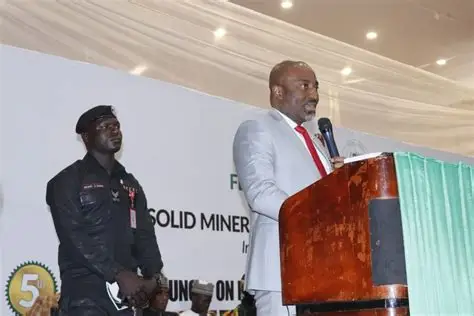
The Executive Chairman of the Economic and Financial Crimes Commission, EFCC, Mr. Ola Olukoyede, has vowed to intensify its crackdown on illegal mining by going after the financiers, mineral buyers, compromised public officials and other collaborators who profit from the illicit exploitation of Nigeria’s mineral resources.
Olukoyede made the call on Tuesday, November 3, 2026, while delivering a keynote address at a joint conference on Illegal Mining, Corruption and Climate Implications organised by the Michael Imoudu National Institute for Labour Studies MINILS, Ilorin, in partnership with the Human and Environmental Development Agenda, HEDA.
Speaking on the theme, “Uprooting the Roots of Resource Theft: A Zero-Tolerance Approach to Mining Corruption and Increasing Insecurity in Nigeria,” the EFCC boss observed that despite Nigeria’s abundant mineral resources, including gold, lithium, tin, lead, zinc and other valuable minerals, the country was yet to maximise their economic benefits due to corruption, illegal exploitation and insecurity. He stressed that mineral wealth could only become a national blessing when properly managed and protected from criminal exploitation.
He explained that illegal mining was not merely the handiwork of individuals operating mining pits but involved sophisticated networks of local and international financiers, buyers, compromised officials, transporters and beneficiaries of illicit proceeds. He therefore advocated an enforcement strategy that goes beyond arresting miners to identifying and dismantling the financial networks behind the criminal enterprise. “A serious enforcement strategy must move from the pit to the purse,” he declared, adding that the EFCC would continue to follow the money, investigate financiers and facilitators, trace illicit proceeds and prosecute offenders based on evidence.
Giving an account of the Commission’s efforts, Olukoyede disclosed that between October 2023 and July 2026, the EFCC recorded 52 illegal-mining cases within its specialised enforcement portfolio, resulting in investigations, prosecutions and convictions. He also revealed that the Commission secured the forfeiture of 102 tonnes of solid minerals. He emphasised that illegal mining was not just an economic crime but could fuel extortion, smuggling, violence and other forms of criminality, thereby worsening insecurity in affected communities.
The EFCC Chairman further called for stronger collaboration among mining regulators, law enforcement agencies, financial intelligence institutions, customs authorities, revenue agencies and host communities. He maintained that effective information sharing, joint intelligence and coordinated operations were essential to identifying the financiers and ultimate beneficiaries of illegal mining. He also urged organised labour, traditional institutions, civil society and the media to support efforts aimed at promoting transparency, decent work and accountability in the extractive sector.
Earlier, the Director-General of MINILS and Chief Host, Comrade Issa Aremu, mni, said the Institute was inaugurated in 1983 and named after the renowned labour leader, Pa Michael Imoudu, whose contributions to the labour movement remain significant. He extolled the virtues of the late labour icon and commended the EFCC under Olukoyede’s leadership for its efforts in curbing illegal activities and promoting accountability in the country. He also underscored the importance of the conference in advancing labour education and addressing contemporary challenges confronting workers and the environment.
In his remarks, the Chairman of HEDA Resource Centre, Mr. Olanrewaju Suraju, described illegal mining, corruption and climate degradation as interconnected challenges requiring collective action. He stressed that organised labour must be central to Nigeria’s transition to clean energy to ensure that workers are not left behind.
He explained that the three-day engagement was designed to equip labour leaders with advocacy, skills development and collective bargaining tools, while promoting a joint action plan for monitoring suspicious mining activities and a Green Accountability Campaign.
The high point of the event was the conferment of a Fellowship Award on the EFCC Chairman by MINILS in recognition of his contributions to the fight against corruption and related economic crimes.

Abu Umar
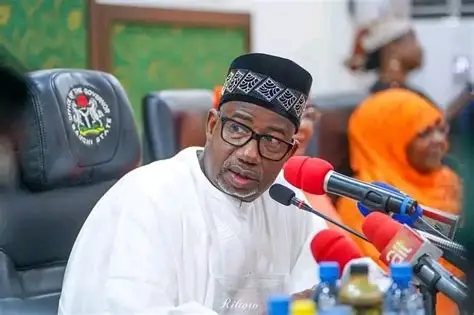
Governor Bala Mohammed of Bauchi State has on Tuesday vowed that his administration will not tolerate any breach of peace, political thuggery or disruption of stability ahead of the 2027 general elections.
Governor Mohammed stated this while addressing members of the State Executive Council in Bauchi.
He said his administration’s collaboration with security agencies has restored peace, allowing citizens to farm, go to school and live freely, and warned that such peace must not be compromised for politics.
“As we approach the election cycle, our security apparatus must remain hyper-vigilant. We will tolerate no breach of peace, no political thuggery and no disruption to the stability of our dear state,” he declared.
The Governor said the government will continue to support security agencies with accommodation, vehicles and logistics to maintain impartiality and effectiveness.
He also warned against last-minute abuse of due process as political temperature rises, insisting that adherence to public procurement laws and financial regulations must be watertight.
“We will leave behind an administration defined by transparency, not last-minute lapses in due process,” he said.
The Governor directed that no bureaucratic delays or lackadaisical attitudes should be entertained, stressing that time is of the essence to solidify his Bauchi Project agenda.
Our Reporter
BudgIT has raised the alarm over the low budget implementation by state governments, revealing that despite pocketing a whopping ₦11.38 trillion from FAAC in 2025, they had spent a paltry 24.4 per cent of their combined ₦35.22 trillion 2026 budgets by the end of June.
The Country Director of BudgIT, Vahyala Kwaga, disclosed this on Tuesday in Abuja at the launch of the 11th edition of the organisation’s State of States Report, titled ‘From Allocation to Impact: Rethinking State Spending Priorities’.
Kwaga said the figures represent an increase of over 232 per cent from the ₦3.43 trillion they received in 2022.
He said the figures showed that state governments had received significantly more money in recent years, particularly following the removal of the petrol subsidy, which increased the revenue shared among the federal, state and local governments.
According to Kwaga, an analysis of 34 states showed that their combined revenue rose from about ₦4.99 trillion in 2022 to ₦15.53 trillion in 2025, while their share of money from the Federation Account increased from ₦3.43 trillion to ₦11.38 trillion within the same period.
Despite the increase in revenue, Kwaga expressed concern over the gap between budgetary allocations and actual expenditure, noting that although the 34 states had collectively budgeted ₦35.22 trillion for 2026, only ₦8.60 trillion had been spent by the end of June, leaving a large part of their planned spending yet to be carried out.
Kwaga said the figures raised questions about how state governments were using the additional money available to them and whether the increased revenue was leading to better roads, schools, hospitals, jobs and other basic services for residents.
“State governments now have access to resources at a scale that should create greater opportunities to address longstanding development deficits.
“But what have these additional resources meant for the people of our states? How much of this increased fiscal capacity is finding its way into better public services, stronger infrastructure and improved human development?” Kwaga queried
Speaking further, the BudgIT Country Director explained that the organisation had revised its methodology for assessing state fiscal performance to place greater emphasis on the quality of public spending and its impact on development, rather than relying largely on conventional indicators such as revenue growth, expenditure and debt sustainability.
He noted that the previous assessment framework examined states’ ability to meet operating expenses through Internally Generated Revenue, annual IGR growth, debt sustainability, debt servicing, personnel costs and the balance between capital and recurrent expenditure.
According to him, while those indicators provided useful information about the financial health of states, they were insufficient to determine whether government spending was producing tangible benefits for citizens, including better schools, functional healthcare facilities, improved livelihoods and essential services.
Kwaga said the revised methodology would pay closer attention to investments in critical sectors, including health, education, agriculture, water, sanitation and hygiene, as well as actual expenditure and the implementation of budgeted projects.
“This year, we are introducing a substantially revised methodology that expands the scope of our assessment beyond conventional measures of revenue growth, expenditure and debt sustainability. We are placing greater emphasis on the quality and developmental orientation of public spending, including how states allocate resources to critical sectors and whether those investments are translating into actual implementation.
“This tells us that the conversation cannot end with how much money states receive or how much they budget. We must also examine how effectively they deploy the resources available to them, what they prioritise and whether their spending is delivering the outcomes that citizens need.
“This is precisely why our revised methodology places greater emphasis on the quality and developmental orientation of public spending. We are looking more deliberately at state investments in critical sectors such as health, education, agriculture, and water, sanitation and hygiene. We are also examining actual expenditure and the implementation of budgeted projects, because what is appropriated on paper must ultimately translate into something tangible.” He said
The Country Director further urged Nigerians, civil society organisations, journalists and policymakers to use the report’s findings to strengthen public scrutiny of state finances, assess the performance of elected officials and demand greater accountability in the management of public resources.
He said the 11th edition represented an important shift in subnational fiscal accountability, stressing that the report should serve not merely as a ranking of states but as an opportunity for governments to identify areas of progress, address shortcomings and learn from one another.

Our Reporter
The Senate on Tuesday rejected suggestion that the Federal Government should revive the Nigeria Airways as a national carrier.
The rejection followed deliberation on a motion titled “Enforcing the Bilateral Air Service Agreement (BASA) sponsored by
Sen. Monguno, Mohammed Tahir (Borno North) at plenary.
Senator Ned Nwoko (Delta North) had moved as an additional prayer to the motion, the need to complete the Federal Government to have a befitting national carrier by reviving the defunct Nigeria Airways.
Senator Sunday Karim (Kogi West) seconded his prayer but when the presiding officer, Senator Godswill Akpabio put the prayer to voice voting, the thunderous shout of ‘Nay’ rented the the hallowed chamber.
However, the three prayers sought by the sponsor of the motion were unanimously carried by senators present at plenary.
The Senate urged the Federal Ministry of Aviation and Aerospace Development to negotiate with the Chinese government how to facilitate direct flights from Nigeria to China by airlines operating in the country.
The Senate also urged the Ministry to renegotiate the commercia terms and operational schedules of the existing Nigeria-China Bilateral Air Service Agreement,BASA.
The Red Chamber as well urged the Federal Ministry of Foreign Affairs to initiate diplomatic talks with Chin. regarding business visa facilitation for Nigerian traders and reciprocal slot allocations to China Airports; and
Sponsor of the motion, Sen. Monguno, had earlier noted that the Administration of late former President Muhmmadu Buhari, Nigeria-China signed a Bilateral Air Service Agreement (BASA) to establish direct commercial air link and govern flight frequencies;
He also noted that the volume of trade between Nigeria and China reached $18 billion in the first half of 2025 (a 35% increase year-on-year building on a total of $28 billion recorded in 2026;
“Aware that BASA instrument is intended to establish direct scheduled Nigeria China flight that would transform Murtala Mohammed International Airport, Lagos and the Nnamdi Azikwe International Airport, Abuja from mere origin/ destination points in to the primary gateway linking west and Central Africa to East Asia;
“Also aware that the population of Nigerians in China is more than 1000,000 people, while that of China in Nigeria is more than 5,000,000 and this has generated the interest of China in Nigeria because it is Africa’s most populous nation and largest economy, offering massive markets on African continent;
“Further aware that the benefits of enforcing such Bilateral agreement will reduce drastically travel time and increase supply chain velocity, retention of Foreign Exchange (capital flight reduction), aeronautical revenues for Nigerian gateways, increase commercial SME Growth and Non-oil export expansion, accelerated perishable exports among other benefits;
“Appreciates that the utilization of BASA between Nigeria-China will actualize the Renewed Hope Agenda of President Ahmed Bola in facilitating the ease of doing business in Nigeria, enhance, Bilateral and diplomatic relationship create massive employment both direct and indirect jobs and, open up export opportunity;
“Acknowledges that what is urgently required to enforce such a fantastic Air Agreement lies across Executive Policy instrument from the Federal Ministry of Aviation and Aerospace Development, the Nigerian Civil Aviation Authority (NCAA), the Central Bank of Nigeria (CBN) and the Nigeria Customs Service; and
“Notes that enforcing the BASA instrument between Nigeria China, the Federal Ministry of Aviation and Aerospace Development and the NCAA hold direct regulatory levers by enforcing strict BASA Reciprocity, rationalize sixth- freedom competition, Bilateral code-share mandates, temporary Airport fee waivers, direct Naira settlement window using the existing Bilateral currency Swap framework, by-passing US dollar, among other enforcing mechanism,” the motion further read.
Upon granting of all the prayers sought for in the motion, the Senate mandated the Committees on Aviation and Foreign Affairs to ensure compliance and report to the Senate with 4 weeks.
-

 General News4 weeks ago
Rivers 2027: We are not part of Rainbow Coalition – APC Legacy Group slams Wike, Fubara meeting
-
General News1 month ago
JOHESU demands: MHWUN puts FG on notice over fresh action
-

 Politics2 months ago
2027: ASAF backs APC governors, rejects rainbow coalition
-

 Politics2 months ago
You have demonstrated diligence, loyalty, statesmanship in leadership, Ekechi salutes Shetimma at 60
-

 Politics3 months ago
2027: Advertising experts raise concerns over irregular regulation of sector
-
FCT News3 months ago
2027: Hasana-Moneme pledges skills, empowerment, credit access for FCT women
-
General News3 months ago
2027: Dame Princess Esom-Nwafor Orizu confirmed as APC flagbearer for Nnewi North /South /Ekwusigo Federal Constituency as INEC releases names of candidates
-
Uncategorized4 months ago
Rescue of Oyo schoolchilden: Tinubu commends security agencies, says action breakthrough in fight against criminality