
General News
FG set to begin local e-passport production in 2027, targets 10m annually

Abubakar Salami
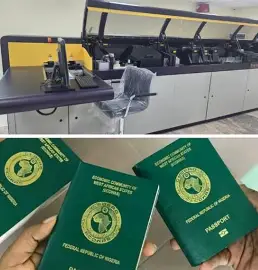
The Federal Government has unveiled a $70m National Passport Booklet Manufacturing Centre in Abuja, with Nigeria expected to commence local production of electronic passport booklets in May 2027 and scale up its annual production capacity to 10 million.
The Minister of Interior, Dr Olubunmi Tunji-Ojo, disclosed this at the groundbreaking ceremony of the manufacturing centre at the Nigeria Immigration Service headquarters in Abuja, saying the project would end the country’s dependence on foreign suppliers for the production of its travel documents.
Tunji-Ojo said the facility, being developed in partnership with IRIS Smart Technologies, would initially have the capacity to produce six million passport booklets annually before being expanded to 10 million, against Nigeria’s estimated annual requirement of between 800,000 and two million booklets.
He described the project as a major step towards domesticating the entire passport production value chain, adding that Nigeria would become the first country in West Africa to manufacture electronic passports when the facility becomes operational.
The minister said the project, which would be commissioned by President Bola Tinubu in May 2027, was being developed on 1.1 hectares of land, would operate off-grid and deploy artificial intelligence-driven technology. He added that the investment was being undertaken without direct government funding.
Explaining the rationale behind the initiative, Tunji-Ojo said the government had made local manufacturing a condition for continuing its partnership with the company, which had previously imported passport booklets for Nigeria.
“We came on board in 2023, under President Bola Tinubu, and we said we cannot be aiding employment of other countries and be creating unemployment in our own country,” he said.
He added that the government had insisted that every stage of the passport production process, from booklet manufacturing and application to processing, personalisation and issuance, should be undertaken in Nigeria by Nigerians.
According to him, the development represents the final stage of a reform programme that began with the automation of passport applications and approvals in 2023, followed by the establishment of a data centre in 2024 and the completion of a centralised passport personalisation centre in September 2025.
The minister said the administration had also addressed several longstanding challenges in the Immigration Service, including passport backlogs, poor migration data management and inadequate border surveillance infrastructure.
He recalled that the country had 204,332 outstanding passport applications when the administration assumed office in 2023, adding that the backlog was cleared within two weeks. He also said the introduction of contactless passport renewal, electronic visas and e-gates at the country’s international airports had improved access to immigration services.
Earlier, the Comptroller-General of the Nigeria Immigration Service, Kemi Nandap, said the manufacturing centre would strengthen national security, reduce dependence on external suppliers and improve the resilience of Nigeria’s passport supply chain.
Nandap noted that Nigerians had endured years of passport shortages and delays, which disrupted travel plans, educational opportunities and family engagements abroad, stressing that the new facility would give the country greater control over the production of its travel documents.
“Passport booklets are sensitive security documents. Producing them within a secured, regulated national environment strengthens our oversight of Nigerian travel documents and reduces avoidable external dependency while keeping the international partnerships and standards that a credible passport requires,” she said.
She added that the facility would also create opportunities for Nigerians to acquire specialised skills in secure document production, quality assurance and equipment maintenance, while assuring that the Immigration Service would work with relevant stakeholders to ensure the project met the required standards.
In his remarks, the Chairman of the Senate Committee on Interior, Senator Adams Oshiomhole, described the project as evidence of the Federal Government’s commitment to domestic manufacturing, job creation and the implementation of President Tinubu’s Renewed Hope Agenda.
Oshiomhole, a former president of the Nigeria Labour Congress, said the facility would create employment opportunities for Nigerian artisans, technicians, electricians, bricklayers and other workers involved in its construction and operations.
“The way to distribute those benefits of reform is to create jobs, because no government, not in the East, not in the West, not developed, not developing, when we talk about rich nations and the prosperity of the people, does it mean that the government is going to create a long dining table for 250 million Nigerians to be called to one dining table to eat?” he said.
He commended Tunji-Ojo and Nandap for driving reforms in the Immigration Service, arguing that manufacturing passport booklets locally would save the country from unnecessary importation while strengthening its industrial capacity.
“Rather than going to sign an agreement in a foreign country to produce Nigerian passports, in fact, there’s a little error on the banner. For the first time in Nigeria’s history, under the leadership of President Bola Tinubu, the visionary, the can-do spirit president, we are going to start to manufacture. I use the word manufacture, Nigerian passports of the finest quality right here in Abuja, for the very first time,” Oshiomhole said.

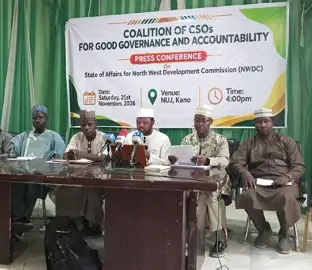
The Coalition of Civil Society Organisations for Good Governance and Accountability (CCSGGA) has expressed concern over delays in distributing interventions procured by the North-West Development Commission (NWDC).
The coalition’s Chairman, Dr Abdulsalam Kani, expressed the concern at a news conference in Kano on Saturday, alongside its Secretary, Akibu Hamisu.
Kani said insecurity, poverty and unemployment remained prevalent across the North-West in spite of the commission’s procurement of intervention materials for its 2026 programmes.
He said the coalition’s inspection of the commission’s facilities revealed undistributed intervention materials and unused employment approvals intended to strengthen its workforce.
Kani recalled that President Bola Tinubu established the NWDC through the NWDC Establishment Act, 2024, to accelerate development and address socio-economic challenges.
He said the coalition secured permission to inspect the commission’s warehouses as part of efforts to promote transparency and independent oversight.
According to him, the inspection revealed several categories of procured items, including Hilux vehicles intended to support vigilante groups and streetlights for community infrastructure and public safety.
Other items included rice, beans, groundnut oil, seasoning and salt procured for internally displaced persons (IDPs) and vulnerable households.
He said the coalition also identified solar-powered irrigation pumps, fertilisers and tractors intended to support farmers and improve agricultural productivity.
“The Commission is therefore sitting on both undistributed materials and unused employment approvals,” Kani said.
He expressed concern over delays in distributing the items across Jigawa, Kaduna, Kano, Katsina, Kebbi, Sokoto and Zamfara states.
Kani said the interventions could improve the livelihoods of farmers, vulnerable households and communities if distributed transparently and equitably.
He said institutional disagreements, administrative bottlenecks and poor leadership coordination should not obstruct interventions intended to address challenges affecting millions.
The chairman urged the National Assembly to extend its oversight functions to the commission.
He also called on the Economic and Financial Crimes Commission (EFCC) and Independent Corrupt Practices and Other Related Offences Commission (ICPC) to deploy monitoring officers.
He said the agencies should ensure that all procured intervention materials were accounted for and distributed transparently across the seven states.
Kani threatened to petition President Tinubu, the EFCC and ICPC if the matter remained unresolved.
He also threatened that the coalition would occupy government houses across the North-West if no action was taken. (NAN).
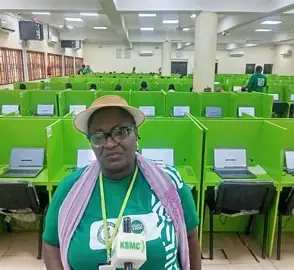
The Teachers Registration Council of Nigeria (TRCN) has set December 2026 as deadline for schools to ensure that, at least, 75 per cent of their teachers are professionally certified and licensed.
Dr. Ronke Soyombo, Registrar/Chief Executive of TRCN, disclosed this in Abuja on Sunday.
She said the measure was aimed at strengthening compliance with professional teaching standards.
Soyombo said schools would be required to meet the certification threshold to qualify to apply for the West African Examinations Council (WAEC) and National Examinations Council (NECO) examinations.
‘By December 2026, schools will be required to have at least 75 per cent of their teachers certified and licensed by TRCN to qualify to apply for WAEC and NECO examinations,’ she said.
Soyombo said the council had integrated its website with WAEC and NECO through an Application Programming Interface (API) to enable the examination bodies verify teachers’ professional status.
She said authorised officials of both examination bodies would be able to access the system using designated login credentials to determine schools’ compliance with the requirement.
The registrar said TRCN had commenced compliance monitoring, adding that it was engaging private school owners and administrators to encourage teachers to register for professional examinations and licensing.
She, however, expressed concern over the low level of compliance, noting that many teachers had passed the professional qualifying examination but failed to complete the licensing process.
‘Our position is that every practising teacher must be professionally licensed.
“Teaching without the required professional credentials would no longer be tolerated,” she said
Soyombo said the council was also implementing an Accelerated Teacher Professionalisation Pathway to enable teachers without professional teaching qualifications to acquire the necessary training.
She disclosed that during a recent teacher recruitment exercise in Nasarawa, TRCN personnel discovered that 250 applicants had presented fake certificates out of approximately 1,000 applicants.
She advised school owners to verify certificates presented by prospective employees, explaining that TRCN certificates carried QR codes that could be scanned to confirm their authenticity.
The registrar added that the council was taking action against impersonation and certificate fraud, disclosing that a suspect identified as Godfrey had been remanded in prison.
On improving service delivery, Soyombo said TRCN had established a six-member call centre to receive and address teachers’ complaints relating to registration, examinations and certification around the clock.
She said the council had also decentralised its operations into geographical regions, with designated personnel responsible for attending to complaints and ensuring quicker responses.
Soyombo explained that a monitoring system had been introduced to track applications awaiting verification, enabling her to identify delays and hold responsible officers accountable.
She said the council was also providing step-by-step assistance to applicants experiencing difficulties with digital processes, adding that incorrect or incomplete academic documents often delayed verification.
The registrar said the reforms were designed to strengthen accountability, eliminate fraudulent practices, improve professional standards and ensure that only qualified and licensed teachers practised in Nigerian schools.(NAN).

Temi Olalekan
The Small and Medium Enterprises Development Agency of Nigeria (SMEDAN) has earmarked N5 billion for grants to tertiary institution students nationwide.
The initiative aims to ease educational costs while encouraging entrepreneurship, innovation and business creation among young Nigerians.
SMEDAN Director-General, Mr Charles Odii, disclosed this in an interview with journalists on Sunday, on the sidelines of the programme’s inauguration in Zaria.
He said the intervention would cover students in universities, polytechnics and colleges of education across the 36 states and Federal Capital Territory (FCT).
Odii said approximately 11,458 students in Kaduna State would benefit, including more than 6,000 from Zaria Local Government Area.
He explained that beneficiaries would receive between N100,000 and N1 million, depending on their institutions, geopolitical zones and socioeconomic backgrounds.
He said the grants would complement the Nigerian Education Loan Fund (NELFUND), which primarily supports tuition payments and students’ welfare.
The Director-General explained that the intervention would provide additional funding to encourage entrepreneurial activities among students.
“We want our students to look for opportunities within themselves and start solving problems around them,” he said.
Odii said such initiatives could help students develop profitable businesses while addressing challenges within their communities.
He cited his experience of starting a fashion business at 17, saying it enabled him to employ people and contribute towards reducing unemployment.
He disclosed that the programme had begun in Kaduna and would subsequently extend to all 36 states and the FCT.
He described the initiative as an investment in young people, aimed at promoting self-reliance, stimulating economic activities and creating employment opportunities.
Odii urged beneficiaries to utilise the grants judiciously, remain diligent and create opportunities for others through their entrepreneurial ventures.
He also urged media organisations to publicise government interventions, saying effective information dissemination would bridge communication gaps and improve public access to available programmes.
-

 General News1 month ago
Rivers 2027: We are not part of Rainbow Coalition – APC Legacy Group slams Wike, Fubara meeting
-

 Politics2 months ago
2027: ASAF backs APC governors, rejects rainbow coalition
-
General News2 months ago
JOHESU demands: MHWUN puts FG on notice over fresh action
-

 Politics3 months ago
You have demonstrated diligence, loyalty, statesmanship in leadership, Ekechi salutes Shetimma at 60
-

 Politics3 months ago
2027: Advertising experts raise concerns over irregular regulation of sector
-
FCT News3 months ago
2027: Hasana-Moneme pledges skills, empowerment, credit access for FCT women
-
General News4 months ago
2027: Dame Princess Esom-Nwafor Orizu confirmed as APC flagbearer for Nnewi North /South /Ekwusigo Federal Constituency as INEC releases names of candidates
-
General News1 month ago
Senator Mandiya slipped, died in Abuja bathroom, corpse discovered after 3 days, says Sen Ningi