
Feature
kidnapping, unsafe roads others reasons for staying away from Nigeria – US-based Nigerian healthcare worker


By Chidera Orji
As the country grabbles with so many socio-economic problems, a United States-based Nigerian Mrs Nkechi Eze (née Nzelu), has identified insecurity as one of the major reasons many Nigerians who are based outside the country are unwilling to return home, adding that the fear of kidnapping, violent attacks and unsafe roads makes visiting home increasingly difficult.
Nkechi, who is practicing healthcare professional in USA, stated this when she spoke with some selected journalists via zoom, said although she personally remains emotionally connected to Nigeria and wishes to reunite with family members, the safety of her children and other loved ones remains her foremost consideration whenever she contemplates travelling home.
She said that her concern goes beyond the possibility of being attacked, stressing the need to be confident that she and her family could travel safely, move around freely and access emergency assistance if anything went wrong.
According to her, staying away from Nigeria does not diminish her love for the country but reflects her responsibility to protect her family from avoidable risks.
As a healthcare professional, Mrs Nkechi Eze expressed particular concern over the growing threats to the lives of medical personnel, noting that health workers should not have to risk kidnapping or death while carrying out their duties.
She observed that insecurity affects healthcare delivery at several levels, as patients may be unable to travel to hospitals at night, medical personnel may struggle to reach their workplaces, and ambulances may avoid dangerous routes.
She warned that such disruptions could have serious consequences for pregnant women experiencing emergencies, accident victims and patients requiring urgent referrals to better-equipped medical facilities.
Eze also noted that financial constraints, transportation difficulties and delays in identifying hospitals capable of providing appropriate treatment could further worsen emergencies in an already challenging environment.
On what would make her reconsider visiting Nigeria, she said sustainable improvements in security, safer roads, effective emergency response systems and credible investigations into criminal activities would be necessary.
She maintained that assurances of safety must be backed by verifiable improvements in the specific communities and locations people intend to visit.
Speaking on banditry, kidnapping and farmer-herder conflicts, Eze said the challenges reflect the need for stronger protection of ordinary citizens, urging authorities to identify and prosecute individuals responsible for criminal activities rather than unfairly blaming entire ethnic or occupational groups.
She called for improved intelligence gathering, stronger collaboration among security agencies, better-equipped and properly supervised local policing structures, as well as efficient investigations and judicial processes.
She also advocated preventive measures, including education, employment opportunities and fair mechanisms for resolving disputes, while emphasizing the importance of respecting human rights to build public confidence in security institutions.
Comparing her experience in the United States with the situation in Nigeria, Eze acknowledged that the US was not free from crime but said the predictability of its security and emergency response systems gave residents greater confidence to plan their daily activities.
She said Nigerians deserved an environment where people could go to work, visit relatives and seek medical attention without living under constant fear or depending on private security arrangements.
On healthcare administration, she highlighted the US emergency care system, where hospitals are required to screen and stabilize patients experiencing medical emergencies regardless of their immediate ability to pay.
She clarified that this does not mean emergency treatment is entirely free, but stressed that urgent medical attention should not be delayed while patients or their relatives search for money.
Turning to Nigeria’s electoral process, Eze said her experience voting in the United States had exposed her to an organized system characterised by voter privacy, clear procedures and mechanisms for verifying election results.
She explained that although voting methods differ across US states, the processes generally provide for identification, private voting, verification and audits to strengthen confidence in the outcome.
While acknowledging the efforts of hardworking electoral officials and citizens in Nigeria, she expressed concern over allegations of electoral violence and manipulation, saying such issues must be addressed through transparent processes and evidence-based investigations.
She, however, cautioned against treating every allegation of electoral malpractice as an established fact, insisting that institutions must make relevant evidence accessible and clearly explain disputed outcomes to the public.
Eze argued that credible elections could contribute to improved governance by giving citizens the opportunity to reward or remove political leaders through the ballot.
However, she stressed that elections alone would not resolve insecurity or reverse the migration of skilled professionals, adding that sustainable progress would also require effective governance, responsible public spending, enforcement of laws and improved working conditions for professionals.
On diaspora voting, she supported extending voting rights to Nigerians living abroad, provided adequate safeguards were introduced to ensure credible registration, proper identity verification, prevent multiple voting and guarantee transparent counting.
She nevertheless maintained that strengthening the credibility and security of votes cast within Nigeria should remain an immediate priority.
Eze said the effectiveness of Nigeria’s security response should ultimately be measured by practical outcomes, including whether farmers could safely return to their farmlands, nurses could work night shifts without fear and victims of kidnapping could receive prompt and professional responses from security agencies.
She maintained that Nigerians deserved dependable public institutions capable of protecting lives, safeguarding livelihoods and restoring confidence in the country’s future.

*SITUATION REPORT: THE POLITICAL SITUATION IN KATSINA STATE –
Katsina, the home state of late President Muhammadu Buhari, has entered a critical phase ahead of the February 6, 2027 governorship election.
While Governor Dikko Umaru Radda (APC) has secured his party’s ticket by consensus and inaugurated the Tinubu/Dikko 2027 Campaign Council, the state is witnessing an unprecedented internal APC battle and a resurgent opposition led by ADC.
Unlike Kaduna where APC dominance is consolidating, Katsina is a case of dominance under stress.
*PRESENT SITUATION*
The Ruling APC – Strength on Paper, Cracks Within:
*Consolidation:* Governor Radda was affirmed by 2,872 delegates at People’s Square, Government House. All 34 members of the State House of Assembly and National Assembly members from Katsina led by Sada Soli Jibia have endorsed him for second term. INEC has listed him with Deputy Gov. Faruk Lawal as running mate.
*Campaign Structure:*
On October 17, 2026, he inaugurated the Tinubu/Dikko Campaign Council chaired by himself, with Deputy Gov. Faruk Lawal as Co-Chair, Sen. Hadi Sirika as Co-Chair II, and Arc. Ahmed Musa Dangiwa as Director-General.
Campaign kick-off is fixed for October 28.
Former Governors Aminu Masari and Ibrahim Shema are listed as Grand Patrons.
Former Gov. Masari donated N160m to ward-level mobilizers.
*The Internal Rift:*
The biggest challenge is not opposition, but a rift between Radda’s camp and the camp of *Ibrahim Kabir Masari, Special Adviser to President Tinubu on Political Affairs* (the Abuja-Katsina camp). Within days (Oct 5-6), five key appointees resigned: Commander-General Hisbah, Dr. Abu Ammar, his Deputy Muhammad Shitu Maslaha, Chairman Pilgrims Board Kabir Bature, SSA on Project Monitoring Fadila Dalhatu, and SA on Youth Development Abubakar Soja Tsanni. Sources link them to Masari’s camp.
The rift escalated when Radda’s ADC, SP Abdulganiyu Bello, and CSO, DSP Hassan Bello, were quizzed by police in Abuja over destruction of billboards bearing Masari and Tinubu along Modoji Junction Road.
The governor himself recently warned politicians to “deliver your wards to Tinubu or face consequences” and asked for forgiveness, signaling anxiety.
The Opposition – ADC as Main Challenger:
Sen. Ahmad Babba Kaita (Katsina North) is governorship candidate with Aminu Yar’Adua as deputy. The party unveiled a 141,107-member structure across 34 LGAs for Atiku Abubakar’s presidential bid.
Kaita is campaigning on insecurity, poverty and bad governance, calling 2027 a chance to “vote out bad leaders” as Katsina marks 39 years of creation.
However, ADC faces a legitimacy crisis: A rival, Salisu Uli, has challenged Kaita’s nomination in court, claiming no valid primary was held on the stipulated date.
INEC listed Kaita, but court hearing is set for October 19.
Former SSG Mustapha Inuwa also left ADC in August.
Regional Compact:*
Kaita joined 6 other North-West ADC candidates (led by Abubakar Malami) to sign the North-West Compact 2027-2031, pledging N110,000 minimum wage, reintroduction of fuel subsidy, and a technology-enabled surveillance network across 21 senatorial districts.
They cited alarming data: over 16,000 lives lost to insecurity between June 2023-Aug 2026, 1,583 kidnappings, and 533,000 hectares of farmland abandoned in Zamfara and Katsina alone.
PDP:
Garba Yakubu Lado is INEC-listed candidate.
PDP remains relevant because it won Katsina in the 2023 presidential election despite losing governorship.
Wike’s backing for Tinubu complicates its 2027 outlook.
WHO HAS THE UPPER HAND?
Technically, APC still has the upper hand* due to control of government, LGA structures, and federal alignment. But *psychologically, the upper hand is contested:*
In Kaduna, APC’s challenge is *external opposition* . In Katsina, APC’s challenge is *internal civil war*
If the Radda-Masari rift is not contained, it could split votes at ward level, as Masari controls significant grassroots network from Daura and beyond.
ADC’s 141k structure is real, but its ability to convert anger over banditry and hunger into votes depends on whether it resolves its court case and presents a united front.
Katsina voters are less concerned with billboard dominance and more with: _Can I go to my farm? Can my child go to school?_ 45% of Nigeria’s out-of-school children are in North-West.
HOW TO CONTAIN OR SUBDUE TENSION
*For APC Leadership:*
*Immediate reconciliation meeting* between Gov. Radda and Ibrahim Masari brokered by former Govs. Masari and Shema and President Tinubu.
The public quarrel over billboards and Hisbah resignations must stop.
Stop threats of “consequences” for non-delivery of wards; instead, encourage forgiveness as the governor himself preached.
Unify campaign council — include all three zonal directors (Katsina South – Bature Masari, North – Gwajo-Gwajo, Central – Prof. Charanchi) in decision-making.
*For Opposition:*
ADC must resolve Kaita vs Uli quickly through internal mechanism before court decides, or risk being disqualified.
Focus campaign on security solutions, not just criticism.
The North-West Compact is a good start but must be localized to Katsina’s 34 LGAs.
*For Security Agencies:*
Katsina has suffered more than most from banditry. Sustained military operations must continue in Batsari, Jibia, Kankara, Dutsin-Ma axis to allow farmers to return before dry season.
Police must remain neutral in APC intra-party dispute and not be used to harass either camp.
*For INEC and Traditional Institutions:*
Emir of Katsina and Emir of Daura should convene peace meeting of all candidates.
INEC should monitor premature vote-buying through the N160m ward donation.
*5. CONCLUSION*
Katsina’s politics has moved from “Buhari’s bloc vote” to “Radda vs The Rest Within APC.”
Governor Radda has the structures, but structures without unity cannot deliver.
The ADC has the message of insecurity and hardship, but message without unity cannot win.
Whoever contains his own internal crisis first will have the upper hand in February 2027.
Katsina, more than Kaduna, needs statesmanship now.
Feature
Christmas comes early for Ondo community as LG Electronics donates 21st solar-powered borehole
By Adagwa Unari
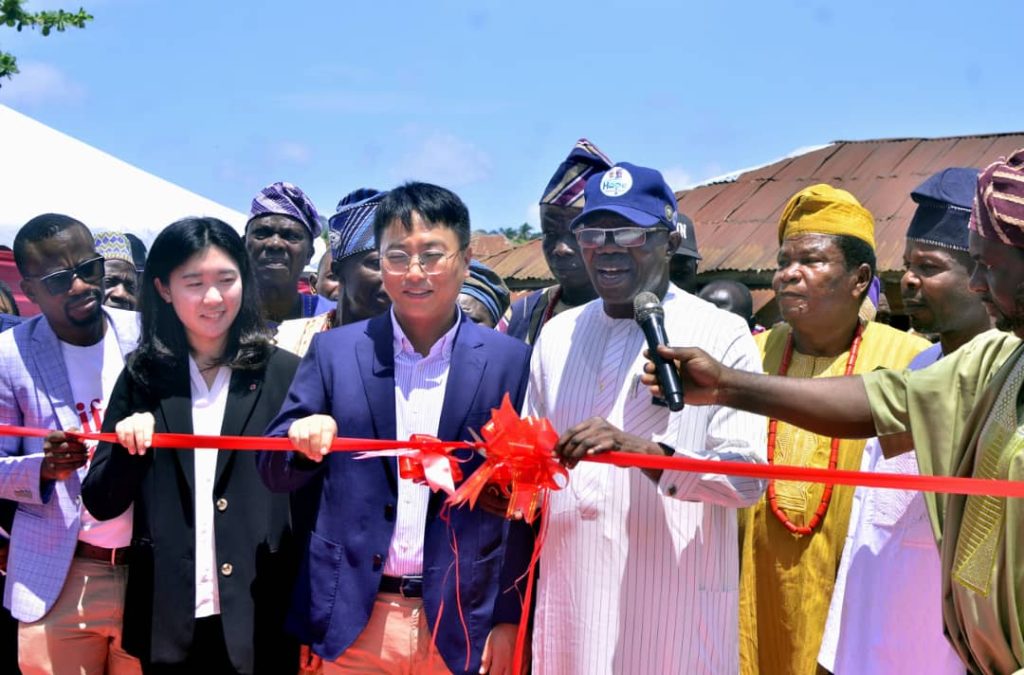
What began as a commitment to bring clean water closer to underserved communities has reached a significant milestone for LG Electronics with the commissioning of its 21st solar-powered borehole at Osan Agba, Oke Oka Akoko, Ondo State.
In Oke Oka Akoko, however, the significance of the intervention is not simply in the number. It is in what reliable access to water means in everyday life: less time spent searching for water, greater convenience for households, improved hygiene and a dependable resource that can serve the wider community.
The new facility extends LG Electronics’ community water initiative into another part of Nigeria, combining access to clean water with renewable energy infrastructure designed to operate independently of the national electricity grid. It also reflects the evolution of the company’s approach to corporate citizenship—from individual interventions to a growing footprint of sustainable community infrastructure built around identified local needs.
At the commissioning, the Akoko South West Local Government Chairman, Hon. Ayọ Ajana, said the intervention demonstrates the value of collaboration between the private sector and communities in addressing practical development needs.
“Water is fundamental to the well-being of every community, and this is the kind of intervention whose impact people can feel every day. What LG Electronics has done in Oke Oka Akoko complements the work of government and shows what responsible private-sector participation in community development can achieve. We welcome this investment, and our responsibility is to ensure that the community takes ownership of it and protects it for the generations that will come after us,” Ajana said.
Hon. Ologunbaba Ruben (Ṣóyọ), the Adedibu of Osan Àgbà Oka, described the facility as an intervention whose value would extend well beyond the commissioning ceremony.
“For us, this is more than the commissioning of a borehole. It is about meeting a need that touches our people every day. Families will use this water, our children will benefit from it, and the entire community has a responsibility to preserve what has been provided. We appreciate LG Electronics for looking beyond the major cities and recognising that communities such as ours also matter,” he said.
Chief Darusa Adedibu, Olugbedere of Igbedere, Osan Àgbà Oka, said the project underscores the importance of bringing development closer to the people.
“Development becomes meaningful when it reaches people where they live. Clean water touches health, hygiene, our homes and the general well-being of the community. We appreciate LG Electronics for bringing this project here. Our responsibility now is to protect it and ensure that it continues to serve everyone,” Adedibu said.
Hon. Ajulo Tayo, Chairman of Udẹ̀ Osan Àgbà Oka, also emphasised the everyday relevance of the project and the need for collective stewardship.
“There are projects people hear about, and there are projects they experience in their daily lives. Water belongs in the second category. This borehole will serve our people every day, and that makes it deeply relevant to this community. Our appreciation to LG Electronics must therefore be matched by our commitment to look after the facility and ensure that its benefits are shared responsibly,” Tayo said.
From One Community to Twenty One
The Oke Oka Akoko commissioning represents the 21st solar-powered borehole delivered by LG Electronics across communities in Nigeria, following the company’s 20th installation in Nariya Rigasa, Kaduna State. The growing programme reflects a deliberate effort to use sustainable technology to address a basic human need while reducing dependence on grid electricity.
For Mr. Hyoung Sub Ji, Managing Director, LG Electronics Nigeria, represented by Mr. Choongbae Seok, General Manager, Media Entertainment Solutions, TV Department, LG Electronics Nigeria, the milestone is significant because of the lives and communities represented by the number.
“Twenty-one communities is an important milestone for us, but the real story is not the number. It is the people behind those twenty-one communities and what reliable access to water can mean to their everyday lives. At LG, we believe innovation has its greatest value when people can feel its impact. Sometimes that is through the technology in their homes; at other times, it means applying technology and our resources to a fundamental need such as clean water,” Seok said.
He added: “The solar-powered model is particularly important because sustainability has been considered from the outset. We are not interested in infrastructure that works only on commissioning day. The objective is to create something relevant, practical and capable of continuing to serve the community. Oke Oka Akoko is another important chapter in that journey.”
By powering the facility with solar energy, LG brings together two dimensions of sustainable development: addressing a basic social need and using renewable energy to support long-term functionality. Just as importantly, the initiative places emphasis on community participation and stewardship, recognising that infrastructure delivers lasting value when the people it serves have a stake in sustaining it.
A borehole can be commissioned in a day. Its real value is measured in the years that follow. From its earlier interventions to Oke Oka Akoko, LG Electronics’ expanding clean-water footprint is turning individual CSR projects into a broader model of community investment where technology, sustainability and local participation meet.
For the people of Osan Agba, the measure is simpler: clean water is now closer to home.
Feature
From Import Dependence to Domestic Supply: PETROAN deepens engagement with indigenous refiners through strategic visit to Azikel Refinery

By Sam Otuonye
For most of its history as an oil-producing nation, Nigeria has lived with a paradox that is as costly as it is familiar: abundant crude at the wellhead, and a persistent reliance on foreign refineries to convert that crude into the fuels on which the economy runs.
The Petroleum Products Retail Outlets Owners Association of Nigeria (PETROAN) believes that paradox is now, at last, becoming solvable, and that retailers have both a commercial interest and a national responsibility in helping to solve it.
It is in this spirit that the National President of PETROAN, Dr. Billy Sotubo Gillis-Harry, led a delegation of the Association’s national executives on an official site inspection and commercial engagement with Azikel Refinery at Obunagha, Yenagoa, Bayelsa State.
The purpose of the engagement:
The visit forms part of PETROAN’s continuing programme of industry oversight and stakeholder engagement. Its objectives were threefold: to assess, at first hand, the state of emerging domestic refining capacity; to open a structured dialogue with an indigenous refiner on the practical terms of collaboration;and to identify commercially viable arrangements that can improve the availability, reliability and distribution of locally refined petroleum products to Nigerian consumers.
The delegation received a comprehensive presentation on the Azikel Refinery covering its development history, operational planning, refining capacity, product slate and the avenues open for partnership with the retail segment of the value chain.
Towards a structured offtake framework:
Central to the discussions was a proposed structured offtake arrangement under which PETROAN members would access petroleum products directly from the refinery on mutually agreed commercial, technical and operational terms.
The significance of such an arrangement should not be understated. Nigeria’s downstream sector has long been characterised by long and often opaque supply chains,in which the distance between the point of production and the retail forecourt is filled by intermediaries, uncertainty and cost.
A direct relationship between domestic refiners and organised retailers compresses that distance. It gives refiners a predictable, aggregated market for their output, and gives retailers a dependable source of supply insulated, to a meaningful degree, from the volatility of international product markets and foreign exchange. The beneficiary, ultimately, is the consumer.
The Azikel Refinery:
The Azikel Refinery has been re-engineered from its original design capacity of 12,000 barrels per day to a 25,000 barrels-per-day full-slate hydro-skimming facility,configured to process crude oil and condensate into Premium Motor Spirit, automotive gas oil, kerosene, aviation turbine fuel and liquefied petroleum gas. Recent reports indicate that the project has entered an advanced stage of construction and integration following the arrival and installation of its 200-tonne Crude Distillation Unit.
PETROAN regards the emergence of facilities of this kind as a structural, rather than incidental, development. Each additional domestic refinery broadens the national supply base, introduces competition among suppliers, and strengthens the resilience of a downstream sector that has, for too long, been exposed to shocks originating far beyond Nigeria’s borders.
Remarks by the National President:
Speaking during the engagement, Dr. Gillis-Harry reaffirmed PETROAN’s commitment to working with indigenous refiners in building a sustainable and commercially sound domestic petroleum products supply chain. He observed that the growth of local refining capacity presents Nigeria with a genuine and progressive pathway out of import dependence, one that must be pursued deliberately and on terms that are workable for all parties.
“As retailers, we want to build practical partnerships with indigenous refineries thatcanimproveproductavailability,strengthensupplychainsandcreategreatercertaintyfor businesses and consumers,” he said.
He emphasised that PETROAN’s objective is not merely to secure supply for its members, but to establish enduring commercial relationships that are equitable and beneficial to refiners and marketers alike.
Response from Azikel Group:
In his response, the President and Chief Executive Officer of Azikel Group, Dr. Eruani Azibapu Godbless, welcomed the delegation and affirmed the refinery’s readiness to build strategic relationships with petroleum products retailers as the facility advances towards commercial operations.
He underscored that collaboration between refiners and retail outlet owners is indispensable to efficient distribution and to securing market access for locally refined products.
Both parties agreed on the necessity of sustained engagement to resolve the commercial, technical and operational requirements on which the proposed offtake partnership will depend.
A broader strategy:
PETROAN wishes to make clear that its engagement with Azikel is one element of a wider strategy to deepen collaboration with indigenous refineries and with stakeholders across the entire downstream value chain.
The Association holds firmly to the view that Nigeria’s refining future must rest on multiple reliable sources of supply, on transparent market participation, and on constructive collaboration among refiners, marketers, regulators and all who have a stake in the sector’s health. Concentration of supply in any single source, however large, carries its own risks; diversity of supply is the surest guarantee of both competition and security.
As projects such as Azikel move from ambition to operation, PETROAN remains committed to supporting every credible initiative that expands domestic refining capacity, improves product availability, strengthens competition, and contributes to amore stable, sustainable and self-reliant petroleum products market for Nigeria.
-
 General News3 weeks ago
Rivers 2027: We are not part of Rainbow Coalition – APC Legacy Group slams Wike, Fubara meeting
-
General News1 month ago
JOHESU demands: MHWUN puts FG on notice over fresh action
-

 Politics1 month ago
2027: ASAF backs APC governors, rejects rainbow coalition
-

 Politics2 months ago
You have demonstrated diligence, loyalty, statesmanship in leadership, Ekechi salutes Shetimma at 60
-

 Politics3 months ago
2027: Advertising experts raise concerns over irregular regulation of sector
-
FCT News3 months ago
2027: Hasana-Moneme pledges skills, empowerment, credit access for FCT women
-
General News3 months ago
2027: Dame Princess Esom-Nwafor Orizu confirmed as APC flagbearer for Nnewi North /South /Ekwusigo Federal Constituency as INEC releases names of candidates
-
Uncategorized4 months ago
Rescue of Oyo schoolchilden: Tinubu commends security agencies, says action breakthrough in fight against criminality