
General News
Where are dividends of subsidy removal, Atiku queries Tinubu


Nkem Okereh
Presidential candidate of the African Democratic Congress (ADC), Atiku Abubakar has cautioned the Federal Government’s continuous basking in the euphoria of increase in the monthly releases to states nationwide insisting that more money to states does not depict true federalism.
Atiku noted that the Presidency celebrated increased allocations to states and local governments as proof that subsidy removal had succeeded.
He also dismissed the Presidency’s attempt to describe increased allocations as “true federalism.”
In a statement by Phrank Shaibu, his
Senior Special Assistant on Public Communication, the former Vice President of Nigeria said true federalism is not simply sending more money to states after unleashing inflation on the entire country.
“True federalism means devolving powers, strengthening institutions, respecting constitutional responsibilities and allowing sub-national governments to become genuine centres of economic productivity,” he said.
According to him, significant increase in FAAC allocations are not an end in themselves, they must translate into visible improvements in the lives of citizens.
“If revenues flowing to all tiers of government have reached unprecedented levels, why are Nigerians still confronted with collapsing purchasing power, worsening insecurity, rising unemployment and deepening poverty?”
He said the Federal Government cannot take credit for higher allocations while distancing itself from the deteriorating living conditions across the country.
“Passing the burden of economic hardship to states while the Federal Government continues to centralise power is not restructuring. It is merely devolving pain.
“The purpose of public finance is not merely to move money between government accounts. It is to improve the welfare of the people. On that score, Nigerians remain unconvinced.”
The Waziri Adamawa further queries the positive evidence of the subsidy removal.policy of the Tinubu administration on Nigerians.
Examining the Presidency’s defence of fuel subsidy removal, Atiku said Nigerians have never opposed difficult reforms. What they reject is hardship without accountability.
“No serious economist disputes that fuel subsidy had become unsustainable. The real question has never been whether subsidy should be removed. The question is: where are the gains?”
He said the Tinubu administration promised that subsidy removal would free enormous resources for infrastructure, healthcare, education, transportation and social protection.
“Three years later, Nigerians are entitled to ask: where are those dividends? Instead of relief, they have experienced the highest fuel prices in history, unprecedented transport costs, soaring food inflation, collapsing purchasing power and an economy where millions now struggle to afford even one decent meal a day.”
“Government cannot ask citizens to celebrate sacrifice while the promised rewards remain invisible.”
The former Vice President said it was ironic that while the Presidency claimed subsidy had been eliminated, it also admitted that substantial crude oil revenues remain tied down by obligations arising from subsidy-related financing arrangements.
“The Presidency cannot simultaneously claim victory over subsidy while explaining away missing oil revenues by pointing to obligations created by subsidy financing. That contradiction speaks louder than any press statement.”

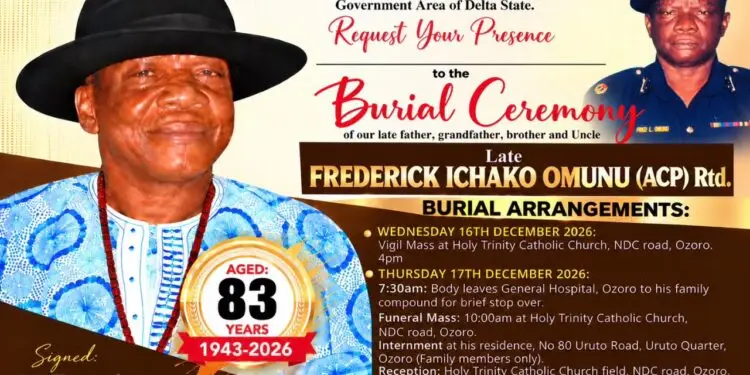
The family of retired Assistant Commissioner of Police (ACP) Frederick Ichako Omunu has announced that he will be laid to rest on Thursday, December 17, 2026, in Ozoro, Isoko North Local Government Area of Delta State, following his death at the age of 83.
The burial programme, jointly announced by the Omunu family of Uruto Quarters and the Omoba family of Urude Quarters, will feature a vigil Mass on December 16 and a funeral Mass on December 17 at Holy Trinity Catholic Church, Ozoro.
Retired ACP Frederick Ichako Omunu died in 2026 at the age of 83.
His burial is scheduled for December 17 in Ozoro, Delta State.
A vigil Mass will hold on December 16 at 4:00 p.m.
The funeral Mass is scheduled for December 17 at 10:00 a.m.
The deceased will be buried at his residence on Uruto Road, Ozoro.
The family has invited relatives, friends and well-wishers to the funeral ceremonies.
According to the funeral announcement, the vigil Mass will take place at 4:00 p.m. on Wednesday, December 16, at Holy Trinity Catholic Church, NDC Road, Ozoro.
On Thursday, December 17, the deceased’s body will leave General Hospital, Ozoro, at 7:30 a.m., with a brief stopover at his family compound.
The funeral Mass will follow at 10:00 a.m. at Holy Trinity Catholic Church, along NDC Road, Ozoro.
Omunu to Be Buried at His Ozoro Residence
Following the funeral Mass, Omunu will be laid to rest at his residence at No. 80 Uruto Road, Uruto Quarters, Ozoro. The family stated that the interment ceremony would be restricted to family members.
A reception for guests will subsequently hold at the field of Holy Trinity Catholic Church, along NDC Road, Ozoro.
The family described the deceased as a father, grandfather, brother and uncle, inviting relatives, friends and well-wishers to join them in honouring his memory.
The burial announcement was signed by family representatives Henry Omunu, Editor, Trumpet Newspaper and Benedict Omunu.
By Our Reporter
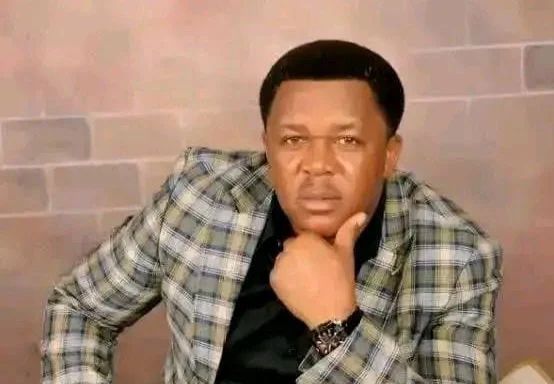
Veteran Nollywood actor Francis Duru has died at the age of 57 following a brief illness, his family has announced.
The family disclosed his death in a statement published on the actor’s official Instagram page in the early hours of Friday.
“We, the family of Francis Duru, regret to announce his passing following a brief illness,” the post reads.
“We appreciate your prayers, love, and understanding. May his soul rest in perfect peace. Amen.”
Duru’s death comes months after he dismissed reports circulating on social media that he was battling a life-threatening illness.
The rumours intensified in June after a video showing the actor looking frail went viral, prompting concerns among fans and colleagues in the entertainment industry.
Responding to the speculation at the time, Duru released a video on Instagram in which he described the footage as “fabricated and malicious”.
Born on July 27, 1969, in Cameroon to Nigerian parents from Imo State, Duru completed his primary and secondary education in the Central African country before moving to Nigeria for university education.
He gained admission to the University of Port Harcourt, Rivers State, where he studied Theatre Arts and graduated with a Bachelor of Arts degree in 1996.
Duru began his acting career in 1989 when he featured in Missing Mark, a film directed by the late Ndubuisi Oko. However, the role did not immediately establish him as a prominent figure in the Nigerian movie industry.
His breakthrough came in 1995 following his appearance in Rattlesnake, an action-comedy produced by the late filmmaker Amaka Igwe. In the film, he played the character Ahanna, a role that helped raise his profile in Nollywood.
Throughout his career, Duru earned several awards and honours in recognition of his contributions to the entertainment industry.
He was named a United Nations ambassador of peace for his positive influence on young people.
In 2020, he won the Best Actor in a Leading Role (Igbo) award at the Best of Nollywood Awards for his performance in Mboputa.
Beyond his acting career, Duru was married to Adokiye, whom he wed in 2003. Their union produced four children.
The family suffered a major loss in August 2024 when one of their children, Ifeanyi, died.
Duru’s death marks the loss of an actor whose career spanned several decades in Nigeria’s film industry.
By Our Reporter
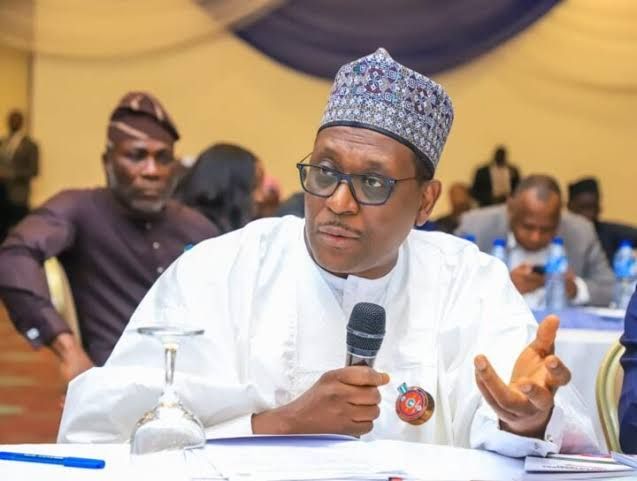
Ali Pate, coordinating minister of health and social welfare, says Nigerians should remain vigilant, shun panic, and stop spreading misinformation about Ebola virus disease.
Speaking on Wednesday after meeting with Femi Gbajabiamila, chief of staff to the president in Abuja, Pate said citizens should rely on verified public health information from trusted sources rather than circulating false rumours.
The minister said the federal government is collaborating with Uganda to manage the situation.
“All I can tell you is that we are collaborating with our sister African nation of Uganda,” Pate said.
“What is important is that we have found this one case. We are doing contact tracing, and we are putting containment measures to ensure that it doesn’t go into our population.”
He urged Nigerians to remain calm and communicate responsibly, adding that the situation should be taken seriously without causing fear.
“Nigerians should be reassured. We must be vigilant, but not panic, and people should respect public health information from trusted sources, and not spread misinformation and false rumours,” Pate said.
The minister said Nigeria has the public health institutions and expertise needed to respond to the situation.
Pate added that the Nigeria Centre for Disease Control and Prevention (NCDC) had activated its incident management system (IMS), with response teams working round the clock and the relevant task force coordinating containment efforts.
“They are working 24/7, and the task force is also active. So, we have things in place that give us confidence that Nigeria can weather this public health crisis,” he said.
He said the government would continue to monitor developments and provide updates as verified information became available.
“If the situation changes, we’ll come out and inform Nigerians,” he said.
Pate reiterated that the immediate priority was to contain the imported case and prevent its spread within the population.
The meeting between Pate and Gbajabiamila came nearly 24 hours after the federal government announced a confirmed case of Ebola disease in the Federal Capital Territory (FCT).
On Tuesday, Pate said 44 close contacts had been identified for tracing to prevent further transmission.
He added that the patient, a woman who recently arrived in Nigeria on an international flight from Uganda, had been admitted to a private hospital in the FCT, where she received care for several days before the diagnosis was confirmed.
-
 General News2 weeks ago
Rivers 2027: We are not part of Rainbow Coalition – APC Legacy Group slams Wike, Fubara meeting
-
General News1 month ago
JOHESU demands: MHWUN puts FG on notice over fresh action
-
 Politics1 month ago
2027: ASAF backs APC governors, rejects rainbow coalition
-

 Politics2 months ago
You have demonstrated diligence, loyalty, statesmanship in leadership, Ekechi salutes Shetimma at 60
-

 Politics2 months ago
2027: Advertising experts raise concerns over irregular regulation of sector
-
FCT News2 months ago
2027: Hasana-Moneme pledges skills, empowerment, credit access for FCT women
-
General News3 months ago
2027: Dame Princess Esom-Nwafor Orizu confirmed as APC flagbearer for Nnewi North /South /Ekwusigo Federal Constituency as INEC releases names of candidates
-
Uncategorized3 months ago
Rescue of Oyo schoolchilden: Tinubu commends security agencies, says action breakthrough in fight against criminality