
Back Page Columnist
Strait of Hormuz: If you daboh me, i tarka you – the power of geography


By Sam Otuonye
There are moments in history when a simple sentence captures the spirit of an entire political struggle. In Nigeria, one such sentence was: “If you Tarka me, I Dabo you.” Today, as the United States and Iran wrestle over the Strait of Hormuz, that old Nigerian political expression has acquired a new international meaning: ‘if you hit me, I will hit you back.’
But history teaches that such a contest can become dangerous when the people involved are not ordinary individuals but powerful governments, armies and nations.
The present confrontation between United States President Donald Trump and Iran is, in many ways, a classic case of action and retaliation. Washington wants Iran to yield. Tehran wants Washington to pay a price for every pressure put on it. And in the middle of the struggle is a narrow stretch of water through which a huge part of the world’s energy supply passes.
The Nigerian story goes back to1974, during the military administration of General Yakubu Gowon.
There was a Joseph Sarwuan Tarka, a prominent politician from the Middle Belt, a powerful member of Gowon’s government who had served as Federal Commissioner for Transport and later Federal Commissioner for Communications. He was one of the most influential political figures from what was then Benue-Plateau State.
Then came a Godwin Daboh, a businessman and fellow Tiv from Benue. In 1974, Daboh publicly accused Tarka of corruption and impropriety. He went as far as swearing an affidavit containing allegations against the powerful Federal Commissioner. The controversy became a major national political story.
Tarka fought back.
The confrontation became so bitter that it produced the famous political expression: “If you Tarka me, I will Dabo you.” In simple language, it meant: ‘if you attack me, I will retaliate.’
Under mounting public and political pressure, Tarka resigned from the federal cabinet in August 1974. The controversy did not end there. It became one of the memorable political battles of that era and eventually entered Nigeria’s political vocabulary as a metaphor for retaliation.
Tarka returned to politics during the Second Republic. He was elected Senator for Benue East in 1979 and became Chairman of the Senate Committee on Finance and Appropriation.
The Strait of Hormuz is not merely another waterway. It is a narrow maritime passage between Iran and Oman, linking the Persian Gulf with the Gulf of Oman and the Arabian Sea. At its narrowest point, it is only about 20 miles wide. Yet through this narrow passage moves an extraordinary volume of the world’s energy supplies.
This explains why Hormuz is everybody’s business. If the Strait is seriously blocked, the consequences do not stop in Tehran, Washington or the Gulf. They travel to Beijing, New Delhi, Tokyo, Seoul, London, Lagos and every economy that depends on affordable energy.
Oil prices rise. Transport becomes expensive. Electricity costs rise. Food becomes more expensive. Inflation returns. Businesses suffer. Poor countries suffer even more.
That is why Hormuz is sometimes described as the world’s energy artery.
President Trump has demonstrated a willingness to use military power against Iran. But the present crisis shows the limits of military power.
The United States and Iran have been involved in a prolonged conflict since the U.S.-Israeli strikes on Iran began on February 28, 2026. The fighting has centred not only on Iran’s nuclear and military capabilities but increasingly on control of the Strait of Hormuz.
Washington can destroy military installations. It can attack infrastructure. It can impose sanctions. It can deploy warships. But destroying Iran is a different matter.
Iran can retaliate against American interests and Gulf infrastructure. It can threaten shipping. It can disrupt energy supplies. And because Hormuz is so important to the world economy, every additional military escalation carries a global economic price.This is the dilemma now confronting Trump.
This is where the phrase “If you Tarka me, I Dabo you” becomes relevant.
Iran has effectively demonstrated that it has a weapon that cannot easily be bombed away: Geography.
The Strait lies beside Iranian territory. Iran does not need to defeat the United States in a conventional war to impose enormous economic costs. It only needs to make the movement of ships sufficiently difficult, dangerous or expensive.
Trump therefore faces an uncomfortable choice. He can continue escalating and risk a wider war, higher energy prices and greater pressure on the global economy.
Or he can negotiate, even if negotiation requires concessions that may look politically uncomfortable.
Diplomacy often means accepting something less than everything one wants in order to prevent something worse.
That appears to be the calculation behind the current discussions. It is expected that a deal between Iran and Oman would soon ensure commercial shipping to proceed, with U.S. measures tied to Iran’s compliance.
Trump may therefore be discovering the oldest lesson in international politics: military superiority does not automatically produce political victory.
The strongest man in the room may still need the cooperation of the man controlling the doorway.
Nigeria should understand this lesson.
For Nigeria, the Hormuz crisis should not be treated as a distant Middle Eastern quarrel.
Nigeria is an oil-producing country, but Nigerians remain heavily exposed to international energy prices. Any prolonged disruption in Hormuz can affect crude prices, shipping costs, foreign exchange, inflation, petroleum products and government revenue.
The crisis should therefore remind that oil security is also national security.
Nigeria must develop strategic fuel reserves, improve domestic refining, strengthen alternative energy sources and reduce its vulnerability to shocks in international oil markets.
When two individuals fight, they hurt each other. But when two governments fight, millions of innocent people pay the bill.
That is why the world should hope that Washington and Tehran do not allow “If you Tarka me, I Dabo you” to become the governing principle of international diplomacy.
Because in the Strait of Hormuz, there is no room for a fight in which everybody wins.
There is only room for restraint, negotiation and a settlement that keeps the world’s energy artery open.
Sam Otuonye, anipr
Journalist/Public Affairs Analyst, writes through samotuonye22@gmail.com


By Lemmy Ughegbe, Ph.D
Nigeria speaks passionately about fighting corruption. Yet it repeatedly struggles to prove its most celebrated corruption allegations in court.
We have built an elaborate anti-corruption architecture. We have enacted laws, created specialised investigative units and committed considerable public resources to prosecuting financial crimes. Still, when the most consequential cases reach judgment, the outcome often raises uncomfortable questions about the competence of those entrusted with enforcing the law.
The latest judgment in the long-running Malabu Oil saga brings those questions back into national focus.
On Thursday, 15 October 2026, the Federal High Court in Abuja discharged and acquitted businessman Aliyu Abubakar, Malabu Oil and Gas Limited and six other defendants of money laundering charges linked to Oil Prospecting Licence 245. Justice Inyang Ekwo held that the Economic and Financial Crimes Commission (EFCC) failed to prove its case beyond reasonable doubt.
The decision closes another chapter in one of Nigeria’s most controversial oil-related prosecutions. It also exposes investigative and prosecutorial weaknesses that deserve serious public scrutiny.
Malabu is no ordinary financial dispute. At its centre is OPL 245, an immensely valuable offshore block first awarded in 1998 and later entangled in disputes involving government officials, multinational oil companies and allegations of illicit payments. The 2011 settlement involving the Federal Government, Malabu, Shell and Eni was valued at about $1.3 billion. For years, the affair drew international attention and came to symbolise Nigeria’s struggle to enforce accountability in its petroleum sector.
Yet the real significance of this judgment lies less in the size of the transactions than in the court’s assessment of the prosecution.
Justice Ekwo faulted the EFCC for pressing charges despite a 2018 advice from the Office of the Attorney-General of the Federation against prosecution for insufficient evidence. The court also found that the investigation had not been concluded before the charges were filed. In related proceedings involving Abubakar, it noted deficiencies in forensic evidence, including reliance on photocopies rather than original documents.
These are not trivial procedural lapses. They strike at the foundations of criminal justice.
One principle must be stated plainly. An acquittal is not a licence to keep treating defendants as criminals in the court of public opinion. The presumption of innocence is a constitutional guarantee, not an inconvenience to be discarded whenever public anger runs high.
The defendants were entitled to insist that the prosecution prove every essential element of its case. It did not. The judgment must therefore be respected, however strongly anyone feels about the wider Malabu controversy.
But respecting an acquittal does not require silence about institutional performance.
If investigators pursue complex financial crime allegations without completing the necessary groundwork, what mechanism exists to catch such failures before defendants endure years of litigation? Who reviews the evidential foundation of major prosecutions? Who decides whether the prospect of conviction justifies the public expense? And when courts identify serious investigative failings, what consequences follow?
Nigeria must stop measuring anti-corruption success by the number of arrests, the prominence of suspects or the drama surrounding charges.
An arrest is not a conviction. An allegation is not evidence. A press conference is no substitute for a properly assembled prosecution brief.
The credibility of criminal justice rests on patient investigation, competent forensic analysis, admissible evidence and prosecutors able to present a coherent case that meets the demanding standard of proof beyond reasonable doubt.
There is also a constitutional question about the relationship between the EFCC and the Attorney-General.
Section 174 of the Constitution vests the Attorney General of Federation with wide powers over federal criminal proceedings, including the power to institute, take over or discontinue prosecutions, having regard to the public interest, the interests of justice and the need to prevent abuse of legal process. The EFCC, for its part, holds statutory investigative and prosecutorial powers.
Effective law enforcement requires both institutions to operate within their mandates, without bureaucratic rivalry or political interference.
Equally, the Attorney-General’s authority must never become a shield against legitimate investigation. Advice against prosecution may be entirely justified where evidence is weak, but it must itself serve the public interest. The right response is neither blind obedience nor reckless defiance. It is a transparent, legally defensible process guided by evidence, constitutional authority and professional judgment.
Repeated failures in high-profile cases carry a double danger.
They expose individuals to prolonged prosecution without adequate evidential basis. They also erode public confidence in the state’s capacity to pursue genuine wrongdoing. Both outcomes injure justice. The innocent deserve protection from wrongful prosecution, just as society deserves competent investigation where credible evidence exists.
The EFCC should treat this judgment as an occasion for serious institutional reflection, not merely another unfavourable ruling.
A thorough review of the investigation, evidential preparation and prosecution strategy is warranted. That review should separate genuine professional failings from reasonable decisions that simply did not persuade the court. Not every acquittal proves incompetence, just as not every prosecution is justified because the allegations sound grave. The distinction matters.
The National Assembly also has a legitimate oversight role. It should examine whether our anti-corruption agencies have the forensic capacity, technical expertise and internal safeguards that complex financial investigations demand.
Crimes involving multinational transactions, offshore structures and intricate banking records cannot be prosecuted on assumptions or shortcuts. They require specialised knowledge, international cooperation and painstaking preparation.
The Malabu judgment should prompt a more mature national conversation about what success in the anti-corruption fight truly means.
Nigeria does not need agencies that merely look formidable before television cameras. It needs institutions whose investigations are rigorous, whose prosecutions are fair and whose conduct inspires confidence even when verdicts disappoint the public.
The real scandal would be to learn nothing from the failures the court has identified.
The fight against corruption must itself be governed by competence, accountability and the rule of law. Otherwise, Nigeria risks becoming a country where allegations make headlines, prosecutions consume years, and justice is left to explain why the evidence was never good enough.
Lemmy Ughegbe, Ph.D, FIMC, CMC
Email: lemmyughegbeofficial@gmail.com
WhatsApp ONLY: +2348069716645

NIGERIA DOES NOT HAVE ONLY A TALENT PROBLEM.
WE HAVE A TALENT-USE PROBLEM
Why capable people underperform inside incapable systems
By Dr. Omolaraeni Olaosebikan
There is a peculiar thing that happens to some Nigerians when they leave Nigeria. The employee once described as difficult suddenly becomes a star performer. The young professional told to “calm down” for asking too many questions becomes valued for initiative. The doctor, engineer, researcher or technologist who struggled to make an impact inside one system begins to flourish inside another.
We usually call it brain drain. Perhaps we should also ask what the brain was draining from. Nigeria unquestionably has a skills problem, but we have spent so much time asking whether our people are sufficiently skilled that we have paid too little attention to an equally uncomfortable question: what happens to capable people after we put them inside our institutions?
The skills deficit is real. A 2025 report cited by the Lagos State Employment Trust Fund found that 65 per cent of Nigerian employers regard skills gaps as a major barrier to organisational transformation. Employers are also searching for capabilities in cybersecurity, artificial intelligence, data, systems thinking and customer service. Nigeria therefore cannot pretend that every struggling employee is simply a misunderstood genius. Our education-to-employment pipeline needs serious repair.
But that is only half the diagnosis. A country can suffer a shortage of particular skills and simultaneously waste a disturbing amount of the talent it already possesses. Those realities are not contradictory.
Consider the labour market itself. The National Bureau of Statistics reported that informal employment accounted for 93 per cent of employment in the second quarter of 2024, while time-related underemployment stood at 9.2 per cent. The official unemployment rate was 4.3 per cent. The figures remind us that the question is no longer simply whether Nigerians are working. It is what kind of work they are doing, under what conditions, and how productively their abilities are being used.
Employment is not the same thing as productivity. Possessing talent is not the same thing as creating an environment in which talent can perform.
Put a highly capable person inside a system where approvals take weeks, initiative threatens hierarchy, technology is inadequate, promotion bears little relationship to merit, mistakes are punished more severely than inertia, and the safest career strategy is to agree with the most senior person in the room. Eventually, something predictable happens: the employee adapts.
Curiosity becomes caution. Initiative becomes compliance. Ideas become things discussed privately after meetings rather than offered during them. The organisation then looks at the diminished version of the employee it helped to create and concludes: our people are simply not good enough.
The cost goes far beyond individual frustration. The World Bank’s Human Capital Index Plus now looks not only at health and education but also at how skills develop during working life. For Nigeria, its 2025 assessment places the education pillar at 64, below the lower-middle-income-country median of 88. It estimates that increasing effective schooling to 12 years could raise labour earnings by about 20 per cent over the long term.
The important point is that human capital does not stop developing on graduation day. The workplace can sharpen ability, stretch it and reward it. It can also slowly diminish it.
That should make employers reconsider the fashionable complaint that “young people don’t want to work.” Some do not. Every generation has its share of entitlement, indiscipline and mediocrity. But leadership becomes lazy when anecdotes become a diagnosis of an entire generation.
Before declaring that talent has disappeared, organisations should examine what they reward. Do we reward the person who solves the problem, or the person who never challenges the boss? Do we promote competence or proximity? Can an employee respectfully disagree without being branded arrogant? When somebody brings a new idea, is the first instinct “How could this work?” or “Who authorised you?”
These questions are becoming more urgent because Nigeria is not operating in a closed labour market. The World Bank says about 3.5 million people enter Nigeria’s labour force every year. Weak creation of quality jobs, limited entrepreneurial opportunities and rising emigration make the challenge even sharper.
Our demographic advantage will therefore not become an economic dividend merely because Nigeria has millions of young people. Population becomes productive capital only when ability meets opportunity, tools, accountability and competent leadership.
This is also where the japa conversation deserves greater honesty. Salary matters. Security matters. Infrastructure and quality of life matter. But people also migrate towards systems: systems in which equipment works, processes are clearer, expertise carries weight, professional effort can produce an outcome and performance has a reasonable chance of being recognised.
When trained people repeatedly conclude that their abilities can create greater value elsewhere, retention cannot be solved entirely with patriotic appeals. Sometimes the problem is not simply that another country pays more. It is that another system allows the person to do more.
The private sector should resist reading this as criticism meant only for government. Dysfunction has no exclusive address. A beautifully branded company can still have a culture where information is hoarded, managers are insecure, meetings replace decisions and talented employees spend more energy navigating personalities than solving problems.
None of this absolves the Nigerian professional of responsibility. Talent without discipline is potential wasted. Qualifications without continuous learning expire quickly. The future workplace will increasingly reward adaptability, digital fluency, critical thinking, communication and the ability to learn faster than a job description changes.
Accountability must therefore run in both directions. Employees must keep developing themselves. Organisations must stop demanding world-class performance while preserving systems that punish world-class behaviour.
Nigeria needs to broaden the question. Yes, how do we produce better talent?
But also: how do we stop wasting the talent we produce? Our schools must improve. Businesses must train. Young professionals must keep learning. Yet organisations must also build cultures in which merit can breathe, managers lead rather than merely supervise, technology enables rather than frustrates, and intelligent disagreement is not mistaken for insubordination.
Perhaps, then, the Nigerian who suddenly excels abroad has not acquired an entirely new brain at Heathrow, Toronto Pearson or JFK. Sometimes what has changed is the ecosystem around that brain: the tools, expectations, incentives, consequences, processes and permission to perform.
That does not mean every Nigerian system fails or every foreign one succeeds. It means that before we conclude that our greatest problem is a shortage of capable people, we should examine the machinery into which we place them. A nation cannot complain indefinitely about losing its best minds while refusing to interrogate the conditions under which those minds are expected to work.
The story we tell about talent determines where we look for the solution. Blame the people, and we keep searching for better people. Examine the system as well, and we begin building places where good people can become exceptional. Nigeria needs both better-prepared talent and institutions capable of using that talent well and this is why the narrative matters.
Dr. Omolaraeni Olaosebikan
Strategic Communications & Reputation Management Expert | Founder, The Narrative Matters®
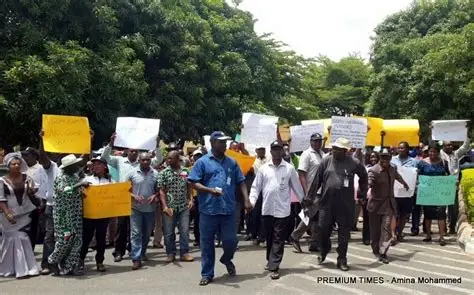
By Lemmy Ughegbe, Ph.D
When teachers abandon their classrooms in protest, the consequences extend beyond the dispute between workers and government. Lessons are suspended, academic calendars disrupted and children lose instructional time that cannot always be recovered. Yet behind every teachers’ strike may lie grievances that deserve attention rather than dismissal.
That is the dilemma confronting the Federal Capital Territory, where the Nigeria Labour Congress commenced an indefinite strike on 7 October over teachers’ promotions, career progression and administrative decisions affecting education personnel.
The confrontation escalated when FCT Minister Nyesom Wike directed the six area council chairmen to enforce no work, no pay against participating workers. He described the action as politically motivated and maintained that legitimate demands were being addressed. Labour disagrees.
At the centre of the dispute is a requirement that teachers can only be promoted when vacancies exist. The NLC argues that qualified teachers have consequently suffered prolonged career stagnation despite meeting advancement requirements. It also seeks reconsideration of teachers excluded from the 2025 promotion examinations and reversal of certain redeployments and demotions.
These are serious concerns. Career progression affects morale, professional dignity and commitment to public education. But government’s position also warrants examination. Promotions have implications for staffing structures, budgets and public service rules. The question is whether the existing framework fairly recognises professional growth or traps qualified teachers in positions they have outgrown.
A teacher may acquire additional qualifications, develop competence and accumulate valuable classroom experience without a senior administrative vacancy arising. Should such development count for nothing until somebody retires or resigns? The FCT Administration owes teachers a convincing answer.
There is, however, disagreement within organised labour. The FCT Trade Union Congress and the Academic Staff Union of Secondary Schools have reportedly distanced themselves from the strike, questioning the consultation preceding it and warning about its consequences. Their reservations complicate any suggestion that all affected workers speak with one voice.
Industrial action is a legitimate bargaining instrument, but it carries responsibilities. Union leaders should demonstrate that negotiations have been meaningfully pursued, their demands clearly defined and their mandate properly established. Equally, government should not dismiss employment grievances merely by questioning labour leaders’ political motivations.
Wike has alleged that FCT NLC chairman Knabayi Adalo is pursuing a political agenda. Adalo disputes that characterisation and maintains that teachers have endured prolonged stagnation. Even if political motives were established, they would not automatically invalidate genuine employment concerns.
The proper response is evidence. How many teachers qualify for promotion but remain stagnant? How many vacancies exist? Which agreements have been implemented, and which remain outstanding? What financial or administrative constraints prevent resolution? Both sides should place verifiable answers before the public.
The no work, no pay directive introduces a legal dimension. Government may invoke applicable rules concerning remuneration during strikes, while workers retain rights associated with lawful collective action, subject to statutory requirements. Whether deductions are lawful in these circumstances should be assessed against the law, not political rhetoric.
But there is a third party whose interests risk disappearing beneath the confrontation: the child.
Children neither negotiate promotions nor determine employment policy. Yet when classrooms close, they suffer consequences without any influence over the dispute. Examination candidates lose preparation time. Children from disadvantaged households may have no access to private lessons or digital alternatives. Repeated disruptions can therefore deepen educational inequality.
The right to education must remain central to the debate. It would be unfair to demand that teachers endure indefinite injustice simply because their work is indispensable. A demoralised workforce ultimately damages educational quality. But it is equally troubling when unresolved employment disagreements repeatedly interrupt children’s learning.
The solution lies neither in humiliating teachers nor in treating classrooms as permanent bargaining instruments.
The FCT Administration and labour representatives should establish a transparent, time bound mechanism to review the promotion policy, identify outstanding entitlements and resolve contested administrative decisions. Where negotiations have failed, independent mediation deserves consideration. Any settlement should include a credible plan to recover lost instructional time.
Beyond this dispute, Abuja should examine whether education sector employment conflicts require a standing resolution framework capable of intervening before disagreements escalate into school closures. Prevention is preferable to emergency negotiations after pupils have already lost weeks of learning.
Nigeria frequently promises improved educational standards and a more competitive workforce. Such ambitions require fair career structures, accountable administration and consistent classroom teaching. The present confrontation offers an opportunity to address all three.
Wike and organised labour may disagree about who caused the strike, and each may consider its position justified. But neither can transfer responsibility for resolving the dispute to children sitting at home.
When government and teachers fight over the conditions of teaching, both must remember the purpose of teaching.
Whatever the eventual outcome, Abuja’s schoolchildren should not be made to pay the price of a dispute they did not create.
Lemmy Ughegbe, Ph.D, FIMC, CMC
Email: lemmyughegbeofficial@gmail.com
WhatsApp ONLY: +2348069716645
-
 General News2 weeks ago
Rivers 2027: We are not part of Rainbow Coalition – APC Legacy Group slams Wike, Fubara meeting
-
General News1 month ago
JOHESU demands: MHWUN puts FG on notice over fresh action
-

 Politics1 month ago
2027: ASAF backs APC governors, rejects rainbow coalition
-

 Politics2 months ago
You have demonstrated diligence, loyalty, statesmanship in leadership, Ekechi salutes Shetimma at 60
-

 Politics2 months ago
2027: Advertising experts raise concerns over irregular regulation of sector
-
FCT News2 months ago
2027: Hasana-Moneme pledges skills, empowerment, credit access for FCT women
-
General News3 months ago
2027: Dame Princess Esom-Nwafor Orizu confirmed as APC flagbearer for Nnewi North /South /Ekwusigo Federal Constituency as INEC releases names of candidates
-
Uncategorized3 months ago
Rescue of Oyo schoolchilden: Tinubu commends security agencies, says action breakthrough in fight against criminality