
Feature
Customers accuse major Nigeria bank of illegal deductions, misrepresentation

….as bank denies allegations
By Our Correspondent
Some Nigeria banks have been enmeshed in myriads of customer and employee complaints, ranging from illegal deductions, service delays, signature forgery, to prolonged casual staffing, unauthorized loans, unbearable deposit targets, career stagnation, and sundry infractions and mistreatments.
Recently, Sterling Bank, one of the Holding Companies (Holdco), has faced multiple high-profile legal actions and police investigations regarding alleged unauthorized or fraudulent deductions, including notable cases brought by individual employees and corporate clients. In one instance, the Nigeria Police Force indicted the bank and several executives over alleged money laundering and fraudulent deductions totaling millions of dollars following petitions by corporate customers like Miden Systems Ltd. Plaintiffs alleged unauthorized loan bookings, forged signatures, and blocked accounts.
Also, some of the workers have sued the bank at the High Court and National Industrial Court over ungranted or unsolicited salary loans that resulted in continuous, involuntary deductions from employee allowances and accounts.
But, in these legal proceedings, Sterling Bank’s legal teams filed defense amendments, contest the validity of the claims, or assert compliance with internal loan processing and credit recovery protocols.
Sterling Bank, prides itself as the “One-customer bank”. However, today, it is not only one customer but several of the bank’s customers complain about what they described as the bank’s “persistent deceit, illegal deductions from their accounts and misrepresentation of facts”, giving plethora of instances to back up their claims even as the bank has denied the allegations, stating that it did no wrong.
Sterling Bank started in 1960 as an investment and merchant banking institution named Nigeria Acceptances Limited (NAL), which became Nigeria’s first merchant bank in 1969. It later changed its name to NAL Merchant Bank Plc and listed on the Nigerian Stock Exchange as public Limited liability company. In 2006, NAL Bank merged with four other financial institutions (Magnum Trust Bank, NBM Bank, Trust Bank of Africa, and Indo-Nigeria Merchant Bank) to form Sterling Bank. It also acquired Equatorial Trust Bank (ETB) to expand its national market share and branch network. Recent restructuring led to the establishment of a holding company structure named Sterling Financial Holdings Company (Sterling HoldCo).
Speaking to our correspondent in Abuja at the weekend, a corporate account holder in the bank, Mrs. Obiageri Obiefule, stated that for a long time, customers have been at the mercy of the bank, which she claimed, on a regular basis debit them for all manner of reasons, some of which she said, were questionable and dubious including hidden charges.
According to her, “these charges amount to loss of millions of Naira to us, the bank customers to the effect that sterling bank declare trillions yearly as profit at the detriment of its customers who lacked the voice to complain.
“Even the regulatory agencies seem to be helpless in this situation as they have failed to address our several complaints”, she alleged.
Another customer, Marvelous Okoro also accused the bank of refusing to release her bank statement four months after she applied for it. She alleged that she had been witnessing withdrawal alerts on her account and had applied to the bank for statement of account to verify the transactions, but expressed concern over the bank’s refusal wondering what could be the reason. She said her fear was based on complaints by two of her friends who she alleged had similar experiences with the bank yet to refund the money deducted from their accounts.
“The trend of fraudulent activities including unwarranted deductions is becoming alarming and portrays the bank in bad light. Please help me appeal to them to release my bank statement to enable me verify my bank transaction details”, she pleaded.
Observers have expressed concern over several allegations of fraudulent practices being leveled against Sterling bank.
On 8th October, 2025, a group that called itself, Coalition of Civil Society Organizations Against Banks Fraudulent Practices and Customers Victimization, (CCSOABFFPCV), staged a peaceful protest at the Abuja headquarters of the Central Bank of Nigeria as well as in front of Sterling Bank, Abuja regional office.
At the apex bank’s office, the group submitted a petition, which was received by Mrs. Hakama Sidi Ali, the Acting Director, Corporate Communications, Central Bank of Nigeria.
The petition dated Monday 6th October, 2025, was addressed to Mr. Olayemi Cardoso, Governor, Central Bank of Nigeria, Abuja.
The protesters displayed placards with several inscriptions like; conspiracy;
forgery; criminal breach of trust; taking loan is not a crime; stop suffocating your customers; theft; make loan repayment transparent etc.
Comrade Flora Elekwa, Director, Mobilization and Advocacy of the CSO, told officials of the CBN and the Media that the trend of fraudulent activities occasioned by unwarranted deductions was becoming alarming and portrayed the Sterling bank in bad light.
The petition was signed by Comrade (Dr.) Sam Wisdom, National Coordinator; Comrade Flora Elekwa, Director, Mobilization and Advocacy; and Lady Cecilia Bisong, National Organizing Secretary.
“The street protest and advocacy match are aimed at drawing the attention of the government, regulatory authorities, and the general public to these unwholesome, illegal practices with a view to rectifying the situation” Mrs Elekwa said.
Particularly, the group faulted the manner Sterling Bank treats its customers and pleaded with the CBN as a supervisory government agency responsible for monitoring and supervision of all banks and financial institutions in Nigeria to immediately ask the management of Sterling bank to have a change of heart. The group specifically mentioned the case of Midden Systems Ltd, said to be a major customer of the bank but which allegedly lost over Two Hundred Million Dollars in its account to illegal deductions by officials of sterling bank.
Miden Systems Limited had in a petition to the Central Bank of Nigeria (CBN), the House of Representatives and the Inspector-General of Police (IGP) alleged that the bank through its Chief Executive Officer together with the Sterling bank’s Financial Holdings Company Plc and four others used its name to open various spurious accounts through which it allegedly syphoned the company’s funds domiciled with the bank up to the tune of over $200,000,000 (Two Hundred Million Dollars).
The Company, accused the bank of fraudulent accounting, mismanagement of contract proceeds, money laundering, unauthorized fund transfers, opening of fake bank accounts in the name of MIDEN Systems without authorization, and forgery of bank documents in clear violation of banking regulations.
“Funds were moved and misappropriated by the bank at reckless abandon with huge and massive spurious debits to the company’s account”, the company alleged in the petition.
The Company further stated that in line with standard bank practices and extant applicable laws, it continuously and consistently demanded for its statement of account which sterling bank refused to release.
Our Correspondent gathered that in June 2012, MIDEN Systems Ltd, an indigenous oil service firm, entered into a Term Loan/Vessel Finance Facility Agreement with Sterling Bank to enable Miden finance the acquisition of six Light Marine Vessels to be used in operation of the firm’s contract with SPDC.
Under the agreement, the Company contributed $7.3 million (30%) of vessel cost, while the Bank provided the sum of $17 Million dollars ($17,079,000.00) amounting to 70% as loan (via Letters of Credit) for the purchase of the vessels in Malaysia and Singapore. The Repayment plan was structured such that 70% of all contract proceeds from Shell Petroleum Development Company would be transferred, as Loan Repayment, to a Debt Servicing Repayment Accounts (“DSRA”) domiciled with Sterling Bank, while 30% would be reserved for the Company’s operational needs. The tenor of the loan was a 60 months duration (with 6 months moratorium) and billed to terminate by September 2017.
A Police Investigative Report of the activities of Sterling Bank dated 14 January 2025, (copy made available to us) uncovered series of grave banking malpractices committed by Sterling Bank between 2016 and 2024 with regards to the loan transaction.
According to the report, the bank has been misappropriating contract proceeds without rendering proper account statements to the customer. It said that several unauthorized payments were made from the customer account to unknown persons, including disclosed and undisclosed Sterling Bank customers.
“Despite multiple formal requests by the customer, Sterling bank refused to provide account statements thereby concealing transaction records (credit and debit notifications) and falsifying book entries.
“In addition, the bank failed to disclose the status of the loan liquidation process thereby creating financial opacity”, the Police report stated.
The police also said it discovered the creation of multiple fake accounts by the bank, including an unusual 20-digit account in the name of the company without authorization.
According to the report, “the Bank unlawfully consolidated the Customer Company’s account with the account of a different and distinct company, Chasewood Nigeria Limited, in order to fraudulently impose dubious and illegal debt obligations on the Company”.
It was found that Sterling Bank deliberately denied the Customer access to its 30% share of proceeds, thereby crippling the Company’s operations.
Between 2016 and 2024, Sterling Bank allegedly received more than $57 million in contract payments from SPDC and yet falsely claims the Company owes an additional $30 million Dollars to the Bank.
Further findings show that Sterling Bank received a total credit of One Hundred Million and Twenty-Two Thousand US dollars (USD122,768,041.69) in the domiciled account without rendering a proper account of the application and sources of funds to the customer contrary to CBN Rules & Regulations.
“The discoveries are shocking and sordid” An Insider source disclosed
The Police in the report said although Sterling Bank claimed that a $30 million loan was applied for, approved and disbursed in one day- 13th January 2017, the loan application did not emanate from the company. It accused the bank of forging the company’s lodgment of loan application and some documents relating to the loan including Account officer/branch review of loan application, credit committee approvals, customer’s board meeting/resolution. Etc.
“They purportedly fulfilled all terms and conditions for loan disbursement under one day and diverted the funds to private accounts operated by top officials of the bank”, the Police said.
Furthermore, the Police report indicates high level criminal conspiracy at the top management level of the bank to defraud the customer and conceal evidence. The bank unlawfully disbursed and failed to account for the sum of One Hundred and Twenty-Two Million dollars (USD122,768,041.69) admittedly credited to the Company’s account between 03/05/2016 and 19/07/2024.
The Bank also failed to apply the remittances in the sums of Fifty Seven Million US Dollars (USD57,301,865.56) and Six Billion, Nine Hundred and Seventy Million Naira (NGN6,972,548,982.39,) respectively, by SPDC between 2013 to 2020 towards reducing alleged debts but rather channeled the funds to unknown beneficiaries and accounts suspected to be operated by bank insiders and top officials.
According to the Police report, “ the bank falsified book entries on 13 January 2017 by pretending to credit the Company’s account with $30 Million US dollars when in fact there was no outstanding debt on the account.”
It sated that on 16th September 2017, the bank fraudulently transferred from the account the sum of USD28,302,140.59, under an unlawful scheme titled AA Loan Repayment – when there was no transaction linked to the account as well as other fraudulent transactions on 6th May 2016 and 27th August 2016.
Following the police findings, the matter was escalated to the House of Representatives Committee on Public Petitions, where the Nigeria Police Force submitted a report indicting Sterling Bank for alleged money laundering and mishandling of Miden Systems’ accounts.
To avoid further investigations and embarrassment by the Lawmakers, the Bank hurriedly approached the Federal High Court, sitting in Lagos, on 5th of February 2025, to seek a restraining order on the House of Representatives from further probe or investigation of Sterling Bank Limited and the Group Chief Executive Officer of Sterling Financial Holdings Company, Yemi Odubiyi pending the determination of the Motion on Notice.
At the resumed hearing of the case on April 30th 2025, the Court could not hear the matter but went on a prolonged adjournment raising concerns on the process.
Section 37(3) of the Cybercrimes (Prohibition and Prevention) Act 2015 explicitly criminalizes unauthorized debits by financial institutions.
Evidently, those familiar with the case said Sterling Bank’s actions, as outlined in the Police report, clearly violate this provision and Sections 18; 20, 24(1); 25 of the BOFIA, which prohibit fraudulent banking practices.
In separate interviews with our Correspondents, Legal experts and Consumer Advocacy group, Citizens Network for Consumer Rights, described the stunning revelations as a financial heist and called for the authorities to conduct a thorough and impartial investigation with a view to initiating possible criminal prosecution of those found culpable.
But the bank has consistently denied all fraudulent claims, describing both the publications and the protests at its branches as illegal attempts to disrupt its business operations.
With the above issue still pending, observers have wondered why the bank rather than amicably settle the matter, resorted to calling the Chief Executive of Miden Systems, Dr. Brenda Usoro unprintable names in a frantic bid to blackmail him before the public, a move one analyst described as “bank’s desperate bid to paint him in bad light”.
“Tell me, how can a man who brought million Dollar business to a bank but was robbed of his hard-earned money by the bank officials, be called by the same bank as a chronic debtor? That is laughable. I can only compare it to the proverbial case of the pot calling the kettle black”, said Chief James Ogene, a former Federal lawmaker and an Abuja based industrialist and estate developer.
“I have known Dr Usoro for the past 25 years and during this period we have done a number of businesses. He is trust worthy, honest, very reliable and sincere to a fault. If he tells you something, that is the way it is. Therefore, for someone to call him names in order to blackmail and tarnish his image, that person needs to examine himself or herself. I know the bank did that out of vengeance”, Chief Ogene added.
But the case of Miden Systems Limited is not the only albatross hanging on the neck of Sterling Bank and its officials. In August, 2025, lawyers representing one Olalekan Adejumo (not real name), a Lagos State resident, wrote to Sterling Bank, demanding an investigation and the immediate closure of a strange account the bank opened in their client’s name.
“My lawyers sent a letter to Sterling Bank yesterday, demanding an immediate closure of the strange account,” said Adejumo.
“You won’t believe that as we speak, the account is still very much active. It has not been closed by the bank.
“Despite all the efforts I personally made in getting Sterling Bank to close the account, it is still active.”
The lawyers also requested for a comprehensive report that would reveal the identity of the bank staff who were responsible for the opening of the account and how relevant account opening protocols and legal requirements, including the Know Your Customer (KYC) exercise, Bank Verification Number (BVN) validation and inclusion, and telephone number, and email address and National Identification Number (NIN) linkage, were bypassed before the account was opened.
Adejumo’s lawyers also demanded the unmasking of Legbeti Anuoluwapo, an individual who carried out a N5,000 transaction on the strange bank account, documents that were submitted for the account opening, an apology letter from Sterling Bank and confirmation that no loans, overdrafts and financial liabilities will be attached to the Lagos resident’s identity or BVN through the account.
Another allegation against the bank is delay in acting on customers’ requests.
One of such cases was that of a foreign-based Nigerian student who in 2022 almost lost her university admission with the threat of deportation after Sterling Bank delayed processing her tuition remittance. She was said to have initiated a Central Bank of Nigeria (CBN) Form ‘A’ transaction through Sterling Bank on August 10, 2022, to pay her school fees abroad. Nearly three months passed without the bank remitting the funds or providing a positive update despite multiple emails. With a tight deadline on October 27, 2022, she faced potential expulsion and deportation due to the unfulfilled payment.
In a Twitter thread shared @DasilvaOlamide, she wrote: “I’m at the verge of losing my admission and getting a deportation because of Sterling Bank. I initiated my Form A since 10th August. I have sent them several emails showing them that my school requires the payment or I will be deported, my deadline is tomorrow. HELP!
“Sterling bank has still not done anything, please help me keep retweeting and tagging. Today is the deadline or I will be deported. It’s not fair that I have paid since August 10th and the money hasn’t been remitted to my school”, she wrote.
Source: https://twitter.com/DasilvaOlamide/status/1585234028852318209?s=20&t=a00_kcj9Vv59B0-05p1USQ
That is not all. In November, 2017, Grant Properties Ltd accused Sterling Bank of illegally selling its collateral for an N8 billion loan, but the bank denied any wrongdoing.
According to the property development company, Sterling Bank excised 10 hectares of its land valued at N5 billion, from a 50-hectare collateral and illegally sold it for pittance to a front company belonging to a senior director of the bank.
Delivering judgement on the matter, a Lagos high court ruled that the collateral was illegally sold and ordered the bank to return the property to the company.
The business deal started in 2002 when Grant Properties secured a 50-hectare land in Lekki, Lagos state, to build “Victory Park Estate”.
Sterling Bank was expected to transfer, alongside the loan, every part of the land to AMCON, but it was discovered that the bank left out 10 hectares which it sold to a Real Estate Development (RED) Company — said to be a front for a very senior director of the bank.
Olajide Awosedo, chairman of Grant Properties, said in a chat with journalists that a non-executive director of Sterling Bank had called him “face to face, brought out a survey of 10 hectares of my land and said, ‘Sir, sell this portion of land to me, if you want N10bn from my bank. I will make sure you get it. I am the chairman of real estate finance of the bank”. He refused.
“They moved my loan to AMCON, but rather than transfer all my collateral with the loan, the bank (Sterling) withheld the 10 hectares its director had his eyes on and sold it to him through a surrogate company owned by the director and his associates,” Awosedo added.
He alleged that the director initially sold the land to his front company at N18,500/sq metre, amounting to N1.85b for the 10 hectares — a far cry from the market worth of N5 billion, according to him.
About 2.4 hectares from the land was immediately sold to UAC Properties Development Company (UPDC), another property development company owned by UAC Plc, at a higher rate of N26,000/sq. metre. It was this that became the subject of litigation that ended in favour of Grant Properties.
In a related development, six employees of Sterling Bank Plc were last year rearraigned before Justice Ambrose Lewis Allagoa of Federal High Court sitting in Lagos for defrauding the bank to the tune of N1,257,536,572.50.
Following the “not guilty” plea to the 3-counts amended charge preferred against them by the Police, the judge adjourned the matter to July 18, 2025 for trial. Other further dates fixed for the trial were 15th,16th and 17th of October, 2025 for continuation of trial
The defendants includes Victor Nwabueze Ogochukwu ‘m’, Favour Odey ‘f’, Adekunle Daniel ‘m’, Akachukwu Alagbogu, Oguntade Yetunde ‘f, Nasiru Momoh ‘m’.
According to the amended charge, the defendants were alleged to have sometimes between the 3rd and 4th of November 2024 suppressed one of the Sterling Bank banking platforms and Bance Application from their various customers’ accounts to different fraudulent accounts with the collusion of an internal staff/external parties for possible compromise on sensitive data and security system of Sterling Bank by using international mobile equipment identity 14984244, IP address 84252.113.3 & 88 transaction.
The defendants were further alleged to have committed internet fraud to the sum of N1,257,536,572.50.

Feature
kidnapping, unsafe roads others reasons for staying away from Nigeria – US-based Nigerian healthcare worker

By Chidera Orji
As the country grabbles with so many socio-economic problems, a United States-based Nigerian Mrs Nkechi Eze (née Nzelu), has identified insecurity as one of the major reasons many Nigerians who are based outside the country are unwilling to return home, adding that the fear of kidnapping, violent attacks and unsafe roads makes visiting home increasingly difficult.
Nkechi, who is practicing healthcare professional in USA, stated this when she spoke with some selected journalists via zoom, said although she personally remains emotionally connected to Nigeria and wishes to reunite with family members, the safety of her children and other loved ones remains her foremost consideration whenever she contemplates travelling home.
She said that her concern goes beyond the possibility of being attacked, stressing the need to be confident that she and her family could travel safely, move around freely and access emergency assistance if anything went wrong.
According to her, staying away from Nigeria does not diminish her love for the country but reflects her responsibility to protect her family from avoidable risks.
As a healthcare professional, Mrs Nkechi Eze expressed particular concern over the growing threats to the lives of medical personnel, noting that health workers should not have to risk kidnapping or death while carrying out their duties.
She observed that insecurity affects healthcare delivery at several levels, as patients may be unable to travel to hospitals at night, medical personnel may struggle to reach their workplaces, and ambulances may avoid dangerous routes.
She warned that such disruptions could have serious consequences for pregnant women experiencing emergencies, accident victims and patients requiring urgent referrals to better-equipped medical facilities.
Eze also noted that financial constraints, transportation difficulties and delays in identifying hospitals capable of providing appropriate treatment could further worsen emergencies in an already challenging environment.
On what would make her reconsider visiting Nigeria, she said sustainable improvements in security, safer roads, effective emergency response systems and credible investigations into criminal activities would be necessary.
She maintained that assurances of safety must be backed by verifiable improvements in the specific communities and locations people intend to visit.
Speaking on banditry, kidnapping and farmer-herder conflicts, Eze said the challenges reflect the need for stronger protection of ordinary citizens, urging authorities to identify and prosecute individuals responsible for criminal activities rather than unfairly blaming entire ethnic or occupational groups.
She called for improved intelligence gathering, stronger collaboration among security agencies, better-equipped and properly supervised local policing structures, as well as efficient investigations and judicial processes.
She also advocated preventive measures, including education, employment opportunities and fair mechanisms for resolving disputes, while emphasizing the importance of respecting human rights to build public confidence in security institutions.
Comparing her experience in the United States with the situation in Nigeria, Eze acknowledged that the US was not free from crime but said the predictability of its security and emergency response systems gave residents greater confidence to plan their daily activities.
She said Nigerians deserved an environment where people could go to work, visit relatives and seek medical attention without living under constant fear or depending on private security arrangements.
On healthcare administration, she highlighted the US emergency care system, where hospitals are required to screen and stabilize patients experiencing medical emergencies regardless of their immediate ability to pay.
She clarified that this does not mean emergency treatment is entirely free, but stressed that urgent medical attention should not be delayed while patients or their relatives search for money.
Turning to Nigeria’s electoral process, Eze said her experience voting in the United States had exposed her to an organized system characterised by voter privacy, clear procedures and mechanisms for verifying election results.
She explained that although voting methods differ across US states, the processes generally provide for identification, private voting, verification and audits to strengthen confidence in the outcome.
While acknowledging the efforts of hardworking electoral officials and citizens in Nigeria, she expressed concern over allegations of electoral violence and manipulation, saying such issues must be addressed through transparent processes and evidence-based investigations.
She, however, cautioned against treating every allegation of electoral malpractice as an established fact, insisting that institutions must make relevant evidence accessible and clearly explain disputed outcomes to the public.
Eze argued that credible elections could contribute to improved governance by giving citizens the opportunity to reward or remove political leaders through the ballot.
However, she stressed that elections alone would not resolve insecurity or reverse the migration of skilled professionals, adding that sustainable progress would also require effective governance, responsible public spending, enforcement of laws and improved working conditions for professionals.
On diaspora voting, she supported extending voting rights to Nigerians living abroad, provided adequate safeguards were introduced to ensure credible registration, proper identity verification, prevent multiple voting and guarantee transparent counting.
She nevertheless maintained that strengthening the credibility and security of votes cast within Nigeria should remain an immediate priority.
Eze said the effectiveness of Nigeria’s security response should ultimately be measured by practical outcomes, including whether farmers could safely return to their farmlands, nurses could work night shifts without fear and victims of kidnapping could receive prompt and professional responses from security agencies.
She maintained that Nigerians deserved dependable public institutions capable of protecting lives, safeguarding livelihoods and restoring confidence in the country’s future.
*SITUATION REPORT: THE POLITICAL SITUATION IN KATSINA STATE –
Katsina, the home state of late President Muhammadu Buhari, has entered a critical phase ahead of the February 6, 2027 governorship election.
While Governor Dikko Umaru Radda (APC) has secured his party’s ticket by consensus and inaugurated the Tinubu/Dikko 2027 Campaign Council, the state is witnessing an unprecedented internal APC battle and a resurgent opposition led by ADC.
Unlike Kaduna where APC dominance is consolidating, Katsina is a case of dominance under stress.
*PRESENT SITUATION*
The Ruling APC – Strength on Paper, Cracks Within:
*Consolidation:* Governor Radda was affirmed by 2,872 delegates at People’s Square, Government House. All 34 members of the State House of Assembly and National Assembly members from Katsina led by Sada Soli Jibia have endorsed him for second term. INEC has listed him with Deputy Gov. Faruk Lawal as running mate.
*Campaign Structure:*
On October 17, 2026, he inaugurated the Tinubu/Dikko Campaign Council chaired by himself, with Deputy Gov. Faruk Lawal as Co-Chair, Sen. Hadi Sirika as Co-Chair II, and Arc. Ahmed Musa Dangiwa as Director-General.
Campaign kick-off is fixed for October 28.
Former Governors Aminu Masari and Ibrahim Shema are listed as Grand Patrons.
Former Gov. Masari donated N160m to ward-level mobilizers.
*The Internal Rift:*
The biggest challenge is not opposition, but a rift between Radda’s camp and the camp of *Ibrahim Kabir Masari, Special Adviser to President Tinubu on Political Affairs* (the Abuja-Katsina camp). Within days (Oct 5-6), five key appointees resigned: Commander-General Hisbah, Dr. Abu Ammar, his Deputy Muhammad Shitu Maslaha, Chairman Pilgrims Board Kabir Bature, SSA on Project Monitoring Fadila Dalhatu, and SA on Youth Development Abubakar Soja Tsanni. Sources link them to Masari’s camp.
The rift escalated when Radda’s ADC, SP Abdulganiyu Bello, and CSO, DSP Hassan Bello, were quizzed by police in Abuja over destruction of billboards bearing Masari and Tinubu along Modoji Junction Road.
The governor himself recently warned politicians to “deliver your wards to Tinubu or face consequences” and asked for forgiveness, signaling anxiety.
The Opposition – ADC as Main Challenger:
Sen. Ahmad Babba Kaita (Katsina North) is governorship candidate with Aminu Yar’Adua as deputy. The party unveiled a 141,107-member structure across 34 LGAs for Atiku Abubakar’s presidential bid.
Kaita is campaigning on insecurity, poverty and bad governance, calling 2027 a chance to “vote out bad leaders” as Katsina marks 39 years of creation.
However, ADC faces a legitimacy crisis: A rival, Salisu Uli, has challenged Kaita’s nomination in court, claiming no valid primary was held on the stipulated date.
INEC listed Kaita, but court hearing is set for October 19.
Former SSG Mustapha Inuwa also left ADC in August.
Regional Compact:*
Kaita joined 6 other North-West ADC candidates (led by Abubakar Malami) to sign the North-West Compact 2027-2031, pledging N110,000 minimum wage, reintroduction of fuel subsidy, and a technology-enabled surveillance network across 21 senatorial districts.
They cited alarming data: over 16,000 lives lost to insecurity between June 2023-Aug 2026, 1,583 kidnappings, and 533,000 hectares of farmland abandoned in Zamfara and Katsina alone.
PDP:
Garba Yakubu Lado is INEC-listed candidate.
PDP remains relevant because it won Katsina in the 2023 presidential election despite losing governorship.
Wike’s backing for Tinubu complicates its 2027 outlook.
WHO HAS THE UPPER HAND?
Technically, APC still has the upper hand* due to control of government, LGA structures, and federal alignment. But *psychologically, the upper hand is contested:*
In Kaduna, APC’s challenge is *external opposition* . In Katsina, APC’s challenge is *internal civil war*
If the Radda-Masari rift is not contained, it could split votes at ward level, as Masari controls significant grassroots network from Daura and beyond.
ADC’s 141k structure is real, but its ability to convert anger over banditry and hunger into votes depends on whether it resolves its court case and presents a united front.
Katsina voters are less concerned with billboard dominance and more with: _Can I go to my farm? Can my child go to school?_ 45% of Nigeria’s out-of-school children are in North-West.
HOW TO CONTAIN OR SUBDUE TENSION
*For APC Leadership:*
*Immediate reconciliation meeting* between Gov. Radda and Ibrahim Masari brokered by former Govs. Masari and Shema and President Tinubu.
The public quarrel over billboards and Hisbah resignations must stop.
Stop threats of “consequences” for non-delivery of wards; instead, encourage forgiveness as the governor himself preached.
Unify campaign council — include all three zonal directors (Katsina South – Bature Masari, North – Gwajo-Gwajo, Central – Prof. Charanchi) in decision-making.
*For Opposition:*
ADC must resolve Kaita vs Uli quickly through internal mechanism before court decides, or risk being disqualified.
Focus campaign on security solutions, not just criticism.
The North-West Compact is a good start but must be localized to Katsina’s 34 LGAs.
*For Security Agencies:*
Katsina has suffered more than most from banditry. Sustained military operations must continue in Batsari, Jibia, Kankara, Dutsin-Ma axis to allow farmers to return before dry season.
Police must remain neutral in APC intra-party dispute and not be used to harass either camp.
*For INEC and Traditional Institutions:*
Emir of Katsina and Emir of Daura should convene peace meeting of all candidates.
INEC should monitor premature vote-buying through the N160m ward donation.
*5. CONCLUSION*
Katsina’s politics has moved from “Buhari’s bloc vote” to “Radda vs The Rest Within APC.”
Governor Radda has the structures, but structures without unity cannot deliver.
The ADC has the message of insecurity and hardship, but message without unity cannot win.
Whoever contains his own internal crisis first will have the upper hand in February 2027.
Katsina, more than Kaduna, needs statesmanship now.
Feature
Christmas comes early for Ondo community as LG Electronics donates 21st solar-powered borehole
By Adagwa Unari
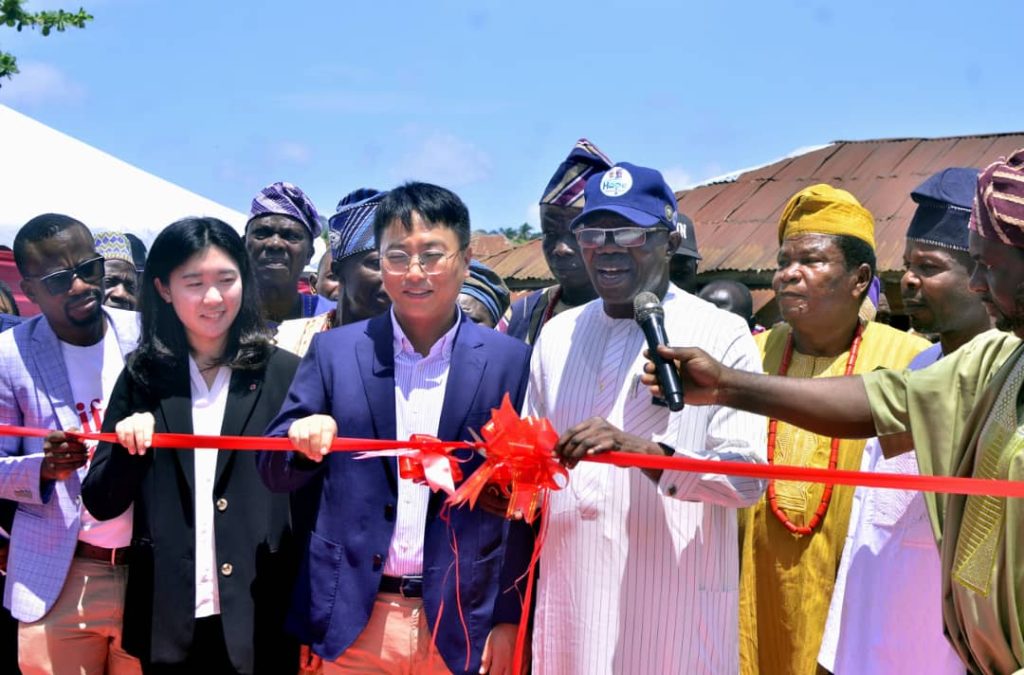
What began as a commitment to bring clean water closer to underserved communities has reached a significant milestone for LG Electronics with the commissioning of its 21st solar-powered borehole at Osan Agba, Oke Oka Akoko, Ondo State.
In Oke Oka Akoko, however, the significance of the intervention is not simply in the number. It is in what reliable access to water means in everyday life: less time spent searching for water, greater convenience for households, improved hygiene and a dependable resource that can serve the wider community.
The new facility extends LG Electronics’ community water initiative into another part of Nigeria, combining access to clean water with renewable energy infrastructure designed to operate independently of the national electricity grid. It also reflects the evolution of the company’s approach to corporate citizenship—from individual interventions to a growing footprint of sustainable community infrastructure built around identified local needs.
At the commissioning, the Akoko South West Local Government Chairman, Hon. Ayọ Ajana, said the intervention demonstrates the value of collaboration between the private sector and communities in addressing practical development needs.
“Water is fundamental to the well-being of every community, and this is the kind of intervention whose impact people can feel every day. What LG Electronics has done in Oke Oka Akoko complements the work of government and shows what responsible private-sector participation in community development can achieve. We welcome this investment, and our responsibility is to ensure that the community takes ownership of it and protects it for the generations that will come after us,” Ajana said.
Hon. Ologunbaba Ruben (Ṣóyọ), the Adedibu of Osan Àgbà Oka, described the facility as an intervention whose value would extend well beyond the commissioning ceremony.
“For us, this is more than the commissioning of a borehole. It is about meeting a need that touches our people every day. Families will use this water, our children will benefit from it, and the entire community has a responsibility to preserve what has been provided. We appreciate LG Electronics for looking beyond the major cities and recognising that communities such as ours also matter,” he said.
Chief Darusa Adedibu, Olugbedere of Igbedere, Osan Àgbà Oka, said the project underscores the importance of bringing development closer to the people.
“Development becomes meaningful when it reaches people where they live. Clean water touches health, hygiene, our homes and the general well-being of the community. We appreciate LG Electronics for bringing this project here. Our responsibility now is to protect it and ensure that it continues to serve everyone,” Adedibu said.
Hon. Ajulo Tayo, Chairman of Udẹ̀ Osan Àgbà Oka, also emphasised the everyday relevance of the project and the need for collective stewardship.
“There are projects people hear about, and there are projects they experience in their daily lives. Water belongs in the second category. This borehole will serve our people every day, and that makes it deeply relevant to this community. Our appreciation to LG Electronics must therefore be matched by our commitment to look after the facility and ensure that its benefits are shared responsibly,” Tayo said.
From One Community to Twenty One
The Oke Oka Akoko commissioning represents the 21st solar-powered borehole delivered by LG Electronics across communities in Nigeria, following the company’s 20th installation in Nariya Rigasa, Kaduna State. The growing programme reflects a deliberate effort to use sustainable technology to address a basic human need while reducing dependence on grid electricity.
For Mr. Hyoung Sub Ji, Managing Director, LG Electronics Nigeria, represented by Mr. Choongbae Seok, General Manager, Media Entertainment Solutions, TV Department, LG Electronics Nigeria, the milestone is significant because of the lives and communities represented by the number.
“Twenty-one communities is an important milestone for us, but the real story is not the number. It is the people behind those twenty-one communities and what reliable access to water can mean to their everyday lives. At LG, we believe innovation has its greatest value when people can feel its impact. Sometimes that is through the technology in their homes; at other times, it means applying technology and our resources to a fundamental need such as clean water,” Seok said.
He added: “The solar-powered model is particularly important because sustainability has been considered from the outset. We are not interested in infrastructure that works only on commissioning day. The objective is to create something relevant, practical and capable of continuing to serve the community. Oke Oka Akoko is another important chapter in that journey.”
By powering the facility with solar energy, LG brings together two dimensions of sustainable development: addressing a basic social need and using renewable energy to support long-term functionality. Just as importantly, the initiative places emphasis on community participation and stewardship, recognising that infrastructure delivers lasting value when the people it serves have a stake in sustaining it.
A borehole can be commissioned in a day. Its real value is measured in the years that follow. From its earlier interventions to Oke Oka Akoko, LG Electronics’ expanding clean-water footprint is turning individual CSR projects into a broader model of community investment where technology, sustainability and local participation meet.
For the people of Osan Agba, the measure is simpler: clean water is now closer to home.
-

 General News4 weeks ago
Rivers 2027: We are not part of Rainbow Coalition – APC Legacy Group slams Wike, Fubara meeting
-
General News1 month ago
JOHESU demands: MHWUN puts FG on notice over fresh action
-

 Politics2 months ago
2027: ASAF backs APC governors, rejects rainbow coalition
-

 Politics2 months ago
You have demonstrated diligence, loyalty, statesmanship in leadership, Ekechi salutes Shetimma at 60
-

 Politics3 months ago
2027: Advertising experts raise concerns over irregular regulation of sector
-
FCT News3 months ago
2027: Hasana-Moneme pledges skills, empowerment, credit access for FCT women
-
General News3 months ago
2027: Dame Princess Esom-Nwafor Orizu confirmed as APC flagbearer for Nnewi North /South /Ekwusigo Federal Constituency as INEC releases names of candidates
-
Uncategorized4 months ago
Rescue of Oyo schoolchilden: Tinubu commends security agencies, says action breakthrough in fight against criminality