
Feature
At Okopoly Alumni 40th anniversary, Amb. Ikebunwa Lotanna receives double honours

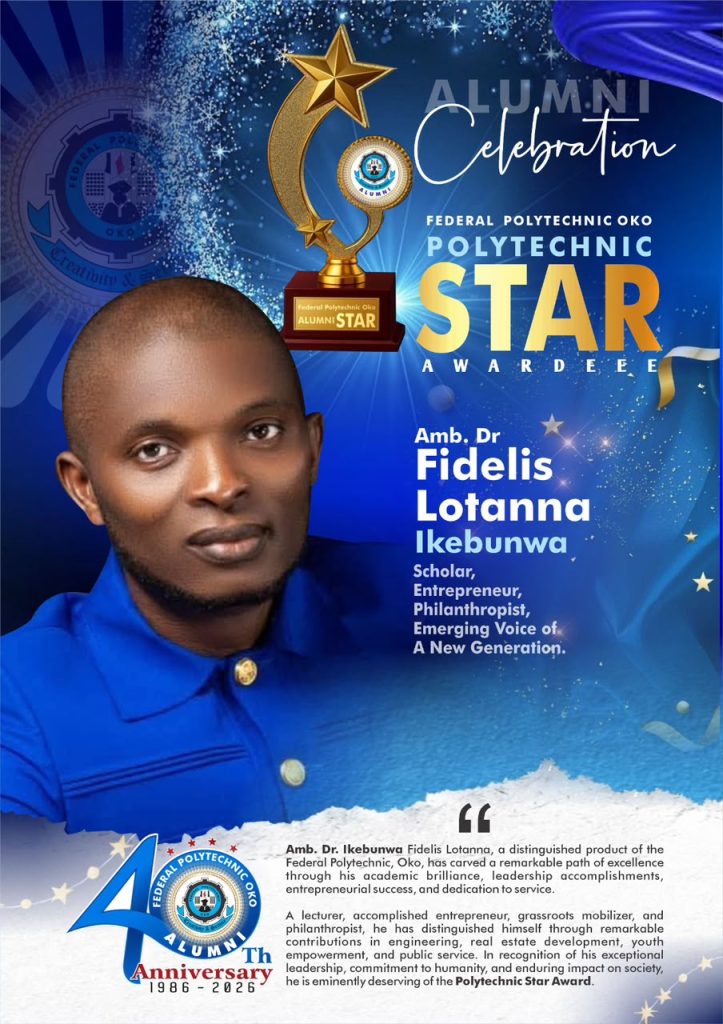
How an alumnus of Federal Polytechnic Oko moved from engineering and entrepreneurship to philanthropy, human capital development and community service, writes Ijeoma Nwajiobi
There are moments in a person’s journey when an award is more than just an award. It becomes a pause, an opportunity to look back at the road travelled, the obstacles encountered, the people touched along the way, and the possibilities that lie ahead.
For Amb. Dr. Ikebunwa Fidelis Lotanna, Saturday, September 26, 2026, was one such moment. At a gathering that brought together generations of alumni, academics, public figures, professionals and friends of Federal Polytechnic Oko, Ikebunwa returned to the institution as more than a former student. He returned as a Polytechnic Star, and in the same breath, as an Oko Polymath.
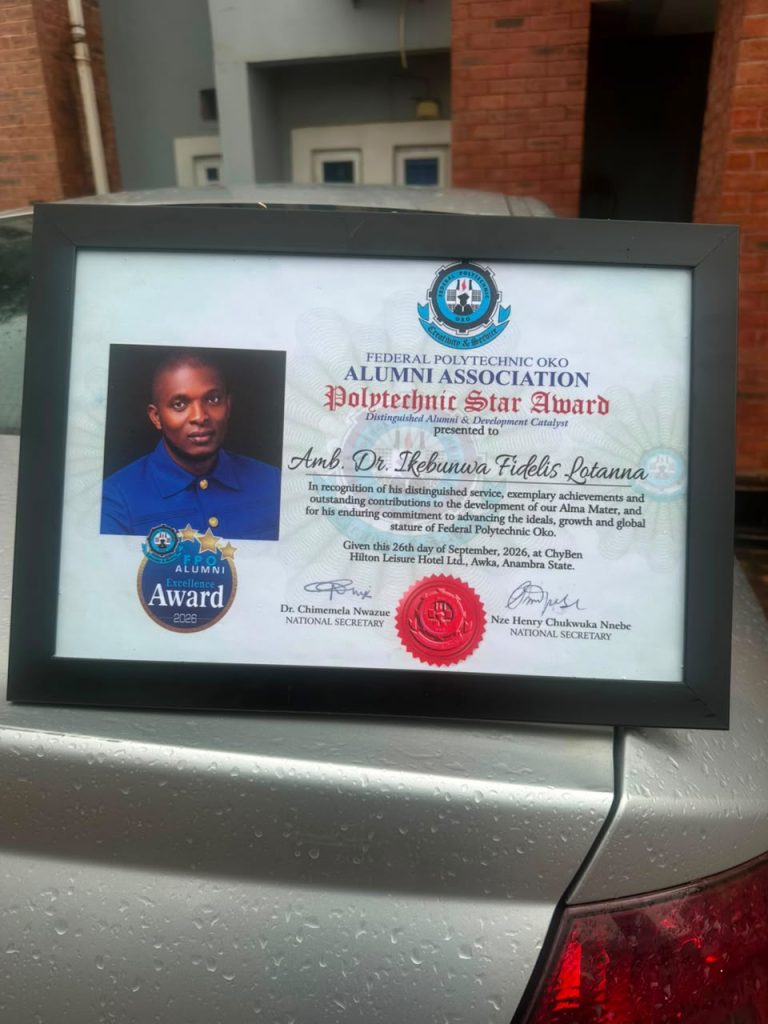
The Federal Polytechnic Oko Alumni Association, celebrating four decades of its existence, honoured him with the prestigious Polytechnic Star Award and inducted him into the Oko Polymath Hall of Fame at a ceremony held at ChyBen Leisure Hotels & Resort, Awka, Anambra State.
The occasion, marked by the “1986–2026” anniversary identity, was a celebration of institutional memory. But for Ikebunwa, it also became a personal reflection on a journey that has taken him considerably beyond the classroom.
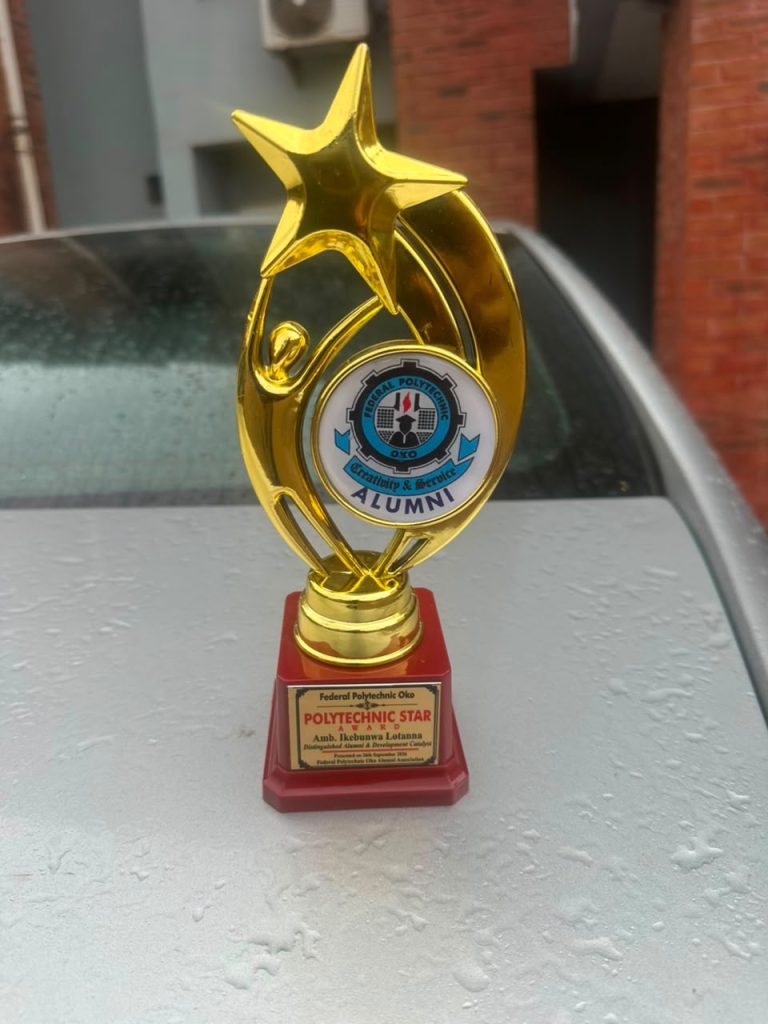
A HOMECOMING WITH A DIFFERENCE
For many alumni, returning to an alma mater is an exercise in nostalgia. For Ikebunwa, it was also a moment of recognition. The award citation described him as a distinguished alumnus whose service, achievements and contributions have advanced the development and ideals of Federal Polytechnic Oko.
The honour was presented during an anniversary programme that featured an anniversary lecture, keynote address, goodwill messages, the presentation of the association’s 40th-anniversary commemorative historical book, awards and honours, and an anniversary toast.
For Amb. Ikebunwa, the recognition reflected a journey that has increasingly been expressed through enterprise, education, philanthropy and community development.
THE MAKING OF A POLYMATH
The word “polymath” evokes breadth, a person whose interests, knowledge and activities refuse to remain confined to one discipline. That breadth is central to the profile presented at Ikebunwa’s induction into the Oko Polymath Hall of Fame.
His professional journey has been associated with engineering, lecturing, entrepreneurship and real estate development, while his wider public activities have extended into youth empowerment, humanitarian initiatives and community mobilisation.
It is a trajectory that does not fit neatly into a single professional description. An Engineer, Entrepreneur, Educator, Philanthropist, Community development advocate, and Public figure.
Each description captures a significant part of his story, but none tells the entire story. The Hall of Fame recognition effectively brings these different strands together under one institutional banner.
WHEN POLITICS DID NOT END THE JOURNEY
Perhaps one of the more revealing chapters of Ikebunwa’s recent public journey is his experience in politics. He contested the House of Representatives primaries for the Nnewi North, Nnewi South and Ekwusigo Federal Constituency under the platform of the NDC.
During the primary election, he was regarded by all as the leading contender in the Parties Primaries. However, the exercise became contentious, with allegations of irregularities that affected the outcome and denied him the party ticket, but the political chapter did not become the end of his public engagement.
Instead, Ikebunwa increasingly turned his attention towards a different form of public participation, one focused less on electoral contests and more on human capital and community development. That shift has found expression in scholarships, support for startups and new businesses, and assistance to vulnerable members of society.
His interventions have extended across Nnewi North, Nnewi South and Ekwusigo Local Government Areas, as well as other parts of Anambra State. The philosophy behind these interventions is rooted in his belief that development is ultimately about people.
To Ikebunwa, a scholarship can alter the direction of a young person’s life. Capital can help keep a small business alive. Support can give an entrepreneur the confidence to expand, while assistance to a vulnerable family can help restore dignity at a difficult moment.
It is through these seemingly individual interventions that Ikebunwa’s post-political chapter has increasingly taken shape.
INVESTING IN PEOPLE
In an era when public conversations about development often revolve around roads, buildings and physical infrastructure, the less visible investment in human beings can easily be overlooked. Yet education, enterprise and opportunity remain among the foundations upon which communities can build sustainable futures.
Ikebunwa’s recent philanthropic activities have therefore centred substantially on people, students requiring educational assistance, entrepreneurs seeking support, young people looking for opportunities, and vulnerable members of communities in need of help.
His scholarship interventions have provided educational support, while funding and assistance to startups and businesses have sought to create or preserve economic opportunities.
These activities have become an important component of the public profile surrounding his name. They also provide context for the Hall of Fame description of him as a personality associated with entrepreneurship, leadership and service.
THE 40-YEAR OKO POLY STORY
The timing of the honour could hardly have been more symbolic. The Federal Polytechnic Oko Alumni Association was not simply celebrating another anniversary. It was marking 40 years, 1986 to 2026.
Four decades provide enough time for an institution to accumulate stories: stories of students who arrived with dreams, graduates who built careers, entrepreneurs who created businesses, academics who shaped minds, and professionals who carried the name of their alma mater into different corners of society.
The anniversary programme sought to capture some of that history through the presentation of the commemorative publication, “Oko Polymaths.” The book, presented as part of the anniversary activities, chronicles aspects of the institution’s alumni history and achievements. It was against this backdrop that Ikebunwa’s induction became even more significant.
He was not being recognised in isolation. His name was being placed within a broader institutional story, the continuing story of what graduates of Federal Polytechnic Oko have gone on to accomplish.
A LEGACY STILL IN MOTION
There is an interesting irony in celebrating a journey while it is still unfolding. Legacy is usually discussed in the past tense, but Ikebunwa’s story is still being written.
His transition from political participation to a greater emphasis on philanthropy and human capital development suggests a public journey that continues to evolve.
The scholarships, business support, startup interventions and assistance to vulnerable people represent one chapter. The Polytechnic Star Award and Oko Polymath Hall of Fame now form another.
The significance of September 26, 2026, lies precisely there. It was the day an alumnus returned to the community from which part of his journey began and received institutional recognition for the road he has travelled since.
THE ROAD AHEAD
For Federal Polytechnic Oko, its 40th anniversary is ultimately about continuity, preserving the memories of the past while looking towards the future.
For Ikebunwa, the twin honours offer a similar reflection. The road has moved through engineering and entrepreneurship, education and real estate, politics and philanthropy, professional pursuits and community engagement.
There have been ambitions, setbacks, reinventions and new directions. Yet the thread running through the different chapters has remained an interest in people, enterprise and development.
On September 26, beneath the lights of an anniversary celebration in Awka, the Federal Polytechnic Oko Alumni Association placed a formal seal of recognition on that journey.
For Amb. Ikebunwa, the Polytechnic Star Award and induction into the Oko Polymath Hall of Fame now form part of a continuing story, one whose next chapter is still being written.

Feature
2027: Let South complete tenure, Daura’s son, Auwal begs North, backs Tinubu’s re – election

Ahead of the 2027 general election, a chieftain of the ruling All Progressives Congress (APC), Hon Auwal Lawal Daura, has thrown his weight behind the re-election bid of president Bola Tinubu
Auwal, whose father, Lawal Daura, a former Director General of the Department of State Security (DSS) is the vice presidential candidate of the Allied People’s Movement (APM) called on the north to support president Tinubu’s re-election, and allow the south complete it’s turn in 2031
The Chairman of ALD Foundation and
Wakilin Raya Kasar Daura emphasised the need for political actors and stakeholders to uphold the agreement in principle, between the North and Southern Nigeria to rotate the office of president, noting that it would promote unity and inclusiveness in administration
While promising to mobilise total support for the APC victory in the presidential election, Auwal warned that truncating the rotation of the presidency in 2027 will deepen the division among the zones in Nigeria, as well as leave the north more divided ahead of 2031
The APC chieftain therefore urged northern stakeholders to look ahead for 2031, while the south completes it’s tenure by voting for a southern candidate and the APC in the 2027 election
”The south should be given the opportunity to complete their tenure, while north takes it from them in 2031. The president and the south supported the north, through our late father, General Mohammad Buhari between 2015 and 2023, so I think believe vying for the presidency in 2027 is not in the interest of a United Nigeria
”We will mobilise massively for President Bola Tinubu, he supported north, and therefore deserves our support this time. The APC will win massively in the north. This is payback time for the president
”We therefore urged our people to support a southern president in the 2027 election, so that the north will have a seamless contest when it gets to their turn in 2031. We cannot truncate this zoning arrangement at this time because of selfishness. Let the north wait till 2031 where we will bring out the best of the best from the north” Daura charged
Feature
kidnapping, unsafe roads others reasons for staying away from Nigeria – US-based Nigerian healthcare worker

By Chidera Orji
As the country grabbles with so many socio-economic problems, a United States-based Nigerian Mrs Nkechi Eze (née Nzelu), has identified insecurity as one of the major reasons many Nigerians who are based outside the country are unwilling to return home, adding that the fear of kidnapping, violent attacks and unsafe roads makes visiting home increasingly difficult.
Nkechi, who is practicing healthcare professional in USA, stated this when she spoke with some selected journalists via zoom, said although she personally remains emotionally connected to Nigeria and wishes to reunite with family members, the safety of her children and other loved ones remains her foremost consideration whenever she contemplates travelling home.
She said that her concern goes beyond the possibility of being attacked, stressing the need to be confident that she and her family could travel safely, move around freely and access emergency assistance if anything went wrong.
According to her, staying away from Nigeria does not diminish her love for the country but reflects her responsibility to protect her family from avoidable risks.
As a healthcare professional, Mrs Nkechi Eze expressed particular concern over the growing threats to the lives of medical personnel, noting that health workers should not have to risk kidnapping or death while carrying out their duties.
She observed that insecurity affects healthcare delivery at several levels, as patients may be unable to travel to hospitals at night, medical personnel may struggle to reach their workplaces, and ambulances may avoid dangerous routes.
She warned that such disruptions could have serious consequences for pregnant women experiencing emergencies, accident victims and patients requiring urgent referrals to better-equipped medical facilities.
Eze also noted that financial constraints, transportation difficulties and delays in identifying hospitals capable of providing appropriate treatment could further worsen emergencies in an already challenging environment.
On what would make her reconsider visiting Nigeria, she said sustainable improvements in security, safer roads, effective emergency response systems and credible investigations into criminal activities would be necessary.
She maintained that assurances of safety must be backed by verifiable improvements in the specific communities and locations people intend to visit.
Speaking on banditry, kidnapping and farmer-herder conflicts, Eze said the challenges reflect the need for stronger protection of ordinary citizens, urging authorities to identify and prosecute individuals responsible for criminal activities rather than unfairly blaming entire ethnic or occupational groups.
She called for improved intelligence gathering, stronger collaboration among security agencies, better-equipped and properly supervised local policing structures, as well as efficient investigations and judicial processes.
She also advocated preventive measures, including education, employment opportunities and fair mechanisms for resolving disputes, while emphasizing the importance of respecting human rights to build public confidence in security institutions.
Comparing her experience in the United States with the situation in Nigeria, Eze acknowledged that the US was not free from crime but said the predictability of its security and emergency response systems gave residents greater confidence to plan their daily activities.
She said Nigerians deserved an environment where people could go to work, visit relatives and seek medical attention without living under constant fear or depending on private security arrangements.
On healthcare administration, she highlighted the US emergency care system, where hospitals are required to screen and stabilize patients experiencing medical emergencies regardless of their immediate ability to pay.
She clarified that this does not mean emergency treatment is entirely free, but stressed that urgent medical attention should not be delayed while patients or their relatives search for money.
Turning to Nigeria’s electoral process, Eze said her experience voting in the United States had exposed her to an organized system characterised by voter privacy, clear procedures and mechanisms for verifying election results.
She explained that although voting methods differ across US states, the processes generally provide for identification, private voting, verification and audits to strengthen confidence in the outcome.
While acknowledging the efforts of hardworking electoral officials and citizens in Nigeria, she expressed concern over allegations of electoral violence and manipulation, saying such issues must be addressed through transparent processes and evidence-based investigations.
She, however, cautioned against treating every allegation of electoral malpractice as an established fact, insisting that institutions must make relevant evidence accessible and clearly explain disputed outcomes to the public.
Eze argued that credible elections could contribute to improved governance by giving citizens the opportunity to reward or remove political leaders through the ballot.
However, she stressed that elections alone would not resolve insecurity or reverse the migration of skilled professionals, adding that sustainable progress would also require effective governance, responsible public spending, enforcement of laws and improved working conditions for professionals.
On diaspora voting, she supported extending voting rights to Nigerians living abroad, provided adequate safeguards were introduced to ensure credible registration, proper identity verification, prevent multiple voting and guarantee transparent counting.
She nevertheless maintained that strengthening the credibility and security of votes cast within Nigeria should remain an immediate priority.
Eze said the effectiveness of Nigeria’s security response should ultimately be measured by practical outcomes, including whether farmers could safely return to their farmlands, nurses could work night shifts without fear and victims of kidnapping could receive prompt and professional responses from security agencies.
She maintained that Nigerians deserved dependable public institutions capable of protecting lives, safeguarding livelihoods and restoring confidence in the country’s future.
*SITUATION REPORT: THE POLITICAL SITUATION IN KATSINA STATE –
Katsina, the home state of late President Muhammadu Buhari, has entered a critical phase ahead of the February 6, 2027 governorship election.
While Governor Dikko Umaru Radda (APC) has secured his party’s ticket by consensus and inaugurated the Tinubu/Dikko 2027 Campaign Council, the state is witnessing an unprecedented internal APC battle and a resurgent opposition led by ADC.
Unlike Kaduna where APC dominance is consolidating, Katsina is a case of dominance under stress.
*PRESENT SITUATION*
The Ruling APC – Strength on Paper, Cracks Within:
*Consolidation:* Governor Radda was affirmed by 2,872 delegates at People’s Square, Government House. All 34 members of the State House of Assembly and National Assembly members from Katsina led by Sada Soli Jibia have endorsed him for second term. INEC has listed him with Deputy Gov. Faruk Lawal as running mate.
*Campaign Structure:*
On October 17, 2026, he inaugurated the Tinubu/Dikko Campaign Council chaired by himself, with Deputy Gov. Faruk Lawal as Co-Chair, Sen. Hadi Sirika as Co-Chair II, and Arc. Ahmed Musa Dangiwa as Director-General.
Campaign kick-off is fixed for October 28.
Former Governors Aminu Masari and Ibrahim Shema are listed as Grand Patrons.
Former Gov. Masari donated N160m to ward-level mobilizers.
*The Internal Rift:*
The biggest challenge is not opposition, but a rift between Radda’s camp and the camp of *Ibrahim Kabir Masari, Special Adviser to President Tinubu on Political Affairs* (the Abuja-Katsina camp). Within days (Oct 5-6), five key appointees resigned: Commander-General Hisbah, Dr. Abu Ammar, his Deputy Muhammad Shitu Maslaha, Chairman Pilgrims Board Kabir Bature, SSA on Project Monitoring Fadila Dalhatu, and SA on Youth Development Abubakar Soja Tsanni. Sources link them to Masari’s camp.
The rift escalated when Radda’s ADC, SP Abdulganiyu Bello, and CSO, DSP Hassan Bello, were quizzed by police in Abuja over destruction of billboards bearing Masari and Tinubu along Modoji Junction Road.
The governor himself recently warned politicians to “deliver your wards to Tinubu or face consequences” and asked for forgiveness, signaling anxiety.
The Opposition – ADC as Main Challenger:
Sen. Ahmad Babba Kaita (Katsina North) is governorship candidate with Aminu Yar’Adua as deputy. The party unveiled a 141,107-member structure across 34 LGAs for Atiku Abubakar’s presidential bid.
Kaita is campaigning on insecurity, poverty and bad governance, calling 2027 a chance to “vote out bad leaders” as Katsina marks 39 years of creation.
However, ADC faces a legitimacy crisis: A rival, Salisu Uli, has challenged Kaita’s nomination in court, claiming no valid primary was held on the stipulated date.
INEC listed Kaita, but court hearing is set for October 19.
Former SSG Mustapha Inuwa also left ADC in August.
Regional Compact:*
Kaita joined 6 other North-West ADC candidates (led by Abubakar Malami) to sign the North-West Compact 2027-2031, pledging N110,000 minimum wage, reintroduction of fuel subsidy, and a technology-enabled surveillance network across 21 senatorial districts.
They cited alarming data: over 16,000 lives lost to insecurity between June 2023-Aug 2026, 1,583 kidnappings, and 533,000 hectares of farmland abandoned in Zamfara and Katsina alone.
PDP:
Garba Yakubu Lado is INEC-listed candidate.
PDP remains relevant because it won Katsina in the 2023 presidential election despite losing governorship.
Wike’s backing for Tinubu complicates its 2027 outlook.
WHO HAS THE UPPER HAND?
Technically, APC still has the upper hand* due to control of government, LGA structures, and federal alignment. But *psychologically, the upper hand is contested:*
In Kaduna, APC’s challenge is *external opposition* . In Katsina, APC’s challenge is *internal civil war*
If the Radda-Masari rift is not contained, it could split votes at ward level, as Masari controls significant grassroots network from Daura and beyond.
ADC’s 141k structure is real, but its ability to convert anger over banditry and hunger into votes depends on whether it resolves its court case and presents a united front.
Katsina voters are less concerned with billboard dominance and more with: _Can I go to my farm? Can my child go to school?_ 45% of Nigeria’s out-of-school children are in North-West.
HOW TO CONTAIN OR SUBDUE TENSION
*For APC Leadership:*
*Immediate reconciliation meeting* between Gov. Radda and Ibrahim Masari brokered by former Govs. Masari and Shema and President Tinubu.
The public quarrel over billboards and Hisbah resignations must stop.
Stop threats of “consequences” for non-delivery of wards; instead, encourage forgiveness as the governor himself preached.
Unify campaign council — include all three zonal directors (Katsina South – Bature Masari, North – Gwajo-Gwajo, Central – Prof. Charanchi) in decision-making.
*For Opposition:*
ADC must resolve Kaita vs Uli quickly through internal mechanism before court decides, or risk being disqualified.
Focus campaign on security solutions, not just criticism.
The North-West Compact is a good start but must be localized to Katsina’s 34 LGAs.
*For Security Agencies:*
Katsina has suffered more than most from banditry. Sustained military operations must continue in Batsari, Jibia, Kankara, Dutsin-Ma axis to allow farmers to return before dry season.
Police must remain neutral in APC intra-party dispute and not be used to harass either camp.
*For INEC and Traditional Institutions:*
Emir of Katsina and Emir of Daura should convene peace meeting of all candidates.
INEC should monitor premature vote-buying through the N160m ward donation.
*5. CONCLUSION*
Katsina’s politics has moved from “Buhari’s bloc vote” to “Radda vs The Rest Within APC.”
Governor Radda has the structures, but structures without unity cannot deliver.
The ADC has the message of insecurity and hardship, but message without unity cannot win.
Whoever contains his own internal crisis first will have the upper hand in February 2027.
Katsina, more than Kaduna, needs statesmanship now.
-

 General News1 month ago
Rivers 2027: We are not part of Rainbow Coalition – APC Legacy Group slams Wike, Fubara meeting
-

 Politics2 months ago
2027: ASAF backs APC governors, rejects rainbow coalition
-
General News2 months ago
JOHESU demands: MHWUN puts FG on notice over fresh action
-

 Politics2 months ago
You have demonstrated diligence, loyalty, statesmanship in leadership, Ekechi salutes Shetimma at 60
-

 Politics3 months ago
2027: Advertising experts raise concerns over irregular regulation of sector
-
FCT News3 months ago
2027: Hasana-Moneme pledges skills, empowerment, credit access for FCT women
-
General News3 months ago
2027: Dame Princess Esom-Nwafor Orizu confirmed as APC flagbearer for Nnewi North /South /Ekwusigo Federal Constituency as INEC releases names of candidates
-
Uncategorized4 months ago
Rescue of Oyo schoolchilden: Tinubu commends security agencies, says action breakthrough in fight against criminality